Basic Information
Scientific classification
- Chinese name: Atlantic petrel
- Scientific name: Common Shepherd, British Gull, *Puffinus puffinus*, *Manx Shearwater*, *Puffin des Anglais*
- Classification: Waterfowl
- Family and genus: Procellariiformes, Procellariiidae, Procellarii
Vital signs data
- Body length: Approximately 38 centimeters
- Weight: 350-450g
- Lifespan: No verification data available.
Significant features
The upper body is uniformly black, but may appear brown under strong light, while the lower body is white.
Distribution and Habitat
The Atlantic shearling breeds in the North Atlantic, with its main breeding grounds along the Atlantic coasts of the United Kingdom and Ireland. Breeding grounds are also found in Iceland, Massachusetts (USA), Newfoundland (Canada), the Azores, Portugal, and the Canary Islands of Spain. The Atlantic shearling undergoes an equatorial migration, expanding its range during winter to include the sub-equatorial Atlantic coasts of South America and the southwest coast of South Africa.
During the breeding season, nearly 90% of the Atlantic petrel population nests on islands, isolated headlands along the coasts of Britain and Ireland, and on rocky peaks in certain mountain ranges. The rest of the time, they are a pelagic species, living near the coast. Most birds return to their nesting sites in the spring when they return to the Bay of Biscay or the English Channel coastline.
Appearance
The Atlantic shearling measures 38 cm in length, has a wingspan of 76-89 cm, and weighs 350-450 grams. It is a typical medium-sized shearling, with an upperparts that are uniformly black, though may appear brownish in strong light. Unlike other shearlings in its genus, its black crown is noticeably lower than its eyes. The underparts are white, sometimes with some dark markings under the armpits and the base of the wings. The long, slender, black beak has a small tube at the tip. Its webbed legs are positioned far back, making them excellent swimmers, but they are clumsy on solid ground, significantly limiting their locomotion.
Detailed introduction
The Atlantic petrel (scientific name: Puffinus puffinus), also known as Manx Shearwater or Puffin des Anglais, has two subspecies.
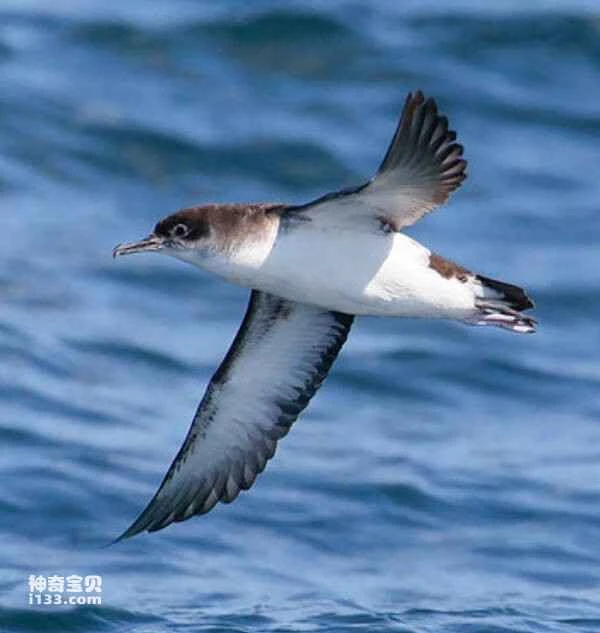
The Atlantic petrel, a marine species, is primarily found in continental shelf waters, frequently appearing in vast oceans, from the cold subarctic waters around Iceland to the tropical waters of South America. They are also present in the North and South Pacific. This species possesses a strong sense of direction, and despite these large movements, they can return to their nesting grounds without error. For such long journeys, the Atlantic petrel's long, narrow wings allow for almost tireless flight, as they utilize the air currents generated by the movement of the waves. These birds navigate the water with ease, appearing and disappearing among the waves. Flight consists of rapid wingbeats and long glides. Atlantic petrels are often seen gathering in "rafts" near their breeding grounds, waiting for darkness to return to the dry land. This strategy aims to evade predation by black-backed gulls. However, this strategy often proves unsuccessful in areas where these two species coexist.
Adult Atlantic shearlings mostly hunt prey on the water's surface, skimming across the water and sometimes touching the water with their feet. Occasionally, they will dive from the air into the water, swimming underwater to hunt fish. Because many fish populations are migratory, Atlantic shearlings will accompany their prey on long journeys to new, more lucrative areas when local resources are depleted. Adults can fly hundreds of kilometers daily between breeding grounds and fishing grounds to feed their chicks.
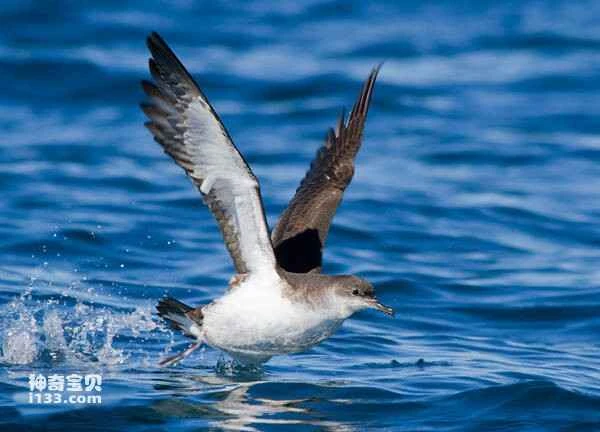
Atlantic petrels feed on small fish, such as herring, anchovies, cuttlefish, and small crustaceans.
The Atlantic petrel's breeding season begins in March, forming colonies on coastal or near-shore islands and nesting in chosen burrows. The female lays a single white egg, averaging 61 mm × 42 mm and weighing 57 grams, of which 7% is shell. After laying the egg, she leaves the nest to forage, while the male begins incubation. Both parents take turns incubating the egg every six days until the chick hatches, a period of 47-55 days after egg-laying begins. When the chicks are a few days old, they are left alone in the burrow by their parents during the day. For safety, the adults return to the nest at night and feed the chicks with regurgitated, semi-digested fish. After two months, the chicks are well-fed and larger than the adults. When they have accumulated enough subcutaneous fat, the chicks are finally ready to go to sea. They may have reached the South Atlantic within three weeks. From the age of two, seagulls return to their native habitat. However, they do not begin nesting and breeding until they are five or six years old.
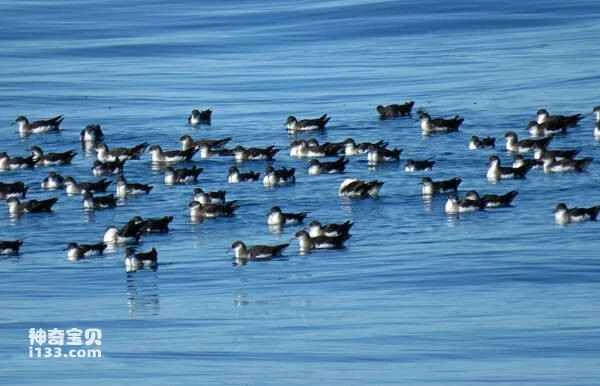
In Europe (covering over 95% of the breeding range), the breeding population is estimated at 342,000–393,000 breeding pairs, equivalent to 684,000–785,000 mature individuals or 1,026,000–1,177,500 individuals (BirdLife International 2015). Brooke also estimated the global population of the Atlantic petrel to be at least 1,000,000 in 2004.
Listed as Least Concern (LC) in the IUCN Red List of Threatened Species 2018 ver3.1.
Protect wild animals and ban the consumption of wild game.
Maintaining ecological balance is everyone's responsibility!