
Basic Information
Scientific classification
- Chinese name: White-chinned Phoenix
- Scientific name: White-chinned Petrel, Procellaria aequinoctialis
- Classification: Waterfowl
- Family and genus: Procellariiformes, Procellariiidae, Procellarii
Vital signs data
- Body length: 51-58 cm
- Weight: Up to 1.4 kg
- Lifespan: No verification data available.
Significant features
It is the second largest petrel after the giant petrel.
Distribution and Habitat
They breed on South Georgia Island. Outside of the breeding season, they can be found as far north as Australia, Peru, and Namibia, and as far south as Antarctica.
Appearance
With its brown feathers, it resembles a skuas from a distance, but the pattern on its beak is quite unique when viewed up close.
It has a body length of 51-58cm, a wingspan of 134-147cm, and a weight of up to 1.4kg.
Detailed introduction
The White-chinned Petrel (scientific name: Procellaria aequinoctialis) is a bird belonging to the genus Procellaria in the family Procellidae of the order Procelliformes.
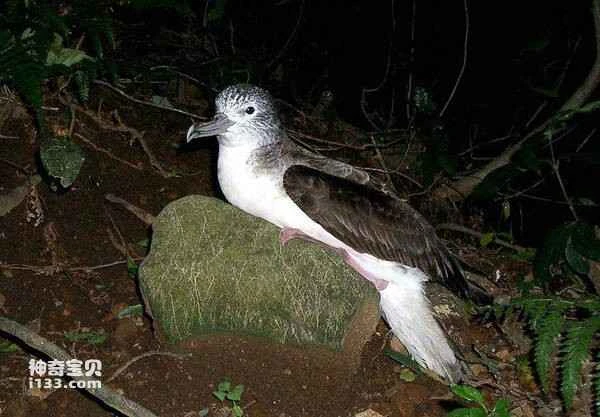
The white-throated petrel feeds on krill and some fish, and likes to follow boats to scavenge for kitchen waste and fish scraps. This makes it particularly vulnerable to being accidentally caught and killed by fishing boats engaged in longline fishing, as it is a better diver than other petrels and will dive deeper to swallow the hook in pursuit of bait. Additionally, invasive rodents such as brown and black rats on the breeding islands also threaten their survival.
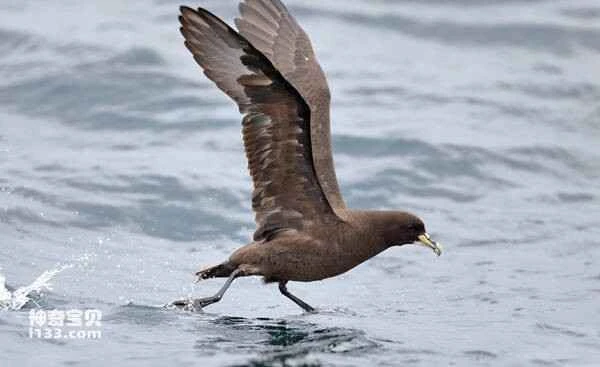
There are approximately 7 million white-throated shelducks in the Southern Ocean, which breed on islands around the Antarctic Convergence, especially on South Georgia Island. Outside of the breeding season, they can be found as far north as Australia, Peru, and Namibia, and as far south as the Antarctic waters.
Protect wild animals and ban the consumption of wild game.
Maintaining ecological balance is everyone's responsibility!


