Basic Information
Scientific classification
- Chinese name: White-fronted Shepherd
- Scientific name: Calonectris leucomelas, Streaked Shearwater
- Classification: Waterfowl
- Family and genus: Procellariiformes, Procellariiidae, Procellarii
Vital signs data
- Body length: 47-52 cm
- Weight: About 420g
- Lifespan: No verification data available.
Significant features
Its body resembles that of a large duck, with a white forehead, front of the head, and sides of the head and neck.
Distribution and Habitat
The White-fronted Shearling is a resident bird in Taiwan and the Penghu Islands, and a summer visitor in the Liaodong Peninsula.
The White-fronted Shearling breeds on islands in the northwestern Pacific Ocean, including the coastal areas from Hokkaido to Kyushu in Japan, the Izu Peninsula, the Ogasawara Islands, Korea, the Liaodong Peninsula and Shandong Peninsula in China, and as far south as the Taiwan Strait and the Penghu Islands. It winters in the Taiwan Strait, the Philippines, Borneo, the Moluccas, and New Guinea, extending north to the Hawaiian Islands and the Kuril Islands, and perhaps even to Sakhalin Island.
Appearance
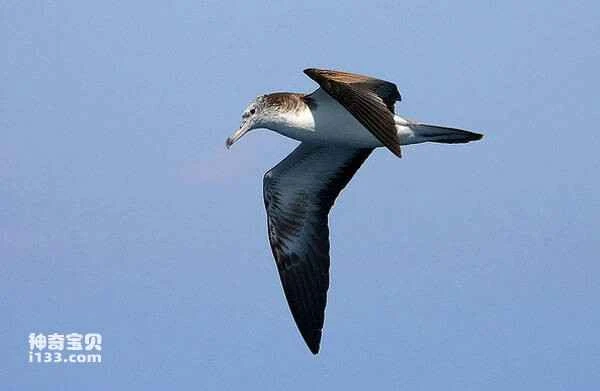
The White-fronted Shearling is a medium-sized seabird. It has a relatively long and slender bill, a short nasal tube, long and narrow flight feathers, and a wedge-shaped tail. The forehead, crown, sides of the head, foreneck, and sides of the neck are white with dark brown longitudinal stripes; the longitudinal stripes on the forehead and lores are narrow and few. The nape, hindneck, back, shoulders, and rump are dark brown, with a few feathers edged in greyish-white. The flight feathers are blackish-brown, with white bases on the secondary flight feathers, and the tail is blackish-brown. The chin, throat, foreneck, and entire underparts are white; the underwing coverts are white with dark brown spots, and the axillaries are pure white.
The iris is dark brown, and the beak bone is brown. The skin on the tarsus and toes is yellow.
Size measurements: Weight 420 g, body length 470-520 mm, bill 46-53 mm, wing 297-343 mm, tail 135-150 mm, tarsus 46-54 mm.
Detailed introduction
The White-fronted Shearwater (scientific name: Calonectris leucomelas) is a typical marine bird.
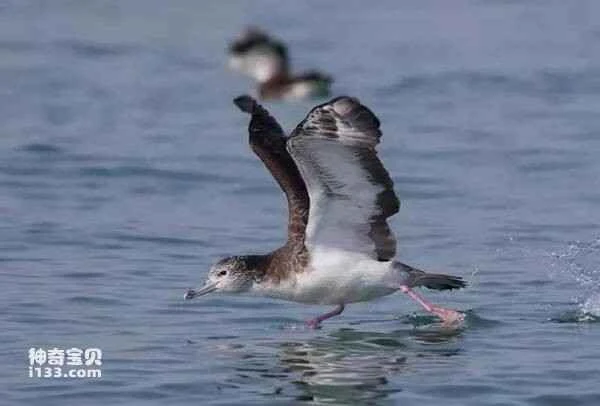
Except during the breeding season, the White-fronted Shearling spends all its time at sea. It is an excellent flier, swimmer, and diver, often spending long periods of time flying day and night over the sea. It typically flies extremely low, gliding across the surface at a slight tilt, or rapidly flapping its wings to skim close to the water's surface. When it spots fish or other prey, it descent quickly to catch it. When swimming, much of its body remains above water, with its tail held high and the front tilted downwards.
The white-fronted shearling primarily feeds on fish, zooplankton, and mollusks. It typically forages while swimming near the surface and often flies low over the sea, swooping down to hunt when it spots food. Because it doesn't dive very deep, it usually only preys on shallow-water fish and marine invertebrates.
The White-fronted Shearling nests on small islands in the ocean and on coastal rocks close to the water. They usually build colonies on islands. Nests are typically placed in rock crevices near the water, on the ground in groves, or on grasslands, lined with a few dry leaves. Each clutch contains one white egg, measuring 67 × 45 mm.
The white-fronted shearling was once quite common in eastern and southeastern coastal China, but has been rarely reported in recent decades, and its population has become extremely small.
Listed as Near Threatened (NT) in the IUCN Red List of Threatened Species ver 3.1: 2015–2018.
Protect wild animals and ban the consumption of wild game.
Maintaining ecological balance is everyone's responsibility!