Basic Information
Scientific classification
- Chinese name: Grey-headed Grebe
- Scientific name: Hoary-headed Grebe (Poliocephalus poliocephalus)
- Classification: Waterfowl
- Genus and family: Order Grebes, Family Grebes, Genus *Hemiberleinii*
Vital signs data
- Body length: No verification information available.
- Weight: No verification information available.
- Lifespan: No verification data available.
Significant features
Distribution and Habitat
Distributed in Australia and New Zealand (including Australia, New Zealand, Tasmania and nearby islands).
They inhabit the vegetation of freshwater lakes and marshes, spend almost their entire lives in the water, and often live in groups.
Appearance
The Grey-headed Grebe is a loon. Its head, entire back feathers, and wings are greyish-black; its neck is greyish-white; its bill is straight, laterally compressed, and pointed; the nostrils are open and located near the base of the bill; its wings are short, with 12 primary flight feathers, the first vestigial, and the fifth secondary flight feather missing. The tail has only some short, soft down feathers, or almost none. The feet are located near the rump. The tarsi are laterally compressed, adapted for diving; all four toes have broad, webbed flaps; the claws are blunt and broad, the inner edge of the middle toe is serrated, the hind toe is short and positioned higher than the other toes, or is absent. The plumage is short and dense, providing excellent moisture resistance; the feathers have accessory feathers, and the preen gland is feathered; the sexes are similar. The skull is either cleft palate or completely nasal; both lack basal wing processes; the digestive system lacks a cecum; the chicks are precocial.
Detailed introduction
The Hoary-headed Grebe (scientific name: Poliocephalus poliocephalus) is a loon belonging to the family Poliocephalus in the order Poliocephalus.
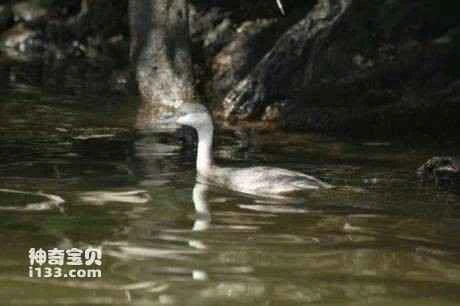
The Grey-headed Grebe is not a good flier. It swims using its legs instead of its wings and rarely walks on land. It can dive to forage, typically diving to depths of only 1-4 meters. Its diet consists mainly of aquatic insects and larvae, crustaceans, mollusks, small fish, and small plants.
When breeding, the Grey-headed Grebe builds a floating nest in the grassy areas near water, using reeds, weeds, and some clay. Each nest contains 2-7 white eggs, often stained with dirt. Both parents take turns incubating the eggs. The eggs hatch after about 25 days. The chicks are precocial, covered in dense downy feathers, and can move freely. For the first 2-3 weeks after hatching, the parents often carry the chicks on their backs; if startled and diving, they tuck them under their wings.
Protect wild animals and ban the consumption of wild game.
Maintaining ecological balance is everyone's responsibility!