
Basic Information
Scientific classification
- Chinese name: Giant Spotted Grebe
- Scientific name: Podilymbus podiceps, Pied-billed Grebe
- Classification: Waterfowl
- Genus and family: Grebes, order Grebes, family Grebes, genus *Giant Grebe*
Vital signs data
- Body length: 31-38 cm
- Weight: 339-568g
- Lifespan: No verification data available.
Significant features
It has a short neck, a large head, tufts of whitish feathers on its rump, and a short, thick, conical beak.
Distribution and Habitat
Breeding grounds: Bermuda, Canada, Jamaica, the United States, and Uruguay.
Origin: Anguilla, Antigua and Barbuda, Argentina, Aruba, Bahamas, Barbados, Bolivia, Bonaire, Saint Eustachians and Saba, Brazil, Cayman Islands, Chile, Colombia, Curaçao, Cuba, Dominican Republic, Dominican Republic, El Salvador, French Guiana, Guatemala, Guyana, Haiti, Honduras, Martinique, Mexico, Montserrat, Nicaragua, Panama, Paraguay, Peru, Puerto Rico, Saint Kitts and Nevis, Saint Lucia, Saint Martín (French), Saint Vincent and the Grenadines, Saint Martín (Dutch), Suriname, Trinidad and Tobago, Turks and Caicos Islands, Bolivarian Republic of Venezuela.
Resident birds: Virgin Islands. Non-breeding grounds: Belize, Costa Rica, and Ecuador. Migratory birds: Saint Pierre and Miquelon Islands.
Seasonal uncertainty: San Bartholomew Island. Wandering (non-breeding grounds): Guadeloupe Island.
Random visits: France, Grenada, Iceland, Ireland, Netherlands, Norway, Poland, Portugal, Spain (Canary Islands), United Kingdom. Random visits (migratory birds): Ecuador (Galapagos Islands).
The species' breeding grounds consist of freshwater lakes with abundant herbaceous plants and aquatic vegetation. They typically choose ponds, lakes, and marshes; in winter, they also inhabit salt marshes and bays. During the breeding season, they select open waters with dense marsh vegetation. During migration and winter, marshes and freshwater ponds remain the most likely habitats, but more open waters such as estuaries and coastal bays are also very important habitats.
Appearance
The Spot-billed Giant Grebe measures 31-38 cm in length, has a wingspan of 56-65 cm, and weighs 339-568 grams. It is a relatively small waterbird. Males and females are similar in appearance and do not exhibit sexual dimorphism. It has a short neck, a large head, tufts of whitish feathers on its rump, and a short, thick, conical beak. In winter, the adult's upperparts, including the top, back, and forehead, are grey or dark brown, the sides are light brown, the underparts, including the tail, are white, the cheeks and neck are reddish-brown, the forehead and throat are black, with a white eye-ring, and the beak is light-colored without a black band. During the breeding season from February to September, the throat is black, the beak is whitish, and a thick, vertical black band encircles the center. Juveniles resemble the adult's winter plumage but have brown and white stripes on their cheeks, and a yellowish-brown beak without the black band.
Detailed introduction
The Pied-billed Grebe (scientific name: Podilymbus podiceps) has three subspecies.
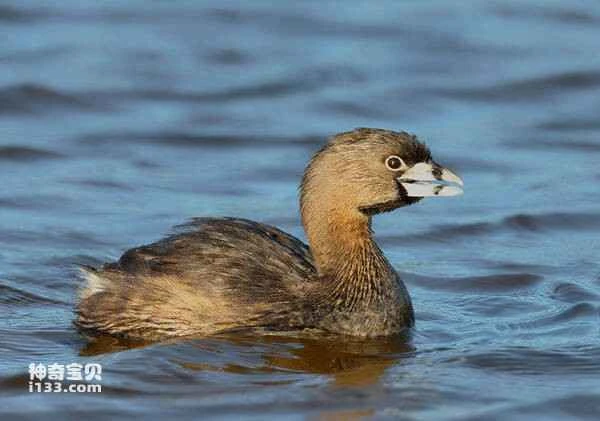
The Giant Grebe is the most common grebe in the New World and the most familiar grebe to temperate North America. In flight, it presents a typical grebe silhouette: an outstretched neck, slightly drooping webbed feet, and rapidly flapping wings. This species is far less sociable than most grebes, almost never forming flocks and sometimes only found in small swampy ponds. When disturbed, it may slowly sink until only its head remains above water. Flight is rarely observed. During the breeding season, it typically hides in swamps, emitting strange, piercing or hoarse calls both day and night.
The Spotted Giant Grebe can be found in both freshwater and saltwater habitats. They have an endearing habit of carrying their newly hatched chicks on their backs, using diving or scuba diving to evade predators.
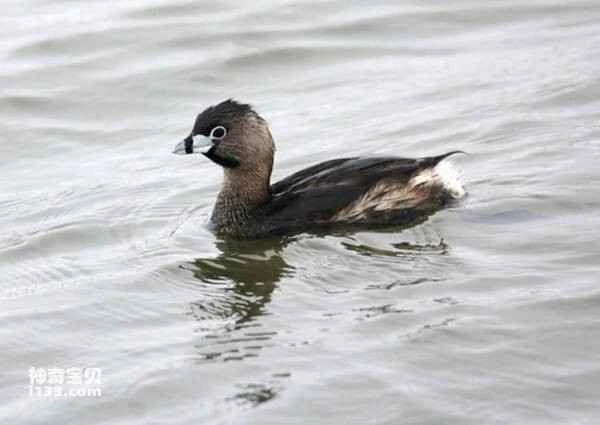
Diet varies depending on location and season. They primarily feed on fish. Like other grebes, they frequently dive to catch fish and consume most small aquatic organisms in their habitat. Their diet includes fish (carp, catfish, etc.), insects (dragonflies, ants, etc.), crustaceans, and amphibians (frogs, tadpoles, etc.). They also consume small amounts of aquatic plants.
The Giant Spotted Grebe can breed from early spring to mid-autumn in favorable climates, potentially resulting in a long breeding season. Courtship rituals are less elaborate than those of most grebes, involving numerous calls, sometimes in duets. Nesting sites are located in shallow marshland, near openings so the birds can approach the nest underwater. Nest building is a joint effort by both parents, who gather plant material such as spirulina or reeds. The nest is built from the bottom of aquatic plants, floating and anchoring to standing vegetation. Each clutch contains 4-7 eggs, less frequently 2-10. The eggs are pale bluish-white with brown markings. Both parents participate in incubation, with the female contributing more. Incubation lasts approximately 23 days. Chicks begin swimming soon after hatching and are fed by both parents, often riding on their parents' backs when young. Adults will carry their chicks while swimming. The age of first flight is unknown. They typically produce one or two broods per year, possibly more in southern regions.
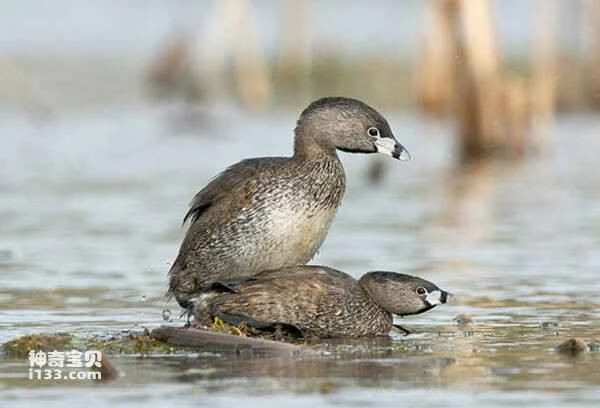
Although population trends are unknown in some areas, the overall population trend of the Spotted Giant Grebe is stable. As of 2016, the species’ population growth in North America over the past 40 years has been minimal or statistically negligible (data from the Breeding Bird Survey: Butcher and Niven 2007). Note that these surveys cover less than 50% of the species’ overall distribution range in North America.
Listed as Least Concern (LC) in the IUCN Red List of Threatened Species 2016 ver 3.1.
Protect wild animals and ban the consumption of wild game.
Maintaining ecological balance is everyone's responsibility!


