
Basic Information
Scientific classification
- Chinese name: Hawaiian Black Goose
- Scientific name: Hawaiian Goose, also known as Yellow-necked Goose, Yellow-fronted Goose, *Branta sandvicensis*.
- Classification: Waterfowl
- Family and genus: Anseriformes, Anatidae, Goose (Gastropoda)
Vital signs data
- Body length: 63-69 cm
- Weight: 1.5-3kg
- Lifespan: No verification data available.
Significant features
Related to the Canada Goose, it is a non-migratory land goose that evolved after the Canada Goose migrated to Hawaii.
Distribution and Habitat
Hawaiian geese were once distributed across the islands of Hawaii, Kahulawe, Lanai, Molokai, and Kauai. Currently, they are confined to the islands of Hawaii, Maui, Molokai, and Kauai.
They inhabit jungles, grasslands, sand dunes, and lava plains. Artificial habitats include lawns and golf courses ranging from sea level to elevations of 2400 meters. Some populations have migrated to lowland and mountainous areas.
Appearance
The Hawaiian Goose measures 63-69 cm in length, with males weighing 1700-3000 grams and females 1500-2500 grams. Adult males have black heads and napes, pale yellow cheeks, and distinct black and white stripes on their necks. Females are similar in color to males. Adult geese have black beaks and feet with a narrow black ring at the base of the beak, soft feathers on the chin, and dark brown irises. They possess napes and vestigial webbed feet, enabling them to traverse very rugged terrain, such as lava fields. Goslings resemble males but are dark brown, with no clear demarcation between the head and neck, and less pronounced stripes.
Detailed introduction
The Hawaiian Goose (scientific name: *Branta sandvicensis*) has no subspecies.
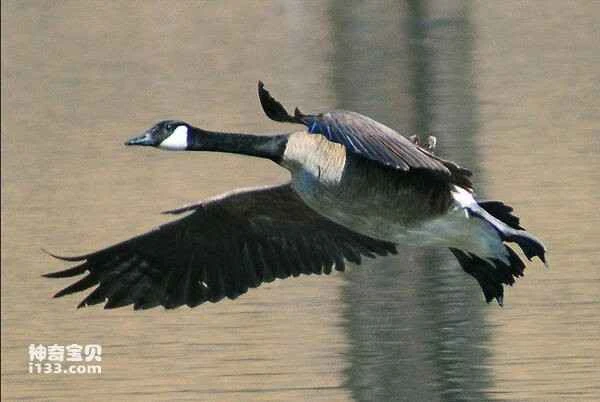
Most geese are migratory birds, living in cold northern regions. However, the Hawaiian Goose is an exception, residing in the tropical Hawaiian Islands. Primarily found in the mountainous regions of the Hawaiian Islands, its webbed feet have somewhat degenerated, adapting it to mountainous terrain. The Hawaiian Goose is a very precious bird species with a very limited distribution, and was once on the verge of extinction.
Hawaiian geese primarily feed on the tender shoots, leaves, stems, fruits, and flowers of grasses or aquatic plants, and also consume roots and plant seeds.
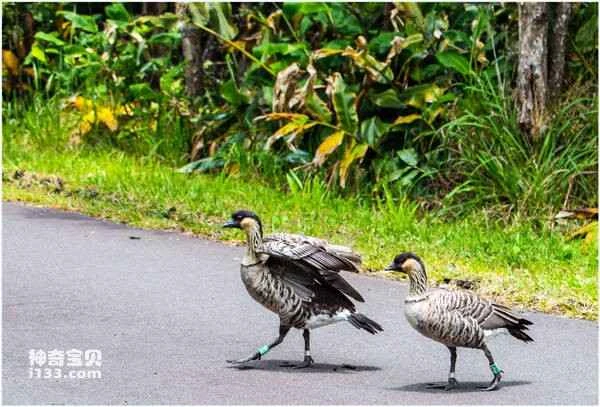
Hawaiian geese have a longer breeding season than any other goose species, from August to April, with peak egg-laying between November and January. Each nest typically contains 2-5 eggs. The female goose is responsible for selecting a nest site, building it, and incubating the eggs, usually choosing a location within the island's vegetation. Incubation lasts about 30 days; the male acts as a lookout. Goslings can forage for themselves after hatching, but they remain flightless for the first three months, making them particularly vulnerable to predation. They stay with their parents until the next breeding season.
The Hawaiian goose is a species of goose endemic to the island of Hawaii. They are found on Maui, Kauai, and the main island of Hawaii, and are also the state bird of Hawaii. Like many other island birds, their population declined sharply after humans arrived. In 1778, when Captain James Cook visited, there were approximately 25,000 Hawaiian geese on the island. However, due to hunting and predation by introduced species—including meerkats, dogs, and pigs—the number of Hawaiian geese plummeted to only 30 by 1952.
Hawaiian geese thrive in captivity. In the first decade of the 21st century, captive Hawaiian geese were released back into the wild. Their numbers have gradually increased, but scientists are also concerned that their gene pool is too homogeneous.
Listed as Near Threatened (NT) in the IUCN Red List of Threatened Species ver 3.1: 2021.
It is listed in Appendix I of the 2019 edition of the Convention on International Trade in Endangered Species of Wild Fauna and Flora (CITES).
Protect wild animals and ban the consumption of wild game.
Maintaining ecological balance is everyone's responsibility!


