
Basic Information
Scientific classification
- Chinese name: Canada Goose
- Scientific name: Canada Goose, Black-fronted Goose (Branta canadensis)
- Classification: Waterfowl
- Family and genus: Anseriformes, Anatidae, Goose (Gastropoda)
Vital signs data
- Body length: Approximately 100 centimeters
- Weight: 3-10.9kg
- Lifespan: Approximately 24 years
Significant features
It is the largest species of Anseriformes in the world.
Distribution and Habitat
This species has a wide distribution, breeding in the tundra of Canada, Alaska, most of the United States, and parts of the northern United States, and wintering in southern North America, including Mexico. Introduced populations inhabit most of the United States south of its normal breeding range, as well as many Western European countries. The Asian subspecies found in the Bering Sea region has been extinct since around 1914.
They inhabit bays, harbors, and estuaries, or low-lying grassy slopes near the coast. Their primary habitat is in the low-lying tundra along the Arctic coast, usually not far from the tidal zone, particularly common on tundra plains fragmented by numerous tidal streams, typically only a few kilometers from the highest tide line. Sometimes they extend from the coastal tidal zone to grassy inland tundra lakes and grassy islands within lakes. During the breeding season, their habitat is mainly tundra or shrub tundra covered with moss and lichen, especially in higher, drier areas of the tundra, or tundra areas near water with sparse shrubs. In winter, they are mostly found around lakes and reservoirs with alkali-tolerant plants, as well as in surrounding low-lying saline lakes and coastal areas, and occasionally in farmland.
After the chicks emerge during the later stages of breeding, they migrate to various lakes and ponds. In winter, they mostly stay in coastal areas with dense vegetation. They typically forage in the morning in the coastal marshes and muddy areas with abundant marine vegetation, before flying back to the sea to rest and drink. In the afternoon, they continue to forage along the coast until sunset. At night, they roost on the vast sea.
Appearance
The Canada Goose is the largest species in the order Anseriformes. This species exhibits relatively low sexual dimorphism, with males being slightly larger than females, but both weighing between 3 and 10.9 kg. They stand 76-110 cm tall with a wingspan of 1.3-1.7 m. Despite minimal difference between sexes, they appear similar. They have long heads and necks, backs with varying shades of brownish-grey feathers, and typically creamy-white or white bellies and rumps. The head and neck are black, with a distinct white bar extending from the throat to the larynx. The tail is short and black with white uppertail coverts. The lower abdomen and undertail coverts are white. There are seven subspecies, distinguished by differences in the head, the size and location of the white patches, and the shades of grey on the plumage. The largest of the seven subspecies is the nominate subspecies of the Canada Goose, typically weighing about 6.4 kg. They have black beaks and legs. The outer edge of the beak has thin, comb-like ridges to aid in feeding.
Young geese are yellow with grayish-green feathers on their backs and sometimes on their heads, depending on the subspecies.
Detailed introduction
The Canada Goose (scientific name: *Branta canadensis*) is also known as the Canada Goose. According to the American Ornithologists Union (2004), in 2014, *Branta canadensis* was divided into the Canada Goose (*B. canadensis*) and the Lesser American Goose (*B. hutchinsii*), with 7 and 5 subspecies respectively.
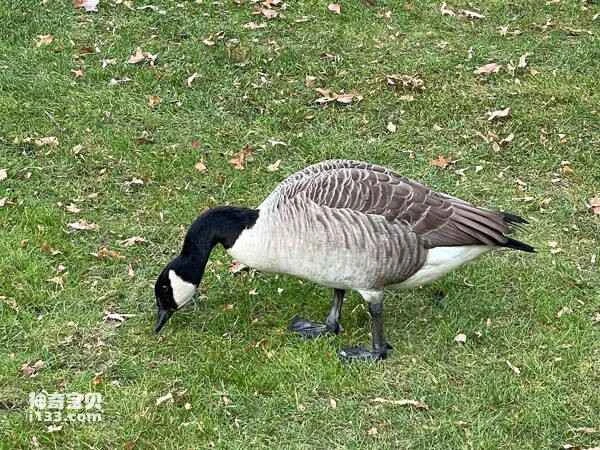
Canada geese primarily feed on plant matter. When they first arrive at their breeding grounds, before the snow melts, they mainly feed on moss and lichen under rocks. As temperatures gradually rise and plants begin to sprout, they begin to forage extensively for newly grown plant shoots, stems, and leaves. In autumn and winter, they forage for seaweed and algae along the coast, and occasionally also for small amounts of aquatic insects, mollusks, small crustaceans, other aquatic invertebrates, and fish eggs. They mainly forage in the early morning and afternoon. During the breeding season, they primarily feed on tundra, while outside the breeding season, they feed on various algae on coastal and seashore mudflats. In addition to the common practice of dipping their heads and necks into the water to feed, they can also, like some ducks, dive tail-up into shallow water to feed on bottom food.
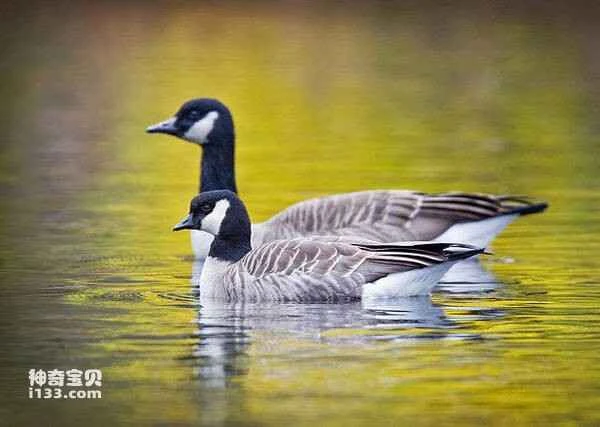
The breeding season for Canada geese is from mid-March to the end of August. The nest is constructed of dry grass and lined with down feathers. Each clutch contains 4-7 eggs, which are white or pale yellowish-white. The female goose is solely responsible for incubating the eggs, while the male guards the nest during both incubation and laying periods. When the female leaves the nest to forage, she covers it with down feathers and grass. If an intruder approaches, the parent geese will call loudly, sounding anxious and adopting a threatening posture, sometimes even preparing to attack the intruder, rather than abandoning the nest. The incubation period is 25-30 days. The goslings are precocial, having already acquired feathers upon hatching. After hatching, the male joins in raising and protecting the goslings, leading them to forage areas with abundant vegetation alongside the female. The parents care for the goslings for 40-73 days. From late July to early August, the adult geese begin molting, a process that takes approximately 15-20 days. Young geese take 2-3 years to reach sexual maturity.
The Canada Goose has a wide distribution, with a global population estimated at an average of 5,000,000–6,200,000 individuals (Wetlands International 2015). The European population is estimated at 1,000–5,000 pairs, equivalent to 2,000–10,000 mature individuals (BirdLife International 2015).
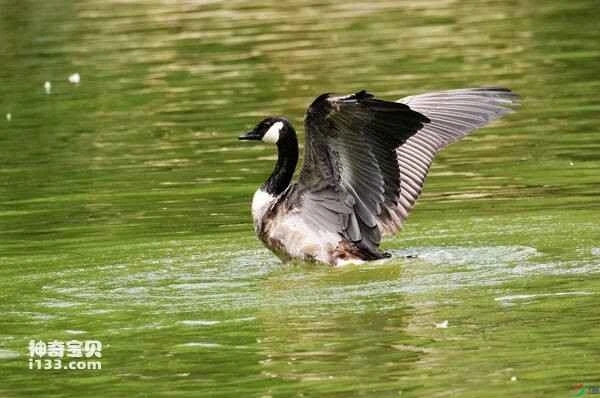
The Miracle of the Hudson River: On January 15, 2009, US Airways Flight 1549 lost power after being struck by a flock of Canada geese during its climb. After confirming that no nearby airports were accessible, the captain decided to make an emergency landing on the Hudson River. The flight made an emergency landing on the Hudson River in Midtown Manhattan six minutes after takeoff, and all 151 people on board survived. This event is known as the "Miracle on the Hudson."
Listed as Least Concern (LC) in the IUCN Red List of Threatened Species 2018 ver 3.1.
Protect wild animals and ban the consumption of wild game.
Maintaining ecological balance is everyone's responsibility!


