
Basic Information
Scientific classification
- Chinese name: Egyptian goose
- Scientific name: Bald Goose, Alopochen aegyptiacus, Egyptian Goose
- Classification: Waterfowl
- Family and genus: Anseriformes, Anatidae, Anseri
Vital signs data
- Body length: 63-73 cm
- Weight: 1.5-2.5kg
- Lifespan: No verification data available.
Significant features
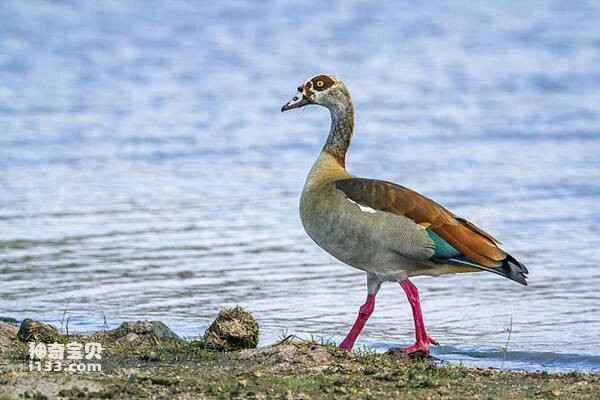
It has brown eyes with reddish circles around its eyes, resembling sunglasses, and its neck and back feathers are chocolate brown.
Distribution and Habitat
It is distributed in Angola, Botswana, Burkina Faso, Burundi, Cameroon, Central African Republic, Chad, Democratic Republic of Congo, Djibouti, Egypt, Equatorial Guinea, Eritrea, Ethiopia, Gabon, Gambia, Guinea, Guinea-Bissau, Kenya, Lesotho, Malawi, Mali, Mauritania, Mozambique, Namibia, Niger, Nigeria, Rwanda, Senegal, Somalia, South Africa, South Sudan, Sudan, Swaziland, United Republic of Tanzania, Tunisia, Uganda, Zambia, and Zimbabwe.
Regional extinction: Israel.
Randomly included: Austria, Belgium, Denmark, Netherlands, United Arab Emirates, United Kingdom.
Migratory birds: Algeria, Benin, China, Ivory Coast, Cyprus, France, Ghana, Hungary, Malta, Oman, Spain, Togo.
Origin uncertain: Qatar.
Appearance
The Egyptian Goose measures 63-73 cm in length, weighs 1.5-2.5 kg, and has a wingspan of 134-154 cm. It has brown eyes with reddish-brown rings around the eye sockets, resembling sunglasses. Its neck and back feathers are chocolate brown. Its large, well-developed wings are composed of neatly arranged black and white feathers. It has long, pink legs and a beige base to its bill. The upperparts are slightly mottled reddish-brown, with a reddish-brown collar around the neck. The upperparts, breast, and almost all of the underparts are yellowish-grey, while the sides are pale beige. The belly is white, with chocolate-brown spots on the breast. The lowerparts and shoulders are brownish-grey, with some reddish-brown areas. The back, rump, and tail are black. The elytra are white with dark lines bordering the primary flight feathers. The flight feathers and tail feathers are black; the primary and secondary flight feathers are metallic green or purplish-red, and the tertiaries are white at the base. It has a large, flat, bright red bill and a pair of three-webbed feet, ideal for swimming.
Detailed introduction
The Egyptian Goose (scientific name: Alopochen aegyptiacus) has no subspecies.
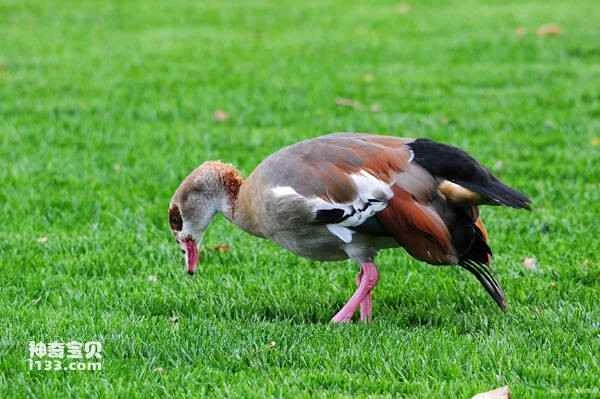
The Egyptian goose is a fierce waterbird with strong territoriality. In addition to its fierce call, it often attacks small ducks that invade its territory. It is a gregarious waterbird and usually appears in pairs. During the day, it is active on the wide grasslands, living a life of early morning and late evening. It forages at dawn and dusk, often gathering in flocks on the vegetated lakeside to feed. However, at night, it shows its home-loving habit and returns to the same place to roost.
Egyptian geese typically graze on land, feeding on a variety of plants, including grasses, seeds, shoots, leaves, grains, and crops. They also forage in shallow waters, including algae and aquatic plants, and sometimes consume animal matter such as worms, locusts, or winged termites.
Egyptian geese tend to pair with members of the same species. During courtship, the female takes the initiative, using all her charm to attract the male. However, the gregarious males must rely on force to determine mating rights. After pairing, the male and female follow each other closely, choosing a location to build their nest. The nest is constructed from materials that can be collected from the surrounding environment and lined with soft feathers. Each clutch contains 5-10 eggs, and the incubation period is 30 days.
Listed as Least Concern (LC) in the IUCN Red List of Threatened Species 2018 ver 3.1.
Protect wild animals and ban the consumption of wild game.
Maintaining ecological balance is everyone's responsibility!


