Basic Information
Scientific classification
- Chinese name: Frilled shark
- Scientific names: Pseudo-eel shark, fringed shark, lizard shark, lace shark, branched-tooth shark, pseudo-eel shark
- Classification: Large fish
- Family and genus: Frilled shark
Vital signs data
- Body length: 2 meters
- Weight: 8.5 kg
- Lifespan: 25 years
Significant features
The head is flat and broad, and the body is slender and flexible.
Distribution and Habitat
Atlantic and Pacific
Appearance
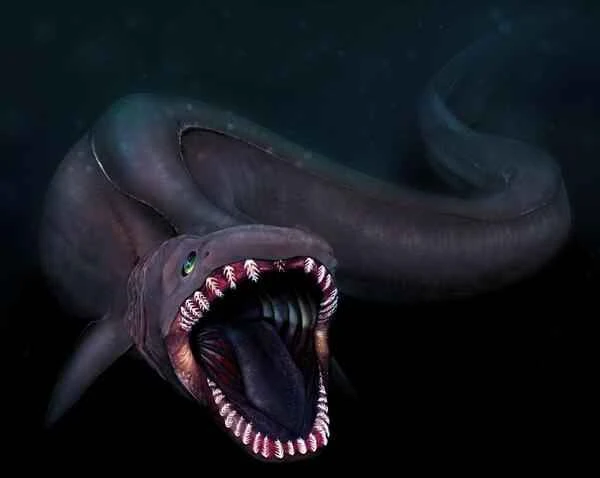
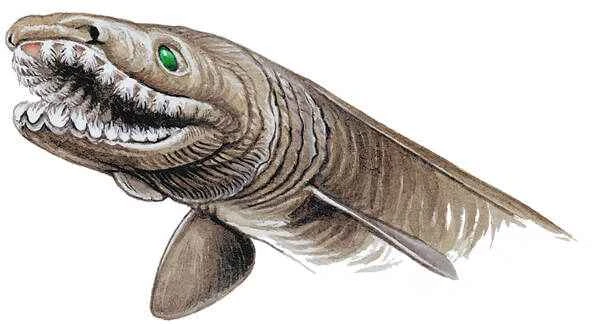
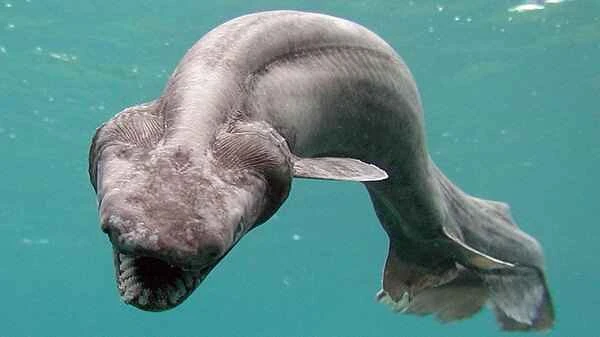
The head has gill slits with folds. The mouth is large, with 19-28 rows of teeth in the upper jaw and 21-29 rows of teeth in the lower jaw, totaling about 300 teeth, almost all of which are trident-shaped.
Detailed introduction
introduction
The frilled shark (Chlamydoselachus anguineus) is a unique and fascinating species that has captivated marine enthusiasts and scientists alike. Due to its ancient lineage and distinctive appearance, this deep-sea predator is often referred to as a "living fossil." In this article, we will explore the frilled shark 's habitat, physical characteristics, diet, reproduction, and conservation status.
Habitat and Distribution
Frilled sharks typically live in deep waters, usually at depths of 200 to 1,500 feet (60 to 460 meters). They prefer continental slopes and deep-sea areas, where they can easily hunt prey. Their distribution spans the Atlantic and Pacific Oceans, and they have been found in locations such as Japan, New Zealand, and the east coast of the United States.
Physical characteristics
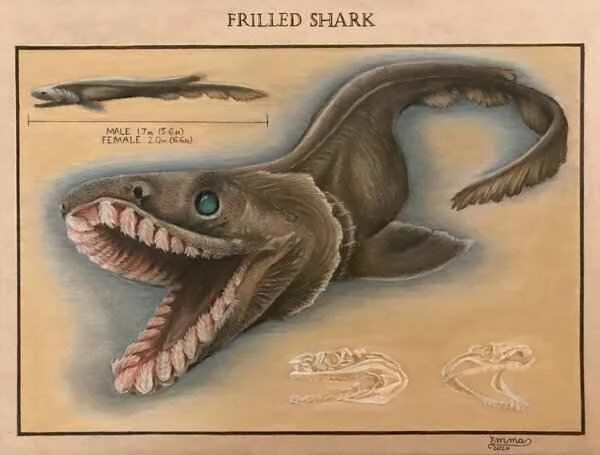
The most striking feature of the frilled shark is its slender, eel-like body, which can grow up to 6.5 feet (2 meters) long. This shark gets its name from the shape of its distinctive gills, which have multiple fleshy folds. These gills give the shark a unique appearance, distinguishing it from other shark species.
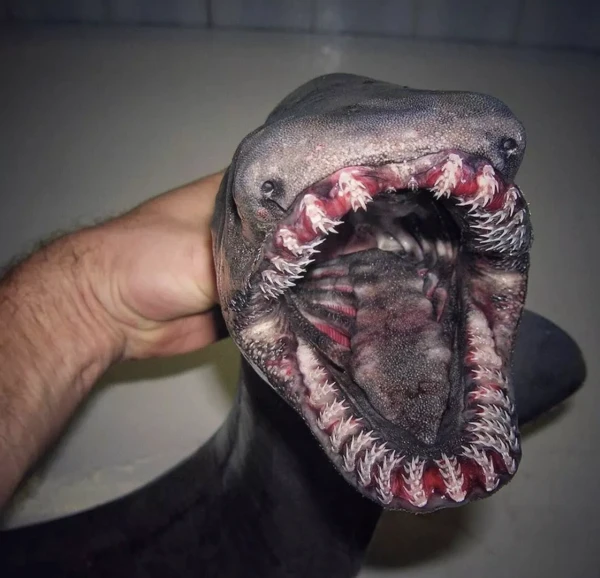
The frilled shark 's mouth is filled with 300 needle-like teeth arranged in 25 rows. This unique tooth structure allows them to effectively grasp slippery prey, such as squid and small fish. Their dark brownish-grey appearance helps them camouflage themselves in the deep-sea environment, thus avoiding predators and prey.
Diet and hunting behavior
As carnivorous predators, frilled sharks primarily feed on squid, fish, and other small marine creatures. They are known for their unique hunting techniques: they can bend their bodies into a U-shape, allowing them to ambush prey from different angles. With their sharp teeth, they can quickly grab and swallow their prey whole.
Reproduction
The breeding process of frilled sharks is quite fascinating. They are ovoviviparous, meaning the eggs develop inside the female, and the pups are born live. After a gestation period of approximately 3.5 years, a female can give birth to 2 to 15 pups, each measuring about 12 to 14 inches (30 to 35 centimeters) in length. This gestation period, lasting several years, is one of the longest in the animal kingdom, which can affect the population's recovery speed. The pups are capable of hunting immediately after birth, but their growth rate is very slow.
Preserve the status quo
Currently, frilled sharks are not considered an endangered species, but they face threats such as deep-sea fishing, habitat destruction, and climate change. As accidental catches in commercial fisheries, they are often caught unintentionally and discarded. Protecting their deep-sea habitats is crucial for their survival, and ongoing research will help us better understand their population status.
The frilled shark is a remarkable example of the diversity and resilience of life in the deep ocean. With its unique physical features and fascinating behavior, the frilled shark offers profound insights into the evolutionary history of sharks. As we continue to explore and study these enigmatic creatures, it is crucial to prioritize their conservation efforts to ensure they remain an integral part of the rich biodiversity of our planet's oceans. Whether you are an ocean enthusiast or just beginning to learn about marine life, the frilled shark is a fascinating species worth exploring further!
Analysis of the predation behavior and food chain of frilled sharks
Frilled sharks are among the top predators in the deep sea, primarily hunting fish, squid, and crustaceans. They use their agile, eel-like bodies to ambush prey, and their powerful jaws allow them to quickly capture and swallow their prey.
In the food chain, frilled sharks are either secondary or apex consumers, preying on smaller deep-sea creatures while providing food resources for larger predators such as large sharks or deep-sea predatory fish.
What are the main predators of the frilled shark?
Frilled sharks have limited natural predators, as they live in deep-sea areas and rarely encounter large predators. Possible predators include:
Large deep-sea sharks , such as sixgill sharks and basking sharks, may prey on them.
Sperm whales primarily feed on deep-sea fish and squid, and may also prey on frilled sharks.
Human activities : Occasionally caught by mistake during deep-sea fishing or seabed resource development, but this is more of an indirect threat.
How long do frilled sharks typically live?
Due to relatively limited research on deep-sea organisms, the lifespan of the frilled shark remains unclear. Based on the generally long lifespan of deep-sea sharks, it is speculated that its lifespan may exceed 25 years or even longer. Slow growth and low reproductive rate are also consistent with its long lifespan characteristics.
The Future of the Frilled Shark: Conservation and Research Directions
Protection Challenges :
Deep-sea fisheries and resource development threaten the habitat of frilled sharks.
Their slow reproduction rate makes them particularly sensitive to environmental changes.
Research areas :
Deep-sea ecosystem research: The frilled shark, as a "living fossil," is a key species for studying evolutionary history and deep-sea ecology.
Deep-sea environmental protection: Monitoring changes in the deep-sea ecosystem through technological means and formulating protection policies.
10 Interesting Facts About Frilled Sharks
"Living fossil" : The ancestors of the frilled shark can be traced back to about 80 million years ago, the same era as dinosaurs.
Snake-like body : The frilled shark's body shape is reminiscent of a sea snake or eel, a unique evolutionary adaptation.
Tridentate teeth : They have about 300 sharp teeth that can firmly grasp slippery prey.
Deep-sea ninjas : They live in the deep sea at depths of 200-1500 meters, avoiding most of the range of human activity.
Slow pregnancy : A gestation period of 3.5 years may be the longest among marine animals.
Swallowing prey : The frilled shark's flexible throat allows it to swallow prey larger than its own head.
Occasionally appearing in shallow waters : Although they mainly live in the deep sea, they sometimes enter shallow water areas due to hunger or environmental changes.
Unique gill folds : Their six pairs of gill slits have "folded edges," making them stand out from the crowd.
Slow but precise : Frilled sharks do not hunt by speed, but by ambush tactics.
Rare and mysterious : rarely observed alive, hence the name "ghost" of the ocean.
Frequently Asked Questions
Frilled Shark ( Chlamydoselachus anguineus ) FAQ
What does a frilled shark look like?
The frilled shark resembles a long snake or eel, with a slender body that can reach up to 2 meters in length. Its name comes from its six pairs of "wrinkled" gill slits, which look like a ruffled collar around its head. It also has approximately 300 sharp, trident-shaped teeth arranged in 25 rows.Where do frilled sharks live?
Frilled sharks are deep-sea sharks that live in depths of 200 to 1500 meters, typically near the seabed. They are widely distributed, found in deep-sea areas from the Atlantic to the Pacific Ocean, including coastal regions of Japan, Australia, and Africa.What do frilled sharks eat?
They are predators, primarily feeding on fish, squid, and other deep-sea animals. Frilled sharks use their teeth to firmly grasp their prey before swallowing it whole. They can also use a special elastic structure in their throats to swallow prey larger than themselves.Why is the frilled shark called a "living fossil"?
The frilled shark is called a "living fossil" because it has almost retained the primitive form of ancient sharks. Its ancestors can be traced back 80 million years, and its appearance and anatomy are significantly different from many existing fish, retaining more ancient features.Are frilled sharks a threat to humans?
Frilled sharks pose virtually no threat to humans. They live in the deep sea and rarely come into contact with humans. Even if they are accidentally caught, frilled sharks will not attack humans unprovoked. Furthermore, their habitat makes conflict with humans extremely unlikely.