Basic Information
Scientific classification
- Chinese name: Red-lipped Batfish
- Scientific name: Galapagos batfish, Ogcocephalus darwini
- Classification: Small fish
- Family and genus: Red-lipped batfish
Vital signs data
- Body length: 25 cm
- Weight: 1kg
- Lifespan: 12 years
Significant features
What's special about it is that it has four "legs," a large head, and uses its pectoral fins to "walk" on the seabed.
Distribution and Habitat
The red-lipped batfish is a species endemic to the Galapagos Islands of Ecuador in South America.
Appearance
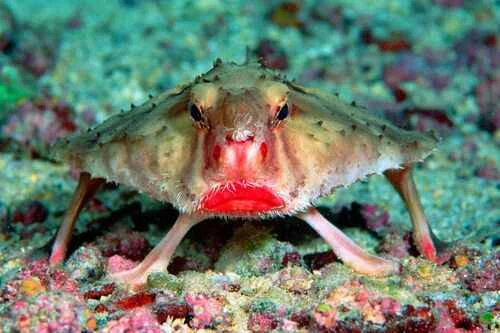
The body is flattened, with a short, thick tail. The head is flat, broad, and flat-shaped. The snout is short, red, and has rostrum spines. The eyes are large. When batfish mature, their dorsal fin transforms into a spiny protrusion, which scientists speculate serves to lure prey. In adults, their dorsal fin grows into horn-like spikes, projecting to attract prey. Their appearance is truly unique.
Detailed introduction
The red-lipped batfish (scientific name: *Ogcocephalus darwini*) is a unique and unusual marine creature that lives in the deep waters of the Galapagos Islands. It is famous for its bright red, lipstick-like lips and unusual body shape, attracting the attention of many marine biologists and enthusiasts. This article will provide detailed information about the red-lipped batfish's habitat, diet, behavior, and predators.
Appearance characteristics of the red-lipped batfish
The most distinctive feature of the red-lipped batfish is its appearance, which makes it clearly different from other fish.
Red-lipped: As the name suggests, this fish has bright red lips that stand out almost like fluorescent light. The purpose of these lips is not yet clear, but scientists believe they may play a role in attracting mates.
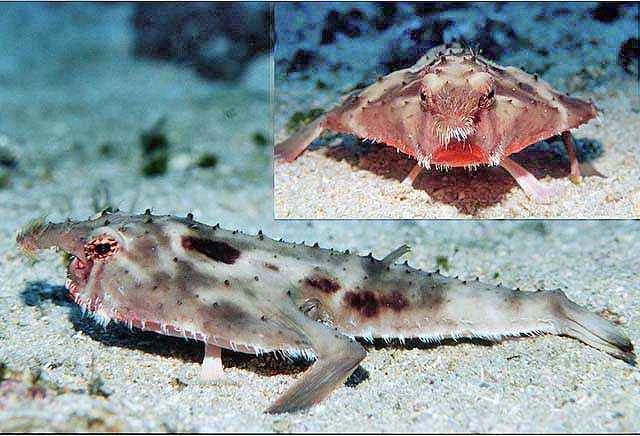
Body shape: The red-lipped batfish has a flat, disc-shaped body and a triangular head. Its pectoral fins have evolved to help it "walk" on the seabed, rather than swimming like most fish.
Fins and tail: Although it has a dorsal fin, the dorsal fin has evolved into a spine-like structure used to lure prey. Its tail is relatively short and is not usually used for swimming.
Size: Red-lipped batfish are relatively small, with an average length of about 40 cm (15.7 inches).
Habitat and Distribution
The red-lipped batfish is endemic to the Galapagos Islands, meaning it is found only in this specific region. More precisely, it inhabits the western waters of the archipelago, particularly the waters near Isabella and Fernandina.
Depth range: Red-lipped batfish typically live at depths between 10 meters (33 feet) and 120 meters (393 feet). They prefer to inhabit sandy or muddy seabeds, close to coral reefs and rocky bottoms.
Water conditions: This fish prefers cooler, nutrient-rich waters, which provide more food.
Behavior and Diet
Walking on the seabed
Unlike most fish that move by swimming, the red-lipped batfish moves along the seabed in a unique way. It uses its evolved pectoral fins to "walk" on the seabed, a slow and clumsy movement somewhat like a bat's flight, hence the "bat" in its name.
Predation habits
Red-lipped batfish are carnivorous, primarily preying on small marine creatures.
Diet: Its diet includes small fish, crustaceans, shrimp, crabs, mollusks, and worms. Its long dorsal fin (also known as a fishing rod-like appendage) is used to lure prey. The fish mimics the movements of small marine animals by wiggling this appendage, enticing prey to approach and mistaking it for food.
Hunting technique: Once prey gets close, the red-lipped batfish will quickly close its mouth to capture the prey.
Reproduction
Because the red-lipped batfish lives in a deep-sea environment and is difficult to observe in its natural habitat, its exact reproductive process remains unknown. However, similar batfish species reproduce through external fertilization, where the female releases eggs into the water, and the male fertilizes them in the water.
Natural enemies and threats
Despite its unique appearance, the red-lipped batfish faces threats from predators in the wild. Larger marine creatures living in the same area may see it as easy prey.
Natural predators: The red-lipped batfish's natural predators include larger fish such as sharks, groupers, and other large predatory fish in the ocean. Because of its slow movement, the red-lipped batfish is an easy target for these faster and more agile predators.
Impacts of human activities: Although the red-lipped batfish is not currently listed as an endangered species, human activities such as fishing and marine pollution may pose an indirect threat to it. While the Galapagos Islands, as a marine protected area, provide some protection, increased human activity in the region could still impact its natural habitat.
Ecological importance
Red-lipped batfish play a vital role in the ecosystem, helping to control the populations of small marine invertebrates. As predators, they maintain a healthy balance in coral reefs and the seabed environment by consuming small fish and invertebrates.
Preserve the status quo
Currently, the red-lipped batfish is not listed as an endangered or threatened species. However, like many marine creatures, it may face challenges from environmental change, overfishing, and habitat degradation in the future. Fortunately, the Galapagos Marine Reserve, where it lives, provides some protection for the species through restrictions on fishing activities and the promotion of marine conservation measures.
The unique charm of the red-lipped batfish
The red-lipped batfish, with its unique appearance and behavior, has become a favorite among marine biologists and photographers. Its red lips, unusual "walking" method, and unusual body structure make it a unique representative of the marine biodiversity of the Galapagos Islands.
Interesting trivia
The red-lipped batfish is often mistaken for its close relative, the pink-lipped batfish (Ogcocephalus porrectus), which is found in the waters off Peru. The two share many physical similarities, but can be distinguished by the color of their lips and their geographical distribution.
How to raise red-lipped batfish?
The Red-Lipped Batfish is a popular ornamental fish due to its distinctive red lips and walking-like gait. However, keeping them is not simple, requiring specific water quality, environment, and diet. Below is a detailed introduction to their varieties, water quality requirements, husbandry techniques, and health management.
1. Five common varieties of red-lipped batfish
There are no clearly defined subspecies of the Red-lipped Batfish, but based on physical characteristics and distribution areas, the following closely related species are often discussed:
Red-lipped batfish ( Ogcocephalus darwini )
A star fish species of the Galapagos Islands, characterized by its bright red lips and grey spotted body.
Shortfin batfish ( Ogcocephalus nasutus )
Distributed in the western Atlantic Ocean, it is characterized by short pectoral fins and a more rounded body.
Longfin batfish ( Ogcocephalus vespertilio )
The pectoral fins are significantly elongated, and the species is found in shallow tropical and subtropical seas, with a relatively deep range of activity.
Small-mouthed batfish ( Ogcocephalus parvus )
Its body is more compact, and its lips are not as brightly red as those of the red-lipped batfish. It is found in the Caribbean Sea.
Black-spotted batfish ( Ogcocephalus pantostictus )
It has black spots on its body and is distributed in the Gulf of Mexico and the Caribbean.
Although these close relatives differ in appearance, they share many similarities in their care.
2. Are red-lipped batfish suitable for beginners?
Actually, red-lipped batfish aren't particularly suitable for beginners. Why? They have relatively high environmental requirements, needing specific water quality conditions, and they like to "walk" on the bottom, so the aquarium setup also has certain requirements. Keeping them requires some basic experience with saltwater fish. Therefore, if it's your first time keeping fish, it's recommended to start with some hardy saltwater fish, such as clownfish or blue devils, before considering trying red-lipped batfish.
What special water quality does the red-lipped batfish require?
The red-lipped batfish is a typical saltwater fish that requires high water quality. Here are the specific details:
(1) Water quality parameters
Salinity : Seawater salinity needs to be maintained between 1.022 and 1.025. Artificial seawater is prepared using sea salt to ensure precise salinity adjustment.
pH value : It is recommended to keep it between 8.1 and 8.4. A slightly alkaline water environment is their optimal range.
Water temperature : The optimal water temperature is 22-26°C. Avoid water that is too cold or too hot. Temperature fluctuations should not exceed ±1°C.
Ammonia nitrogen and nitrates : Ammonia nitrogen should be zero, and nitrates should be below 20 ppm. Use a high-efficiency filtration system to prevent the accumulation of harmful substances.
(2) Water flow and dissolved oxygen
Red-lipped batfish prefer slow-moving water and dislike strong currents. It is recommended to use a water pump with regulating functions to create a gentle flow while maintaining good dissolved oxygen levels to prevent oxygen deficiency from affecting their health.
(3) Filtration and water quality monitoring
Use a protein skimmer to remove impurities from seawater and keep the water clean.
Regularly monitor water quality parameters (salinity, pH, ammonia nitrogen, etc.). It is recommended to use electronic water quality testers or test strips to ensure that the values are within the appropriate range.
(4) Water change frequency
Change 10%-15% of the water weekly to maintain water quality stability. For novice fish keepers, remember to adjust the salinity and water temperature before each water change to avoid drastic fluctuations that could stress the fish.
3. Aquarium setup and environment arrangement for Red-lipped Batfish
Red-lipped batfish are bottom-dwelling fish, so their aquariums should mimic their natural environment as closely as possible. Here is a detailed guide:
aquarium size
A minimum of 150-liter aquarium is required, as it needs sufficient bottom space to "walk around". If keeping other fish together, a larger aquarium is recommended.
Substrate and decoration
Substrate : Use fine sand or coral sand, avoiding rough or sharp materials to prevent injury when it "walks".
Decoration : Add coral reef and cave-like decorations to provide secluded spots. Don't overcrowd; leave room for movement.
illumination
Red-lipped batfish do not require high levels of light; a medium-intensity marine fish light is sufficient. Excessive light may cause them discomfort or stress.
Recommendations for mixed breeding
Red-lipped batfish are gentle in nature and can be kept with other docile fish such as clownfish and blue devils. Avoid keeping them with overly active or aggressive fish, such as three-spotted rocket fish and arowanas.
4. Diet and Feeding Methods for Red-lipped Batfish
Dietary habits
Red-lipped batfish are carnivorous fish, primarily feeding on small invertebrates. The following foods can be provided when keeping them in captivity:
Live bait : saltwater shrimp, marine worms, small crustaceans.
Frozen foods : frozen shrimp, small fish pieces.
Artificial feed : High-protein pelleted feed specifically for marine fish.
Feeding techniques
Frequency : Feed 1-2 times a day, but do not overfeed each time to avoid water pollution.
Feeding method : Red-lipped batfish move slowly, so you can use tweezers to bring the food close to them, or let the food sink to the bottom where they are active.
5. Health Management and Disease Prevention of Red-lipped Batfish
Common diseases
White spot disease : caused by water temperature fluctuations or new fish.
Bacterial infection : May be caused by poor water quality or injury.
Parasitic diseases : Special attention should be paid when feeding live food.
Preventive measures
Water quality management : Regularly test and change the water to maintain stable water quality.
Food hygiene : Live bait must be disinfected to avoid carrying pathogens.
Isolate new fish : New fish should be isolated and observed for at least two weeks before being added to the aquarium.
Observe health status
A healthy red-lipped batfish has bright red lips and a smooth body. If you notice discolored lips, spots on its body, or a decreased appetite, you should immediately check the water quality or consult a specialist.
Red-lipped batfish are unique ornamental fish. Although they are relatively difficult to keep, with proper care, they can definitely become the most eye-catching star in the aquarium!
in conclusion
The red-lipped batfish (Ogcocephalus darwini) is a highly representative fish, showcasing the miracle of marine adaptation and evolution. Found only in the Galapagos Islands, its vibrant red lips, unique "walking" method, and carnivorous diet make it a focus of attention for marine biological research and enthusiasts. Although currently not shown to be endangered, protecting its habitat is crucial for its survival. By gaining a deeper understanding of its ecology, behavior, and the threats it faces, we can better understand and protect this unique species in global marine ecosystems.
Frequently Asked Questions
Red-Lipped Batfish (scientific name Ogcocephalus darwini ) FAQ
Why does the red-lipped batfish look like it's applying lipstick?
The most distinctive feature of the red-lipped batfish is its bright red lips, which appear to be "applying lipstick." Scientists speculate that this may be to attract mates during the breeding season, or as a form of camouflage or signal underwater.Can red-lipped batfish swim?
Although it is a fish, it is not a good swimmer. The red-lipped batfish "walks" on the seabed using its modified pectoral and pelvic fins, moving as if crawling with its "feet." This unique mode of locomotion is adapted to its foraging habits on the seabed.What do red-lipped batfish eat?
They feed on small invertebrates, including worms, small crustaceans, and mollusks. The red-lipped batfish uses a fleshy organ on its head, resembling a fishing rod, to lure prey closer before swiftly capturing it.Where do red-lipped batfish live?
Red-lipped batfish are mainly distributed near the Galapagos Islands and the waters off Peru. They live in shallow to deep sea areas, usually in sandy or coral seabeds at depths of 3 to 76 meters.Does the red-lipped batfish have natural enemies?
Their natural predators include large fish and some marine mammals, such as sharks and seals. However, their brightly colored appearance may serve as a "warning coloration," causing many predators to avoid them. Furthermore, they are quite adept at using camouflage to evade predators.