Basic Information
Scientific classification
- Chinese name: Quokka
- Scientific name: Short-tailed grey wallaby, short-tailed kangaroo
- Classification: Rodentia
- Genus and species: Quokka, family Cricetidae, class Mammalia, phylum Chordata
Vital signs data
- Body length: 40-54 cm
- Weight: 1.5-4.5 kg
- Lifespan: 10 years
Significant features
It has a stocky build, well-developed hind legs, rounded ears, and a short, broad head. Its entire body is covered in coarse brown fur, with a slightly reddish tinge around the face and neck. Compared to other kangaroo relatives, its tail is relatively short, hence its name. It is one of the smallest kangaroos, possessing an amazing jumping ability, capable of leaping vertically up to 1.5 meters, equivalent to 3-4 times its body length. Its smile has earned it the title of "the happiest animal in the world."
Distribution and Habitat
They are found in a variety of habitats, most commonly in dense forests, open woodlands, and shrublands near freshwater areas. While they seem to prefer dense vegetation and damp areas, they also inhabit large numbers on Rottnest Island and Baldhead Island near Albany, where seasonal droughts and harsh environments prevail.
Appearance
The quokka is short and stocky with well-developed hind legs, short, rounded ears, and a bare nose. It has a short, broad head and a forehead with dark stripes. Its entire body is covered in coarse brown fur, with a slightly reddish tinge around the face and neck. It stands less than 60 centimeters tall. Its fur is dense and coarse, short and brownish-gray, with lighter fur on its back. Its hind legs are lighter but allow it to move at great speed through dense grass. It has a stocky, sturdy body and a hunched posture. It has a noticeably short tail. Unlike other quokkas, the quokka has short, well-developed hind legs and a nearly hairless tail. The quokka weighs between 1.5 and 4.5 kilograms, is 40-54 centimeters long, and has a tail length of 26-30 centimeters.
Detailed introduction
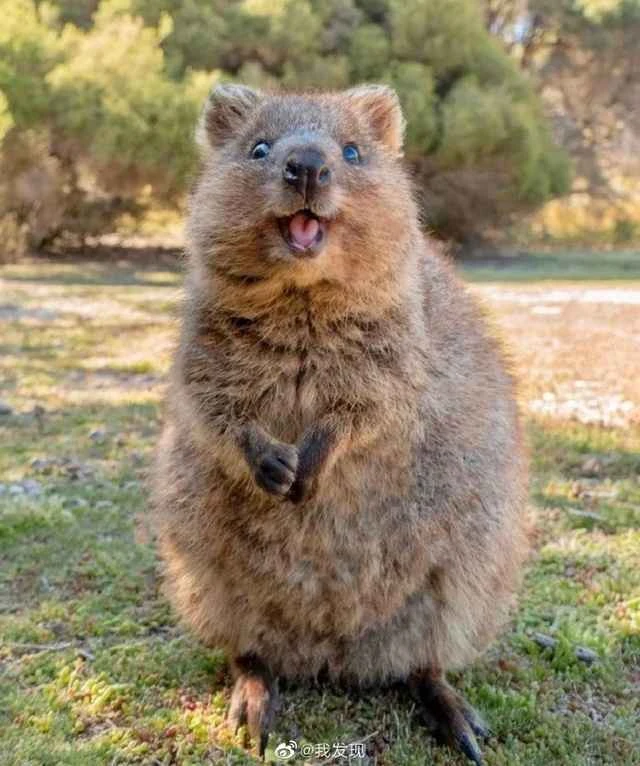
The quokka (scientific name: *Setonix brachyurus *) is a marsupial mammal belonging to the family Coccinellidae . One of the smallest kangaroos , it resembles a mouse. Known as " the happiest animal in the world " for its chubby face and " sweet " smile , it is very friendly and a popular tourist attraction. It has a stocky build, well-developed hind legs, short, rounded ears, a bare nose, a short, broad head , and a forehead with dark stripes. Its body is covered in coarse brown fur, with a slightly reddish tinge around the face and neck. It stands less than 60 centimeters tall. Its fur is dense, coarse, and short, brownish-gray, with lighter fur on its back. Its hind legs are light and allow it to move at great speed through dense grass. It has a stocky, sturdy body with a hunched posture. It has a distinctive short tail. Unlike other quokkas, the quokka has short, well-developed hind legs and a tail with almost no fur. The quokka weighs between 1.5 and 4.5 kg, has a body length of 40-54 cm, and a tail length of 26-30 cm . Its average lifespan is 10 years.
Quokkas live on Rottnest Island, with very few surviving in the southwestern forests of mainland Australia. They inhabit swampy scrubland and are nocturnal. They live in family groups. Herbivores, they eat a variety of grasses and shrubs. When food is scarce, they can obtain energy from the fat stored in their tails. The gestation period is 26 days, and females give birth to one offspring at a time.
The quokka is a type of wallaby, a small marsupial endemic to Australia. Due to predation by wildlife (cats and foxes), altered fire patterns, and habitat loss, its current population is scarce, and it is listed as Endangered on the IUCN Red List of Threatened Species .
Geographical range
The quokka (scientific name: Setonix brachyurus ), the only member of the quokka genus, is a small kangaroo, about the size of a domestic cat.
Quokkas are found in a variety of habitats, most commonly in dense forests, open woodlands, and scrub near freshwater areas. While they seem to prefer dense vegetation and damp areas, they also inhabit large numbers on Rottnest Island and Bald Head Island near Albany , where seasonal droughts and harsh conditions prevail. Quokkas live in groups on a small piece of land in the Two Bays Nature Reserve, coexisting with Gilbert's long-nosed wallabies. On the Australian mainland, quokkas appear to be confined to swampy areas with dense vegetation, preferring scrub or other shady places sufficient to avoid the summer heat, where they spend most of the year, though they sometimes change locations. Like other marsupials, quokkas are herbivores and are often nocturnal.
This species is endemic to southwestern Australia, including the Rottnest ( 17 sq km) and Bald ( 8 sq km) archipelagos, and Breaksea Island ( 1 sq km, Abbott 2006 ). It was initially distributed along the Moore River, 100 km north of Perth, through the more humid southwest, eastward along the south coast, to at least the Green Ranges, 60 km northeast of Albany. As of 2012, the northernmost recorded distribution was in the Darling Ranges, east and northeast of Perth. Additionally, the species is sporadically found along the south coast east of the Green Ranges, including an isolated subpopulation in Stirling Range National Park.
Morphological characteristics
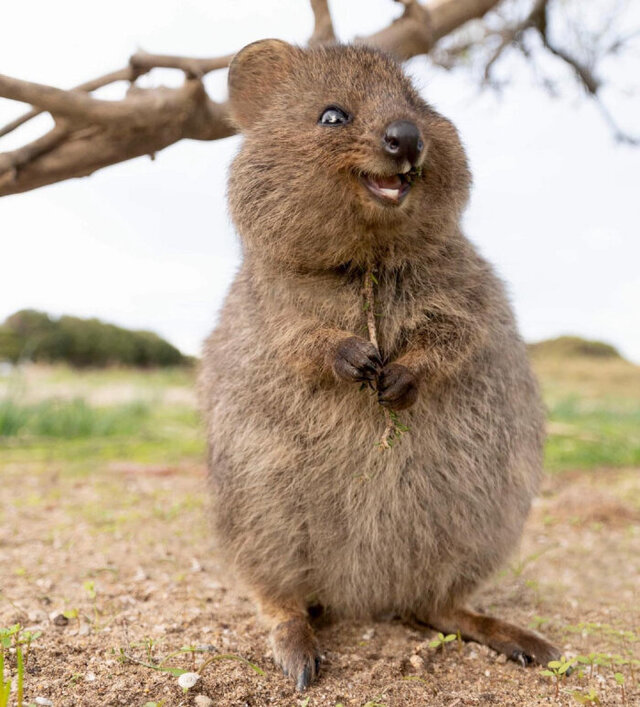
The quokka weighs between 2.5 and 5 kg ( 5.5 to 11.0 lbs), is 40 to 54 cm ( 16 to 21 inches) long, and has a tail that is 25 to 30 cm ( 9.8 to 11.8 inches) long, which is quite short for a member of the kangaroo family. The quokka is robust, with rounded ears and a short, broad head. Despite its small size, it can climb small trees and shrubs. Its rough fur is brownish-grey, fading to a pale yellow undercoat.
Quokkas are not afraid of humans, and it's common for people to approach them, especially on Bald Island near Abney. However, touching the animals in any way is illegal on the island, and the relevant authorities will issue a AU$300 fine for such behavior. Furthermore, if prosecuted, the fine could reach up to AU$2,000.
The quokka is one of the earliest Australian mammals discovered by Europeans. Dutch sailor Samuel Volckertzoon wrote of seeing " wildcats " on Rottnest Island in 1658. In 1696 , Willem de Vlamingh mistook them for giant rats and named the island " Rotte nest ," a name derived from Dutch meaning " rat's nest ." The word "quokka" likely originates from the Nuga word " gwaga ."
Ecology
In the wild, quokkas are confined to a small area in southwestern Western Australia and live in small family units. A large population exists on Rottnest Island, where they inhabit a wide variety of habitats, from semi-arid scrubland to plantations. A smaller population lives on Bald Head Island near Abney, an island devoid of foxes and cats.
population
Although quokkas are numerous on coastal islands, their distribution is very limited, and they are listed as a vulnerable species. On the Australian mainland, they are threatened by predators such as foxes, thus requiring dense ground vegetation for shelter. Extensive deforestation and agricultural development have led to habitat loss, causing a decline in their numbers. The problem has been exacerbated by the clearing and burning of swamps, as well as the introduction of cats, dogs, and dingoes. Furthermore, quokkas typically give birth to one offspring per litter, successfully raising one pup per year. Although they can reproduce continuously, usually reproducing the day after birth, the small number of offspring per litter, coupled with their limited range and the threat of predation, makes this small wallaby extremely rare on the mainland.
Lifestyle
Colonies: Quokkas live in small family units managed by a dominant hierarchy of adult males. This hierarchy is generally stable except during the hot summer months. The overlapping ranges of quokka families reflect their non-territorial nature; they are very friendly animals and most of the time peacefully share habitats without fighting over the presence of 150 other individuals within their territory. However, during the hot summer months, males will fight for the best shelter.
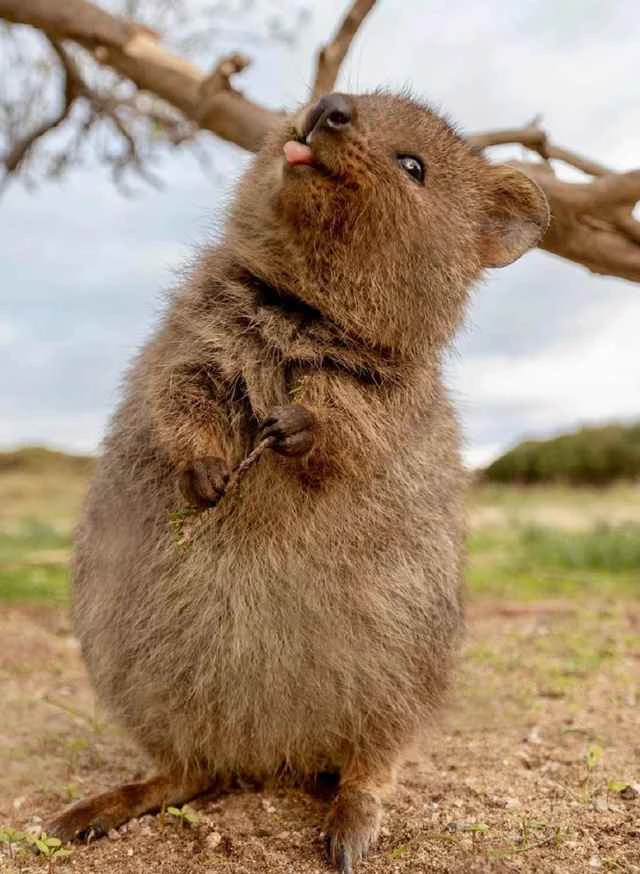
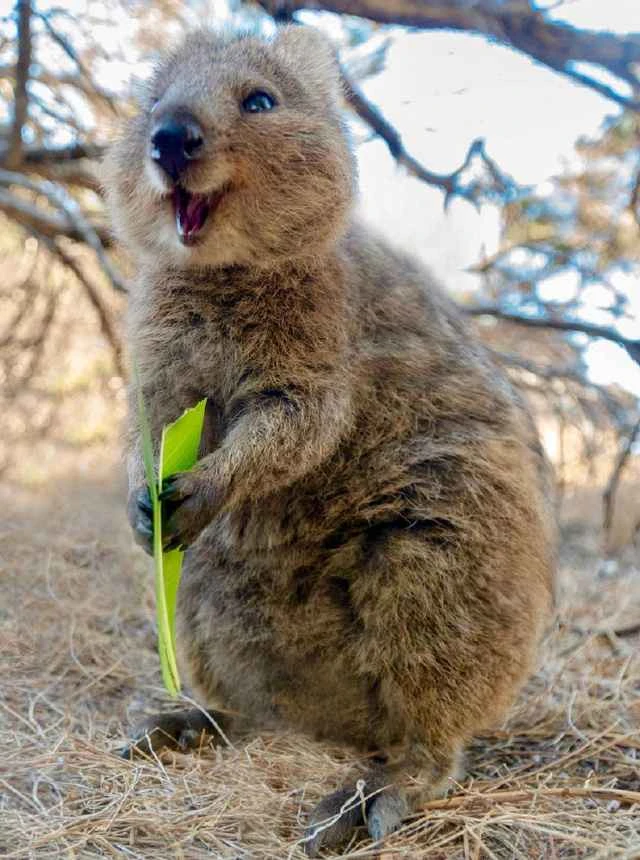
Foraging: Quokkas rest collectively in dense vegetation during the day, but are very active at night, often emerging in groups to forage under the cover of vegetation. They feed on local grasses, leaves, seeds, and roots, immediately regurgitating and chewing them after swallowing . Studies have shown that a local flowering plant is one of the quokka's favorite foods . They frequently dig waterholes or peel succulent plants such as cacti to obtain fresh water, even though they may not have actually drunk water for months. Their remarkable ability to reuse some of their waste products allows them to do so effectively.
Survival: Prolonged drought leading to heat, dryness, and dehydration increases mortality rates for individuals further from water sources. Furthermore, high temperatures cause plant dehydration and nitrogen deficiency, which also affects quokkas. While quokkas may suffer from dehydration, research shows they have excellent thermoregulation abilities, capable of coping with temperatures as high as 44°C. Their small size and exceptional jumping ability make them masters of the bush, allowing them to create escape routes in thickets or dense vegetation to avoid predator threats.
Perception: Quokkas acquire information through touch and chemical signals.
Reproduction methods
They are viviparous, with an average litter size of one offspring per year . The average estrous cycle for females is 28 days. In captivity, they can breed year-round, but in the wild, females are not in estrus from August to January of the following year . The female enters diapause the day after the pup is born. In the wild, they typically mate between January and March. After a short gestation period of four weeks, the mother gives birth to her next pup, named Joy. The pouch period usually lasts six to seven months. During this stage, Joy grows and learns to climb out of the pouch. When startled or cold, Joy will climb back into the pouch, but still requires a nursing period of more than two months.
The average time to sexual maturity is 389 days for males and 252 days for females . In the wild, the average lifespan of males is 10 years and that of females is 10 years. In captivity, the average lifespan of females is 7 years. The overall average lifespan is 5 years.
The global number of mature individuals is estimated at 7,850–17,150 . Regional population estimates are as follows: Rottnest Island 4,000–8,000 individuals, Baldhead Island 500–2,000 individuals, Northern Red Willow Forest 150 individuals, Southern Forest 2,000–5,000 individuals, and Southern Coast 1,200–2,000 individuals.
Risk factors
Before the arrival of European colonists along the southwest coast of Australia, quokkas were numerous and widely distributed. However, the introduction of domesticated predators such as cats, foxes, and dogs, as well as animals attracted by human settlements including predatory birds and wild dogs, led to a significant decline in quokka populations in their habitats. With their habitat increasingly becoming human settlements, they have only small natural habitats on the Australian mainland, and the reduction in their daytime resting places is considered a sign of population decline. Furthermore, the development of Rottnest Island for recreation has reduced quokka habitat and increased disease transmission. The large number of tourists who feed them each year has altered their feeding habits and diurnal patterns, often detrimental to their health.
Protective measures
Australia developed a quokka population recovery plan in December 2013. The Western Australian Department of Environment and Conservation is responsible for quokka conservation and also manages much of their habitat, located within national forests, national parks, and nature reserves, including Baldur Island. Extensive research has been conducted on the ecology and conservation of the quokka in the northern Jala Forest, with special investigations carried out elsewhere within its range. Guidelines for logging management ( Burrows and Liddelow , 2005) and guidelines for fire management adaptability ( Burrow et al., 2007 ) have been developed. Rottnest Island is primarily managed by the Rottnest Island Authority for recreational purposes.


