Basic Information
Scientific classification
- Chinese name: Mountain sable
- Scientific name: Burramys parvus
- Classification: Mammals
- Family: Pygmy possum; Genus: Pygmy possum
Vital signs data
- Body length: The head and body are about 10–11 cm long, and the tail is about 13–15 cm long. The tail is usually longer than the head and body.
- Weight: Adult body weight is mostly in the range of about 35–80 grams. It can increase significantly in late summer and early autumn due to fat gain; the common weight is about 40–45 grams.
- Lifespan: Wild females can live for more than 12 years, making them a very small but long-lived mammal.
Significant features
The Bogon moth, a hibernating creature that thrives on snow cover in the Australian mountains, is a flagship endangered species affected by climate change. It feeds heavily on the Bogon moth and stores food during the spring and summer.
Distribution and Habitat
It is found only in a few high-altitude locations in southeastern Australia (New South Wales and Victoria), preferring high-altitude megalithic mounds and scree slopes, covered with alpine shrubs/meadows, and dependent on rock crevices and stable microclimates.
Appearance
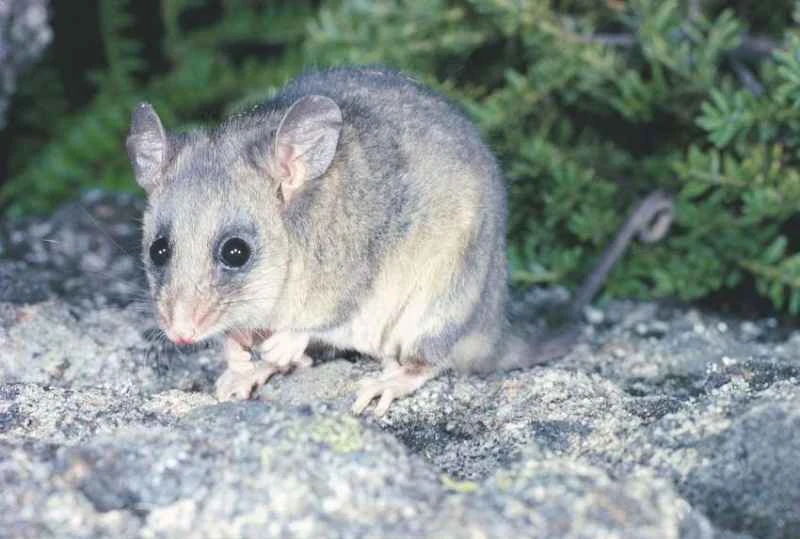
They are about the size of a mouse, with a grayish-brown to grayish-brown back and a lighter belly. They often have dark eye rings. Their tails are long and thin, allowing them to be grasped and are usually longer than their heads and bodies, which helps them climb and maintain balance in rock crevices.
Detailed introduction
The mountain possum ( Buramys parvus ) is one of Australia's most representative small alpine marsupials and the only pygmy possum species that strictly inhabits alpine and subalpine zones. Only the size of a mouse, it hibernates for months deep within boulders and under snow during the long winter, rapidly gaining fat during its "binge-eating season" in late summer and early autumn to store energy for winter.
The mountain possum's ecology is closely linked to an insect—the Bogong moth. Every spring and summer, the Bogong moth migrates to the high mountains of Australia to escape the heat and gathers there, becoming one of the mountain possum's most important and energy-dense food sources. They also feed on berries, seeds, nuts, nectar, and other invertebrates, and are adept at hiding their food in crevices in rocks for easy access during brief awakenings from hibernation.
Classification and nomenclature
The mountain possum belongs to the genus *Burramys* of the family Burramyidae in the order Diprotodontia. It was known only as a fossil for a long time before being rediscovered in the high mountains of Victoria in the mid-20th century, thus becoming an iconic species for Australian wildlife conservation.
Appearance features
The mountain possum is small in size, with a back that is mostly grayish-brown to grayish-brown, and a lighter belly and cheeks. It often has distinct dark "eye rings." Its short, powerful limbs are well-suited for running and climbing among rock crevices and scree slopes. Its long, slender tail, often longer than its head and body, is capable of grasping and helps maintain balance among rocks and carry nesting material. Its dense fur helps protect it from the low temperatures of high-altitude nights.
Distribution range and habitat
Currently, mountain possums are found only in a few high-altitude locations in southeastern Australia, primarily in the high-altitude regions of the Australian Alps in Victoria and New South Wales. They prefer terrain such as "boulder fields" or "rock screes": large accumulations of rocks form stable crevices and cavities, providing shelter from predators and maintaining a microclimate during winter. Above these rock screes are often alpine shrubs and meadows, providing a source of berries, seeds, and insects.
Lifestyle Habits and Behaviors
Mountain possums are primarily nocturnal, active after dusk and foraging among rocks and bushes. They are selective about their nesting sites, often building nests deep within rocky areas using moss and herbs. After the snow covers the ground in winter, they enter a long period of hibernation, during which their body temperature and metabolism significantly decrease; they may occasionally awaken briefly to feed on pre-stored seeds or berries before returning to hibernation. Females sometimes nest together in the hibernation nest to reduce heat loss.
feeding habits
They are omnivorous, but high-energy insects are very important during key seasons. In spring and summer, they feed heavily on Bogong moths and other invertebrates that migrate to high mountains, as well as seeds, nuts, nectar and berries; in autumn, they focus on fattening up and storing food in preparation for hibernation.
Reproduction and life cycle
Breeding typically occurs in spring and summer. Females usually enter the breeding season after hibernation, and each litter can produce 3–4 offspring (raised in a pouch). The offspring gradually learn to forage and move among rocks under the mother's care. This species is known for its longevity: wild females can live for more than 12 years, which is very rare for mammals of such a small size.
Relationship with humans
The distribution area of the mountain possum overlaps with that of ski resorts, roads, and alpine tourism activities. Human activities not only directly cause habitat occupation and fragmentation, but may also indirectly affect its survival by introducing/maintaining predators (such as wildcats and foxes) and altering snow cover, vegetation, and hydrological conditions.
Protecting the status quo and threats
The mountain possum is a recognized high-threat species: listed as Endangered under Australia's EPBC Act and typically classified as Critically Endangered (CR) on the IUCN Red List. Major threats include: shortened snow cover and deteriorating hibernation conditions due to climate change; further fragmentation of alpine habitats; expansion of infrastructure such as ski resorts and roads; predation pressure from feral cats and foxes; and the impact of bogon moth population fluctuations on food supply. Conservation measures often focus on: preserving and restoring rocky slopes and alpine shrubland; constructing habitat connectivity; predator control; ensuring food security and scientific monitoring during critical seasons; and, where necessary, integrated management including artificial breeding and translocation.
Frequently Asked Questions
Q1: Why do mountain possums only live in high-altitude areas?
It relies on the stable microclimate of rock crevices formed by the megaliths and the insulation provided by snow cover to complete its long hibernation, while alpine shrubs and seasonal insects (such as the Bogong moth) provide key food sources.
Q2: Do they really hibernate? How long do they hibernate?
Yes. During winter, after being covered by snow, they enter a long period of hibernation, with a significant decrease in metabolism, which can last up to about 7 months; during this period, they may occasionally wake up briefly to eat stored food.
Q3: What do mountain possums mainly eat?
Omnivorous. In spring and summer, it feeds heavily on invertebrates such as Bogon moths, as well as berries, seeds, nuts and nectar; in autumn, it fattens up and hides food in rock crevices to prepare for winter.
Q4: What are the main threats facing the mountain possum?
Climate change and snow cover reduction, habitat fragmentation and ski resort development, predation by wild cats and foxes, and fluctuations in key food sources (Bogon moth) will all exacerbate their survival risks.