Basic Information
Scientific classification
- Chinese name: Ant Pi
- Scientific name: Jynx torquilla, Eurasian wryneck
- Classification: Climbing birds
- Genus and family: Order Vulpecula, Family Woodpeckers, Genus *Vulpecula*
Vital signs data
- Body length: 16-19 cm
- Weight: 28-47g
- Lifespan: No verification data available.
Significant features
Distribution and Habitat
The ant-like creature is distributed in Afghanistan, Albania, Algeria, Andorra, Austria, Azerbaijan, Bahrain, Bangladesh, Belarus, Belgium, Bosnia and Herzegovina, Bulgaria, Burkina Faso, Cameroon, Chad, China, Ivory Coast, Croatia, Cyprus, Czech Republic, Denmark, Djibouti, Egypt, Eritrea, Estonia, Ethiopia, Finland, France, Gambia, Georgia, Germany, Ghana, Gibraltar, Greece, Guinea-Bissau, Hungary, India, Iran, Saudi Arabia, Iraq, Israel, Italy, Japan, Jordan, Kazakhstan, Kenya, South Korea, Democratic People's Republic of Korea, Spain, United Kingdom, United States, Canada, Thailand, Myanmar, Vietnam, Mauritania, Senegal, Uganda, Tunisia, Finland, Russia, Turkmenistan, Norway, Sweden, Turkey, Romania, and Ukraine.
In China, it is distributed in western Xinjiang, Inner Mongolia, Heilongjiang, Jilin, Liaoning, Hebei, Gansu, Ningxia, Qinghai, Sichuan and southern Tibet. It migrates through southern and southwestern Liaoning, southern Hebei, Shandong, Shanxi and Shaanxi, and overwinters in the Yangtze River Basin, southeastern coast, as well as Hong Kong, Taiwan and Hainan Island.
Migratory birds: Bhutan, Central African Republic, Democratic Republic of Congo, Faroe Islands, Guinea, Iceland, Ireland, Mali, Niger, Somalia, Sri Lanka, China, Togo.
Ant-like creatures mainly inhabit open, sparsely wooded areas in low mountains and plains, especially broad-leaved forests and mixed coniferous and broad-leaved forests. They can also sometimes be found in coniferous forests, forest edge thickets, river valleys, field edges, and orchards near settlements.
Appearance
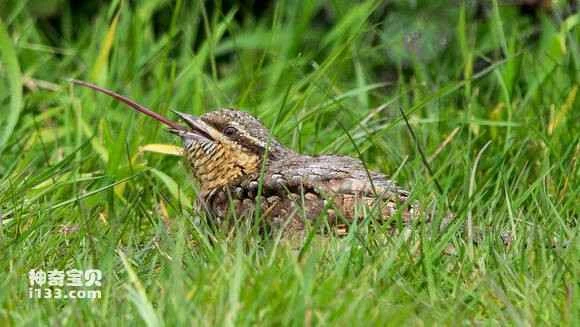
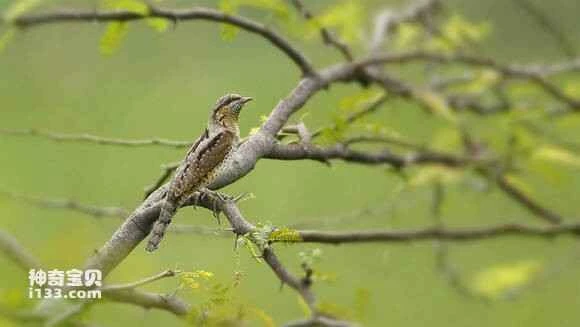
The ant-winged bird is a small bird, 16-19 cm in length. Its forehead and crown are greyish-gray, interspersed with fine blackish-brown horizontal bars and greyish-white terminal spots. The rest of the upperparts are greyish-brown, with brownish wings tinged with brown vermiculated spots. The nape, hindneck, and upper back have broad black longitudinal stripes, interspersed with greyish-gray, forming large ginger-shaped patches. The scapulars and tertiaries also have black longitudinal stripes, with white spots on the edges. The outer flight feathers are pale blackish-brown, with pale chestnut square patches on the outer side and a series of greyish-brown triangular patches on the inner side. The tail is relatively soft, rounded at the tip, and marbled silver-grey or brownish-grey in color, with 3-4 black horizontal bars, interspersed with blackish-brown horizontal bars and vermiculated spots. The bill is straight, small, and weak. The ear coverts are chestnut-brown, interspersed with fine blackish-brown streaks. The whiskers are nearly white. The neck, throat, foreneck, and breast are brownish-yellow, gradually turning grayish-white towards the rear, densely interspersed with fine blackish-brown horizontal bars. The bars are sparser on the belly and lower flanks and become arrow-shaped. The undertail coverts are brownish-yellow with sparse blackish-brown horizontal bars. Juveniles are largely similar to adults, but their plumage is darker. Juveniles have pale gray tail feathers with broad black tips, and their undertail coverts are yellowish-gray.
Size measurements: Weight: Male 28-47 g, Female 30-38 g; Body length: Male 16-19.2 cm, Female 17.5-19.7 cm; Bill length: Male 13-16 mm, Female 10-15 mm; Wing length: Male 77-86 mm, Female 77-85 mm; Tail length: Male 70-76 mm, Female 65-78 mm; Tarsus length: Male 19-23 mm, Female 18-25 mm. (Note: Male ♂; Female ♀)
Detailed introduction
The wryneck, scientifically known as Jynx torquilla and also called Eurasian wryneck, has six subspecies.
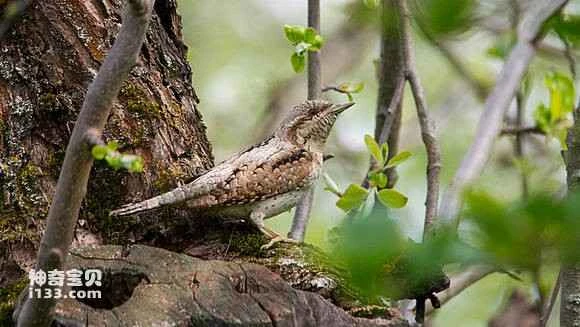
Except during the breeding season when they pair up, ant-wingers are usually solitary. They forage mostly on the ground and move by hopping. Their flight is swift and agile, often taking off and landing suddenly, their movements elusive. When roosting, they mostly perch on low shrubs or thickets, but can also stand upright on tree trunks for extended periods. They can use their claws to grip the trunk and move diagonally. Although ant-wingers spend much of their time on branches, they sometimes roost in low shrubs and grass. Because their body color blends well with the dry grass or sand on the ground, they are easily concealed, often heard but not seen, hence the nickname "ground bird." Their heads are very flexible, able to twist in various directions when startled, hence the name "crooked neck." During the breeding season, they call frequently, their calls short and sharp, sounding like a "caw-caw-caw." Ant-wingers possess a very special foraging tool—their tongue—used to catch ants on the ground or in tree holes. When the ant owl finds an anthill, it extends its tongue into the anthill, then, as if sticking the ant to it, pulls it out. This is a characteristic of the common woodpecker's tongue. The ant owl's tongue is very long and covered with bristles. Combined with the gelatinous mucus secreted by the salivary glands at the base of its beak, the tongue's surface is covered, allowing it to easily capture its prey with a gentle touch. Its diet consists mainly of ants, ant eggs, and pupae, and it also eats some small beetles.
The breeding season for the ant-tailed cricket is from May to July. They pair up as early as the end of April. They nest in tree cavities or abandoned woodpecker holes, as well as in natural burrows in decaying trees and stumps, and even on building walls and the tops of hollow concrete utility poles. Each clutch contains 5-14 eggs, mostly 7-12. The eggs are white, oval or oblong-oval, measuring 22-24 mm × 15-17 mm, and weighing 3-4 grams. Both parents incubate the eggs for 12-14 days. The chicks are altricial, and both parents raise them. After 19-21 days of feeding, the chicks are ready to fly. North of the Yangtze River in China, they are mostly summer visitors, while south of the Yangtze River, they are winter visitors or temporary migrants. They migrate to their breeding grounds in spring (April-May) and leave in autumn (September-October).
Listed as Least Concern (LC) in the IUCN Red List of Threatened Species 2016 ver 3.1.
It was included in the "List of Terrestrial Wild Animals of Beneficial or Important Economic and Scientific Research Value under State Protection" issued by the State Forestry Administration of China in 2000.
Protect wild animals and ban the consumption of wild game.
Maintaining ecological balance is everyone's responsibility!