
Basic Information
Scientific classification
- Chinese name: Ivory-billed Woodpecker
- Scientific name: Ivory-billed woodpecker, white-backed, pearl-beaked, forest pheasant, angel bird, Campephilus principalis
- Classification: Climbing birds
- Family and genus: Order Piliformes, Family Pilidae, Genus *Red-headed Woodpecker*
Vital signs data
- Body length: 48-53 cm
- Weight: No verification information available.
- Lifespan: No verification data available.
Significant features
It is the second largest woodpecker in the world and the largest woodpecker in North America.
Distribution and Habitat
The ivory-billed woodpecker is found in the southeastern United States and Cuba.
Ivory-billed woodpeckers inhabit a variety of evergreen broad-leaved or mixed forests. They were once found in various forest types, from swamps to mountain forests in Florida, USA, and also in the Masson pine forests of the mountains of Cuba. Originally, they lived in lowland hardwood and mountain pine forests, mixed broad-leaved forests, and other forests in the United States and Cuba. Historical records indicate that they were once a very large family, occurring at low densities naturally, suggesting that large, continuous, mature forests were needed to support a viable population (Jackson 2002). Large forested areas included several different types of swamps and broad-leaved forests (Fitzpatrick et al. 2005), totaling approximately 220,000 hectares. In Cuba, widespread loss and degradation of their lowland forest habitat means that any remaining birds are likely limited to intact mountain pine forests.
Appearance
The woodpecker measures 48-53 cm in length and has a wingspan of approximately 84 cm. Resembling an "aristocrat," this large bird boasts an ivory-colored beak, pale lemon-yellow irises with distinct black and white markings, a unique ridge, and a slender profile. Its plumage is glossy black with white patterns, and its wings are speckled with white. It is named for its large, ivory-like beak. The male woodpecker has a bright red crest. Its neck and back are bluish-black with white markings, and its lower jaw is black. The upper and lower wings are edged with white, with a white edge also present on the front of the lower wing, forming a black line down the middle that gradually widens towards the wingtips.
Adults have ivory-colored beaks, while chicks have chalky white beaks. They possess a crest on their heads; the crests of chicks and females are black, while the male's crest is black at the front and red at the back and sides. When standing and with their wings folded, their lower backs appear as a large, triangular white band, distinguishing them from the North American Black Woodpecker. The Ivory-beaked Woodpecker has a strong, straight beak and a long, flexible tongue with thorns and a hard tip. Their beak tip is slightly flattened, a unique feature among North American woodpeckers.
Detailed introduction
The Ivory-billed woodpecker, scientifically known as Campephilus principalis, is the second largest woodpecker in the world and the largest woodpecker in North America.
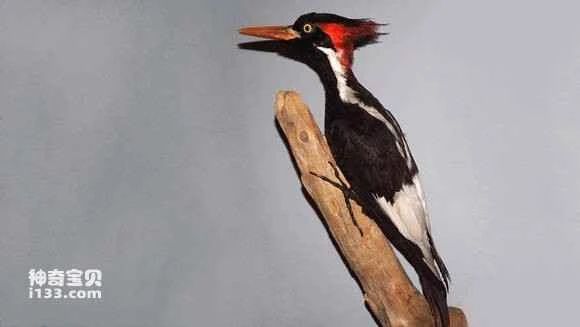
Ivory-billed woodpeckers primarily feed on beetle larvae, such as grubs and small cysticercosis, found in dead trees. They use their strong beaks to dig holes deep within the wood, reaching the insects. Each woodpecker can drill a 12-centimeter-deep hole in dead wood in less than a minute. They also eat seeds, fruits, and other insects.
Ivory-billed woodpeckers are monogamous birds, living and migrating together. They mate approximately from January to March each year. They carve a nest about 15 meters above the ground in dead trees. They lay 1-4 eggs at a time, which take about 3-5 weeks to incubate. Both parents incubate the eggs and care for the chicks, with the male primarily responsible for this at night. The chicks learn to fly after 5 weeks, but the parents continue to feed them for up to 2 months. The following winter, the chicks leave the nest to live independently.
The ivory-billed woodpecker population declined drastically in the 1800s due to hunting. It was generally believed to be extinct after two were shot in Colorado in the 1920s. By 1938, only about 20 ivory-billed woodpeckers remained in the wild, with 6-8 of them in a private old-growth forest in Louisiana. This forest was eventually cleared and logged, and the last female died in 1944. Several reports of ivory-billed woodpecker calls surfaced between the 1940s and 1990s, but none could be confirmed. They were listed as endangered in 1967 and extinct in 1994, but were later reclassified as endangered due to the belief that they still existed.
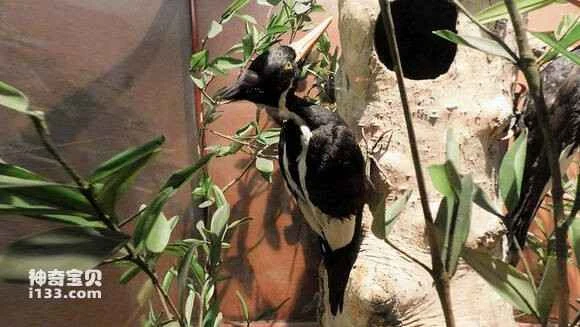
On February 11, 2004, birdwatcher Gene Spalling, while traveling by canoe, spotted a bird he had never seen before along the White River in eastern Arkansas. Spalling recorded the bird's physical characteristics, and upon checking, discovered it was the ivory-billed woodpecker, which had been extinct for 60 years. The news caused widespread shock in the biological community.
A week later, Tim Gallagher of Cornell Laboratory and Bobby Harrison of Oakwood University found Sparling. Led by Sparling, the two ornithologists began their search for the ivory-billed woodpecker. Subsequently, more than 30 ornithologists divided into several research groups and launched an operation hoping to rediscover the ivory-billed woodpecker. In 7,000 hours of searching, the ornithologists spotted the ivory-billed woodpecker 15 times and took numerous photos and videos. After review by experts from various countries, it was confirmed that the ivory-billed woodpecker is still alive. The Nature Conservancy then applied for government funding to protect the ivory-billed woodpecker's habitat and for breeding research. Experts from Cornell Ornithology Laboratory in New York and The Nature Conservancy kept the discovery a secret for over a year to protect the woodpecker's habitat. The protected area and birdwatching area have been established, and breeding research has begun. In order to enable citizens to better protect this rare bird and to attract more private conservation funding, the experts decided to release the information to the public.
Protect wild animals and ban the consumption of wild game.
Maintaining ecological balance is everyone's responsibility!


