
Basic Information
Scientific classification
- Chinese name: Milky White Woodpecker
- Scientific name: Cream-colored woodpecker, Celeus flavus
- Classification: Climbing birds
- Family and genus: Order Versiformes, Family Woodpeckers, Genus *Crested Woodpecker*
Vital signs data
- Body length: Approximately 26 centimeters
- Weight: 95-130g
- Lifespan: No verification data available.
Significant features
Distribution and Habitat
The milky woodpecker is mainly distributed in Suriname, Brazil, Guyana, Colombia, Bolivia, Peru, Chile, Argentina and other countries.
The Milky Woodpecker inhabits swamp forests, wetlands, and woodland edges, forest belts, and mangroves, and is found in the Várzea region (near river forests that are submerged for several months of the year). It also inhabits other types of habitats, such as those found in cocoa plantations. Its vertical habitat ranges from plains to altitudes of approximately 400-700 meters.
Appearance
The Creamy Woodpecker measures 26 cm in length and weighs 95-130 grams. The male has a crest, ranging in color from pale yellow and cream to yellow. Some brown feathers are present on the head and back. The wing color varies. The underparts are pale yellow to cream-colored, with a pale yellow-cream base and more brown. The flight feathers are black, sometimes with large patches of brown. The coverts are pale yellow or cream-colored, while the upper tail coverts are dark brown, and the rump is pale yellow or cream-colored. Except for the pale brown wings and tail feathers, the entire body is golden yellow. The difference between males and females lies in the bright red coloration below the cheeks.
The beak is strong and straight like a chisel; the tongue is long and retractable, often 4 to 5 times longer than the beak. This long tongue is used to search for insects and other larvae that cause diseases in trees. The tip of the tongue is covered with short hooks; the legs are relatively short, with 4 toes, 2 pointing forward and 2 pointing backward; the tail is flat or wedge-shaped, with 12 tail feathers, the shafts of which are stiff and flexible, supporting the body when pecking wood.
Detailed introduction
The cream-colored woodpecker, scientifically known as Celeus flavus, has four subspecies.
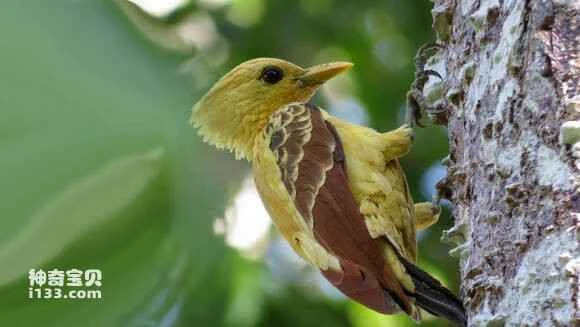
The milky woodpecker is commonly found near rivers; it lives solitary lives. While most woodpeckers can only cling to tree trunks using their four toes, the milky woodpecker can perch on horizontal branches like passerine birds. The woodpecker can drill holes in trees to hook insects. Its long, sharp, and hard beak can penetrate deep into the hard wood, and its long, thin tongue is covered with many barbs and a layer of sticky substance, allowing it to accurately hook out pests. Its diet consists mainly of termites, grubs, and other insects, but it also eats seeds and fruits.
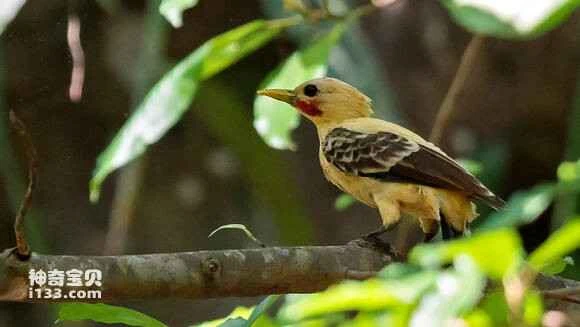
The milky-white woodpecker mates and breeds between August and November each year, with one male and one female. During courtship, the male breaks from its usual silence, vigorously striking hollow tree trunks or metal with its beak to "express its love" and attract the female's attention. The loud tapping echoes through the spring forest, like the sound of a pneumatic drill, announcing the start of courtship season. To attract a mate, the woodpecker chooses a piece of dead wood or any resonant object and taps it quickly and forcefully with its beak.
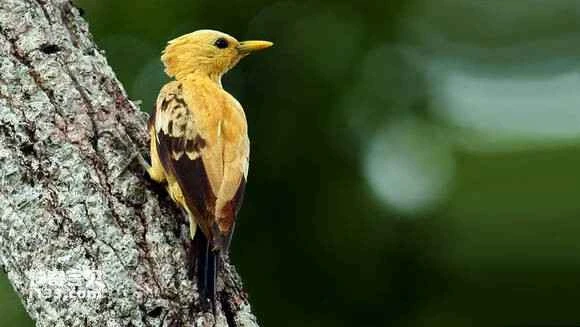
After mating, woodpeckers immediately begin digging a nest. The choice of location depends on the size and strength of their beaks. Stronger birds choose very hard wood. Smaller, weaker woodpeckers often choose softer, rotten wood for nesting, saving energy. Once the burrow is dug, sometimes with a layer of wood, the mother lays her nearly spherical white eggs on top. Both parents work together to build the nest and raise the chicks. The incubation period, feeding period, sexual maturity period, and lifespan of the chicks are unknown.
Listed as Least Concern (LC) on the IUCN Red List of Threatened Species 2013 ver 3.1.
Protect wild animals and ban the consumption of wild game.
Maintaining ecological balance is everyone's responsibility!


