
Basic Information
Scientific classification
- Chinese name: Chestnut Woodpecker
- Scientific name: Micropternus brachyurus, Celeus brachyurus, Cinnamon Woodpecker, Rufous Woodpecker
- Classification: Climbing birds
- Family and genus: Order Vulpecula, Family Woodpeckers, Genus *Caryopsis*
Vital signs data
- Body length: 21-24 cm
- Weight: 67-90g
- Lifespan: No verification data available.
Significant features
Distribution and Habitat
It is distributed in Bangladesh, Bhutan, Brunei Darussalam, Cambodia, China, India, Indonesia, Lao People's Democratic Republic, Malaysia, Myanmar, Nepal, Singapore, Sri Lanka, Thailand, and Vietnam.
It mainly inhabits broad-leaved forests, bamboo forests, sparse forests at forest edges, secondary forests, and shrublands in low mountains, hills, and plains below 1000 meters above sea level. It prefers open woodlands, secondary forests, forest edges, gardens, and plantations at low altitudes. It can also be found in open wastelands.
Appearance
The male Chestnut Woodpecker is entirely chestnut brown, with a slight brownish tinge to the crown and paler feather edges. It has a short crest on the nape, and both the crown and nape have black shaft streaks. The upperparts, including the wings and tail, are covered with black horizontal bars, especially broad and prominent on the wings and tail. The chin, throat, and foreneck feathers have paler edges and faint blackish-brown shaft streaks. A large red patch forms behind the eye and on the cheeks extending to the tips of the ear coverts. The underparts are slightly darker than the upperparts. The flanks have blackish-brown horizontal bars.
The female is similar to the male, but lacks the red spots under the eyes and on the cheeks. The flanks, chest, and abdomen all have dark brown transverse bars.
Juvenile birds resemble females, lacking red spots on the sides of their heads, but having indistinct transverse bars or scaly spots on their chests and abdomens.
The iris is dark brown or reddish-brown, the mouth is black, and the base of the lower mandible is tinged with grayish-green or yellowish-green. The feet, toes, and claws are all black.
Size measurements: Weight: males 70-90 g, females 67-80 g; Body length: males 212-241 mm, females 213-230 mm; Bill length: males 20-23 mm, females 20-23 mm; Wing length: males 112-119 mm, females 114-118 mm; Tail length: males 66-79 mm, females 63-75 mm; Tarsus length: males 20-22 mm, females 20-22 mm.
Detailed introduction
The chestnut woodpecker, scientifically known as Micropternus brachyurus or Celeus brachyurus, and also called Cinnamon Woodpecker or Rufous Woodpecker, has nine subspecies.
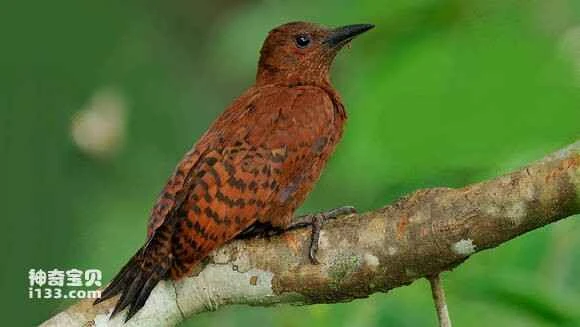
Chestnut woodpeckers are usually solitary. During the breeding season, they appear in pairs or family groups, but generally do not flock together. They prefer to be near ant nests. They also often fly low in the forest, their flight pattern is undulating, and they call out with each rise and fall. They mainly feed on ants and other ants.
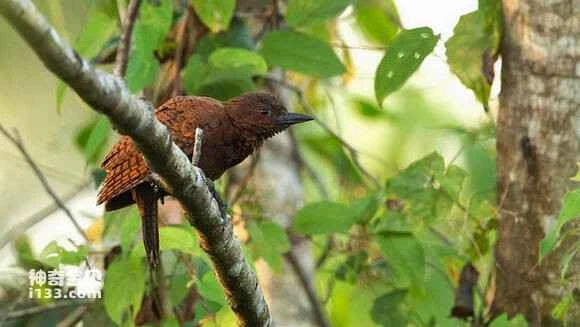
The chiseling sound of the chestnut woodpecker is rarely heard. Its call is a short, rapid "kwee, kwee, kwee, kwee…", descending in 5-10 notes. The chiseling sound is short and gradually slows down.
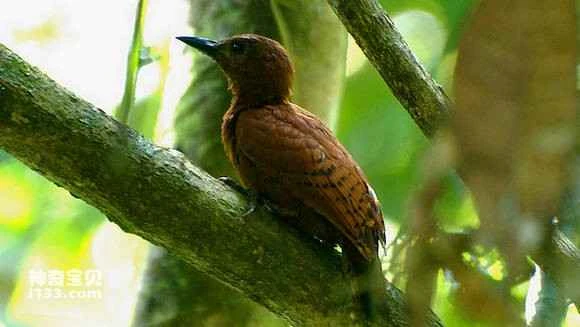
The chestnut woodpecker's breeding season is from April to June. They nest in tree cavities, lining them with wood shavings and dry grass. Each clutch contains 4-6 eggs, sometimes as few as 2 or 3, or as many as 7. Newly laid eggs are white and oval in shape, measuring 25-30 × 17-21 mm. Both parents take turns incubating the eggs. The chicks are altricial.
It is listed in the "List of Terrestrial Wild Animals of Beneficial or Important Economic and Scientific Research Value under State Protection" issued by the State Forestry Administration of China on August 1, 2000.
Protect wild animals and ban the consumption of wild game.
Maintaining ecological balance is everyone's responsibility!


