Basic Information
Scientific classification
- Chinese name: Black-naped Green Woodpecker
- Scientific name: Picus guerini, Black-naped woodpecker
- Classification: Climbing birds
- Classification: Order Versiformes, Family Woodpeckers, Genus *Leptochloa*
Vital signs data
- Body length: 26.5-32.1 cm
- Weight: 105-159g
- Lifespan: No verification data available.
Significant features
Distribution and Habitat
It is distributed worldwide in Albania, Austria, Belarus, Bangladesh, Belgium, Bhutan, Bosnia and Herzegovina, Bulgaria, Cambodia, China, Croatia, Czech Republic, Estonia, Finland, France, Germany, Greece, Hungary, India, Indonesia, Italy, Japan, Kazakhstan, North Korea, South Korea, Lao People's Democratic Republic, Latvia, Lithuania, Luxembourg, Liechtenstein, Macedonia, Malaysia, Moldova, Mongolia, Montenegro, Myanmar, Nepal, Netherlands, Norway, Pakistan, Poland, Romania, Serbia, Slovakia, Slovenia, Spain, Sweden, Switzerland, Turkey, Thailand, Ukraine, and Vietnam.
It is distributed in the eastern, central and southern provinces and regions of China, including Northeast China, North China, Inner Mongolia, Qinghai, Tibet, Xinjiang, Sichuan, Gansu, Southwest China, East China, South China, Hong Kong, Taiwan and Hainan Island.
It mainly inhabits low mountain broad-leaved forests and mixed forests, and also appears in secondary forests and forest edges, but rarely in primary coniferous forests.
Appearance
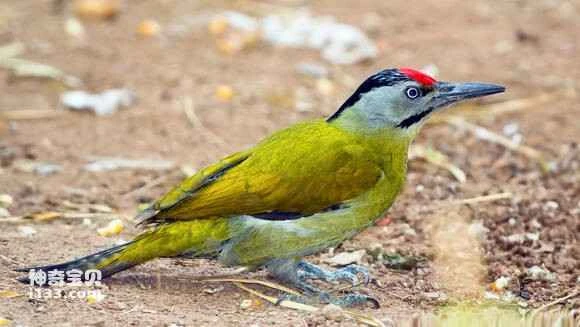
The male has a greyish-black forehead with a reddish-brown crown and a greyish-black or dark grey crown with black shaft streaks on the back of the head, nape, and nape. The lores are black, the supercilium is greyish-white, the ear coverts and sides of the neck are grey, and the malar stripe is broad and distinctly black. The back and upper wing coverts are olive-green, while the rump and upper tail coverts are yellowish-green. The central tail feathers are olive-brown with greyish-white semi-circular spots on each web, the tips of which are black, and the shafts are glossy black. The outer tail feathers are dark brown with dark horizontal bars. The primary flight feathers are black with white square horizontal bars on the outer webs and white horizontal bars at the base of the inner webs. The outer webs of the secondary flight feathers are tinged with olive-yellow, and the white spots are indistinct. The underparts have a greyish-white chin, throat, and foreneck; a greyish-green breast, abdomen, and flanks; and greyish-green undertail coverts with grass-green tips.
The female has a dark gray forehead and crown with black shaft streaks and tip spots, otherwise the same as the male.
Juvenile males have a greyish-brown bill base, a red forehead with a nearly circular patch and orange-yellow feather edges. The crown is dark greyish-green with pale black spots on the feather shafts, the sides of the head to the nape are dark grey, and the flanks, lower belly to undertail coverts are greyish-white with pale black spots and horizontal bars. Otherwise, they are the same as adults.
The iris is red, the mouth is grayish-black, and the feet and toes are grayish-green or brownish-green.
Size measurements: Weight: males 120-159g, females 105-150g; Body length: males 265-311mm, females 273-321mm; Bill length: males 29-40mm, females 31-40mm; Wing length: males 133-150mm, females 138-153mm; Tail length: males 91-123mm, females 90-121mm; Tarsus length: males 24-30mm, females 25-32mm.
Detailed introduction
The Black-naped Woodpecker, scientifically known as *Picus guerini*, has 14 subspecies.
The Black-naped Woodpecker is usually solitary or in pairs, rarely in flocks. In autumn and winter, it is commonly found in sparse woodlands along roadsides and farmland edges, and also frequently in small groves near villages. It flies swiftly, moving in a wave-like pattern. It usually feeds on the lower and middle parts of tree trunks, and also on the ground, especially on fallen logs and anthills. It rarely sings, and its call is simple, consisting of only a single syllable, "ga-ga-". However, during the breeding season, its calls become very frequent and loud, with longer and more varied tones, sounding like "gao-gao-gao-".
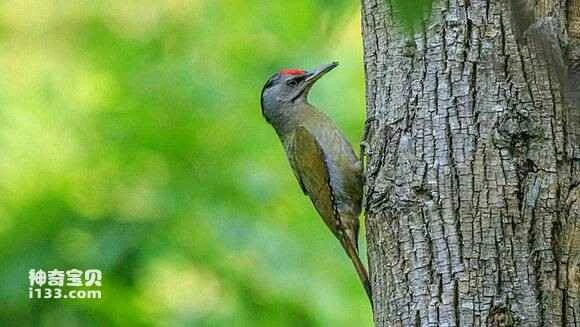
The Black-naped Woodpecker primarily feeds on insects such as ants, bark beetles, longhorn beetle larvae, and insects belonging to the orders Lepidoptera, Coleoptera, and Hymenoptera. When foraging, it often spirals upwards from the base of tree trunks, then flies to the base of another tree to continue its search, using its long tongue to hook out pests that are under the bark or have burrowed into the wood. Occasionally, it also eats plant fruits and seeds, such as wild grapes, red pine nuts, yellow pine cones, and grass seeds.
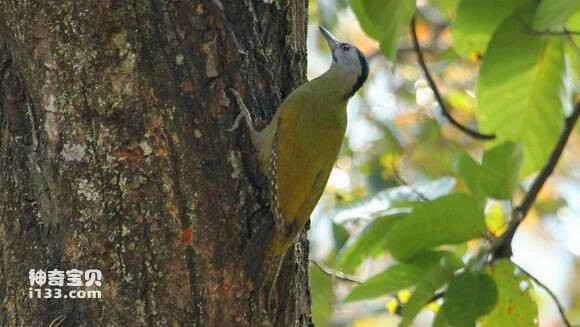
The breeding season for the Black-naped Woodpecker is from April to June. Pairs are observed as early as the beginning of April, their calls increase, they chase each other, and emit a "cawing" sound. They nest in tree cavities, which are jointly dug by both parents. A new nest is dug each year, and old nests are generally not reused. Nesting sites are typically chosen in mixed forests, broad-leaved forests, secondary forests, or forest edges on decaying broad-leaved trees such as ash, aspen, chokecherry, oak, and elm. The nest is 2.7–11 meters above the ground, with a round or oval entrance, 5–6 cm in diameter, an internal diameter of 13–15 cm, and a depth of 27–42 cm. There is no lining inside the nest. They breed once a year, with egg-laying beginning in early May. Each clutch contains 8–11 eggs, most commonly 9–10. The eggs are milky white, smooth, and spotless, oval in shape, measuring 28.5–30.7 mm × 21–22.9 mm, with an average of 29.5 mm × 21.6 mm, and weighing 6.5 g. Incubation begins only after all eggs have been laid, and is undertaken by both parents alternately for 12–13 days. The chicks are altricial, and both parents participate in raising them. Initially, the parents spend more time warming the chicks and feed them less frequently, often entering the nest to feed them. Later, they stop warming the chicks and feed them more often, standing at the entrance of the nest and sticking their heads inside to feed them. After 23–24 days of feeding, the chicks are ready to fly and leave the nest.
Listed as Least Concern (LC) on the IUCN Red List of Threatened Species 2012 ver 3.1.
Protect wild animals and ban the consumption of wild game.
Maintaining ecological balance is everyone's responsibility!