Basic Information
Scientific classification
- Chinese name: Striped-breasted Woodpecker
- Scientific name: Dendrocopos atratus, Stripe-breasted woodpecker
- Classification: Climbing birds
- Family and genus: Order Vulpetiformes, Family Woodpeckers, Genus *Woodpecker*
Vital signs data
- Body length: 18-21 cm
- Weight: 46-49g
- Lifespan: No verification data available.
Significant features
Distribution and Habitat
The Striped-breasted Woodpecker is distributed in western, southern, and southeastern regions of Yunnan Province, including Yingjiang, Luxi, Simao, Xishuangbanna, Jiangcheng, Lüchun, and Hekou. Outside of China, it is found from northern India to eastern Myanmar, northwestern Thailand, Vietnam, and Laos.
The striped-breasted woodpecker mainly inhabits evergreen or deciduous broad-leaved forests in low mountains, hills, and plains below 1500 meters in altitude, and also appears in sparse forests and thickets at forest edges.
Appearance
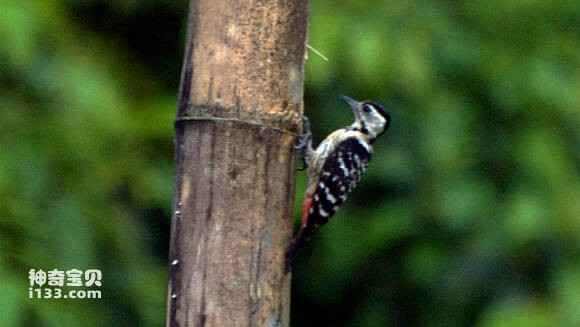
The male Striped-breasted Woodpecker has a brownish-brown forehead, with a row of red markings from the crown to the nape; black on the nape and upper back, with alternating black and white horizontal bars on the middle of the back and shoulders; black wings with black and white spots on the wing coverts and flight feathers, forming a near-barred pattern when the wings are folded. The rump, upper tail coverts, and tail are black; the outer tail feathers have white horizontal bars. The malar stripe is black, extending to the hind edge of the ear coverts; the sides of the head, sides of the neck, whiskers, and upper throat are white, turning to tan or buff-yellow towards the back. The throat, breast, abdomen, and flanks are densely covered with black longitudinal stripes; towards the middle of the abdomen, the stripes are thinner and less noticeable, and the undertail coverts are red.
The female striped-breasted woodpecker is similar to the male, but the top of its head and nape is black instead of red, matching the color of its upper back.
Juvenile striped-breasted woodpeckers resemble females, but the front of their heads is greyish-red. Their underparts are duller, with longitudinal stripes on the breast and inconspicuous transverse bars on the rest of the underparts.
The male striped-breasted woodpecker has a brownish-red iris, while the female has a brown iris, grey beak, dark lead-colored toes and claws.
Size measurements: Weight: ♂ 46 g, ♀ 46-49 g; Body length: ♂ 182-218 mm, ♀ 195-200 mm; Bill length: ♂ 26 mm, ♀ 27 mm; Wing length: ♂ 116-123 mm, ♀ 116-118 mm; Tail length: ♂ 76-80 mm, ♀ 78-81 mm; Tarsus length: ♂ 21-22 mm, ♀ 19-21 mm. (Note: ♂ male; ♀ female)
Detailed introduction
The striped-breasted woodpecker, scientifically known as *Dendrocopos atratus*, has two subspecies.
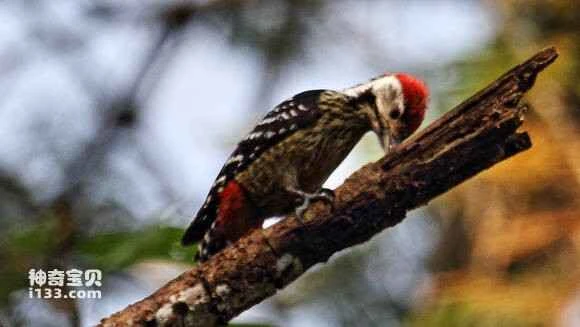
The Striped-breasted Woodpecker is a resident bird, usually seen alone or in pairs, occasionally in groups in bushes or broad-leaved trees. Its diet consists mainly of ants and insects, including larvae of Coleoptera, Lepidoptera, Geometrid moths, Tettigoniidae, Locustidae, Noctuidae, Lepidoptera, Lepidoptera, and Lepidoptera, butterfly larvae, caterpillars, crickets, and mantises. It also occasionally eats small amounts of berries and seeds. Its call is a plosive "tchick" sound and a sharp, descending hiss, along with a strange squeaking panting sound.
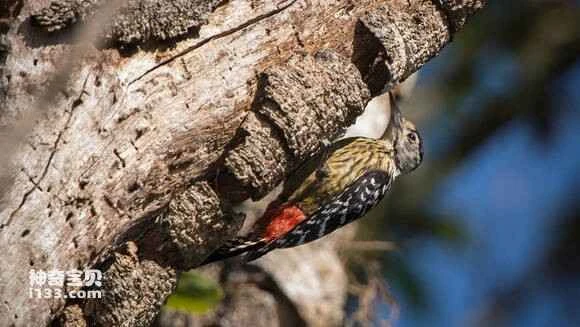
The breeding season for the Striped-breasted Woodpecker is from April to May. They nest in broad-leaved forests in low mountains and plains below 1500 meters, and also in trees along farmland edges, building their nests in tree cavities. Each clutch contains 4-5 eggs, measuring 19-24 mm × 14-17.8 mm. Both parents take turns incubating the eggs; the chicks are altricial.
It is listed in the "List of Terrestrial Wild Animals of Beneficial or Important Economic and Scientific Research Value under State Protection" issued by the State Forestry Administration of China on August 1, 2000.
Listed as Least Concern (LC) on the IUCN Red List of Threatened Species 2012 ver 3.1.
Protect wild animals and ban the consumption of wild game.
Maintaining ecological balance is everyone's responsibility!