Basic Information
Scientific classification
- Chinese name: Blue-eared Barbet
- Scientific name: Psilopogon cyanotis, Megalaima australis, Blue-eared Barbet
- Classification: Climbing birds
- Family and genus: Entomomorpha, Pterygomorphaceae, Pterygomorpha
Vital signs data
- Body length: Approximately 17 centimeters
- Weight: No verification information available.
- Lifespan: No verification data available.
Significant features
It looks very similar to the Blue-throated Barbet, but is smaller.
Distribution and Habitat
The Blue-eared Barbet is distributed in southwestern and southern Yunnan within China; outside of China, it is found in India, Myanmar, Thailand, the Indochina Peninsula, and Indonesia.
The Blue-eared Barbet primarily inhabits tall trees in low hills and plains at the foot of mountains. During the breeding season, it mostly inhabits dense forests, but outside the breeding season, it can also be found in trees along forest edges, bamboo groves, near villages, and beside farmland.
Appearance
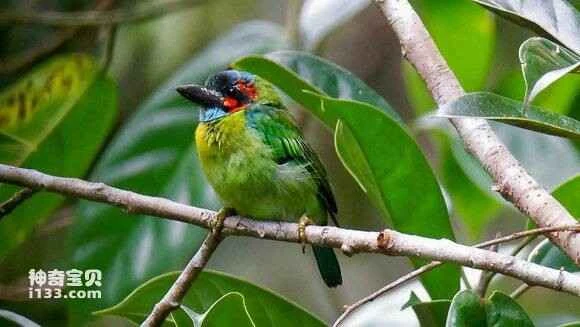
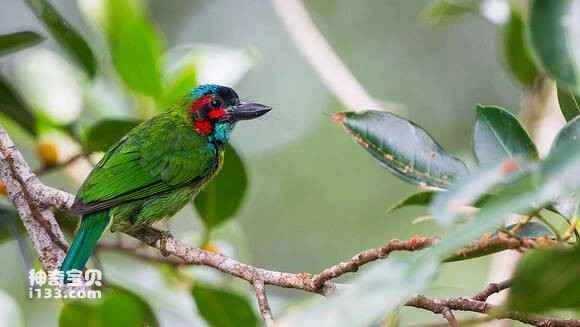
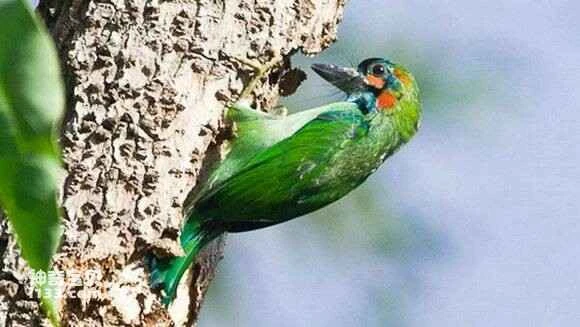
The Blue-eared Barbet has white feathers at the base of its upper beak and nostrils, forming a narrow white band at the base of its forehead. Its forehead and front of the crown are black, with blue markings on the forehead, and blue on the back of the crown; turning dark green towards the nape. The back, shoulders, upper wing surfaces, rump, upper tail coverts, and tail are grass-green. The upper tail is tinged with blue. The primary flight feathers are black with green and ochre-white spots. The lores are a mixture of blue and black; the ear coverts are blue, with a blood-red spot above and below them; there is also a red spot below the eye. The chin and throat are blue, with a black longitudinal stripe between the chin and cheek; a thin black transverse band runs between the throat and breast. The breast, abdomen, and the rest of the underparts are pale grass-green, with some tails tinged with blue.
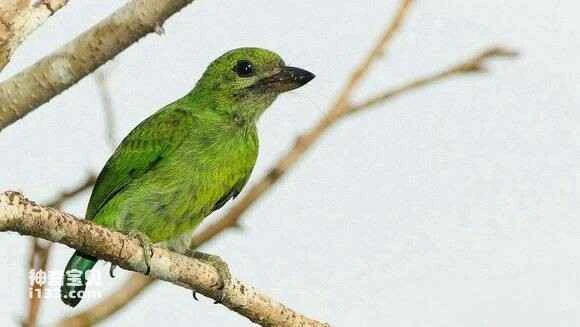
Juvenile blue-eared barbets have entirely blue heads. Otherwise, they resemble adults.
The blue-eared barbet has a dark brown or reddish-brown iris, brown beak corners, a yellowish-green base and mouth cleft, a black tip, and dark green or yellowish-green feet and toes.
Size measurements: body length 170 mm, bill 18-21 mm, wing 77-85 mm, tail 45-50 mm, tarsus 21 mm.
Detailed introduction
The Blue-eared Barbet, scientifically known as *Psilopogon cyanotis* or *Megalaima australis*, has seven subspecies: 1. Nominate subspecies: *Psilopogon cyanotis australis*; 2. Yunnan subspecies: *Psilopogon cyanotis cyanotis*; 3. Malayan subspecies: *Psilopogon cyanotis duvaucelii*; 4. Sumatran subspecies: *Psilopogon cyanotis gigantorhina*; 5. Southeast Asian subspecies: *Psilopogon cyanotis orientalis*; 6. Batu Island subspecies: *Psilopogon cyanotis tanamassae*; 7. Burmese subspecies: *Psilopogon cyanotis stuarti*. Blue-eared barbets are usually solitary or in pairs. When resting, they often perch on horizontal branches at the top of high trees, constantly emitting a loud call. Their calls are varied and rapid, but they are almost silent in winter. They mainly feed on plant fruits and seeds, but also eat some insects and insect larvae.
The Blue-eared Barbet breeds from April to June. They typically nest in evergreen broad-leaved forests at the foot of mountains below 1000 meters in altitude, sometimes also nesting in burrows in trees at forest edges and along ground edges. Each clutch contains 2-4 eggs, with a 3-4 day interval between laying the second and third eggs. The eggs are oblong or broadly oval in shape, white in color, and measure 22-27 × 17-20 mm. Both parents take turns incubating the eggs. At night, both parents roost in the nest burrow. The chicks are altricial.
The population of the blue-eared barbet is extremely small.
It is listed in the "List of Terrestrial Wild Animals of Beneficial or Important Economic and Scientific Research Value under State Protection" issued by the State Forestry Administration of China on August 1, 2000.
Listed as Least Concern (LC) on the IUCN Red List of Threatened Species (IUCN 2016 ver 3.1).
Protect wild animals and ban the consumption of wild game.
Maintaining ecological balance is everyone's responsibility!