
Basic Information
Scientific classification
- Chinese name: Chinese Woodpecker
- Scientific name: Chinese Barbet, Black-browed Barbet, Psilopogon oorti, Megalaima faber
- Classification: Climbing birds
- Family and genus: Entomomorpha, Pterygomorphaceae, Pterygomorpha
Vital signs data
- Body length: 19-24 cm
- Weight: 69-118g
- Lifespan: No verification data available.
Significant features
With thick, dark eyebrow lines
Distribution and Habitat
The Chinese woodpecker is distributed in Guangxi, Hainan Island and Taiwan within China; outside of China, it is distributed in Laos, the Indochina Peninsula, Indonesia and Malaysia.
The Chinese woodpecker mainly inhabits evergreen broad-leaved forests and secondary forests in low and medium mountains and plains at the foot of mountains below 2,500 meters in altitude.
Appearance
The Chinese Barbet has a red forehead, or a black forehead and crown, a vermilion nape (Hainan subspecies), or a yellow forehead and a blue crown (Taiwan subspecies). It has black stripes in front of its eyes, black eyebrows, and red spots on the lores (Hainan and Taiwan subspecies). The sides of the neck and ear coverts are blue, while the nape, back, rump, and tail are green. The flight feathers are black with faint blue edges on the outer webs and egg-yolk yellow edges on the inner webs. The chin and upper throat are golden yellow, while the lower throat and sides of the neck are blue, forming a blue neck ring with a bright red patch or band below it. The breast, abdomen, and the rest of the underparts are pale yellowish-green. The iris is reddish-brown, the bill is thick and lead-black, and the legs are dark gray.
Size measurements: Weight ♂ 85-118 g, ♀ 69-118 g; Body length ♂ 207-246 mm, ♀ 199-245 mm; Bill length ♂ 25-28 mm, ♀ 24-28 mm; Wing length ♂ 98-110 mm, ♀ 94-106 mm; Tail length ♂ 57-75 mm, ♀ 58-75 mm; Tarsus length ♂ 26-29 mm, ♀ 24-29 mm.
Detailed introduction
The Chinese Barbet (scientific name: *Psilopogon oorti*, *Megalaima faber*) has four subspecies: (1. Southern and Central subspecies: *Psilopogon oorti annamensis*; (2. Hainan subspecies: *Psilopogon oorti faber*; (3. Nominate subspecies: *Psilopogon oorti oorti*; (4. Guangxi subspecies: *Psilopogon oorti sini*.)
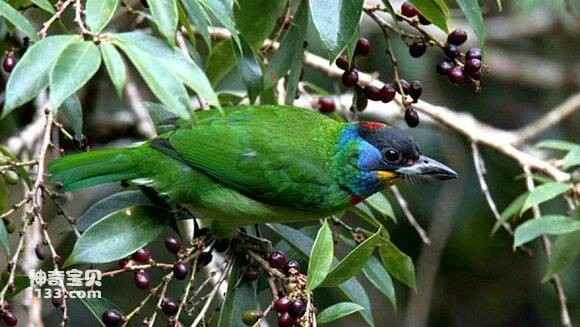
The Chinese woodpecker is a resident bird, usually found alone or in small flocks. It mostly perches in the upper layers or treetops and is not very active. Its flight is clumsy, limited to short distances and unable to sustain prolonged flight. It roosts in tree cavities at night. Its call is monotonous and loud, often repeating a series of calls, sounding like "ga, ga" or "ge, ge, ge," somewhat resembling the sound of a wooden fish drum used by monks chanting sutras. It primarily feeds on plant fruits and seeds, but also consumes small amounts of insects and other animal matter.

The breeding season for the Chinese Barbet is from April to June. They nest in tree cavities, laying three white eggs per clutch.
The Chinese Barbet has a narrow distribution range and a small population in China. In May 2022, a photography enthusiast captured a Chinese Barbet on the summit of Malushan Mountain in Liuzhou City.
It is listed in the "List of Terrestrial Wild Animals of Beneficial or Important Economic and Scientific Research Value under State Protection" issued by the State Forestry Administration of China on August 1, 2000.
Listed as Least Concern (LC) on the IUCN Red List of Threatened Species (IUCN 2016 ver 3.1).
Protect wild animals and ban the consumption of wild game.
Maintaining ecological balance is everyone's responsibility!


