Basic Information
Scientific classification
- Chinese name: Taiwan false woodpecker
- Scientific name: Five-colored bird, Flower Monk, Psilopogon nuchalis, Megalaima nuchalis, Taiwan Barbet
- Classification: Climbing birds
- Family and genus: Entomomorpha, Pterygomorphaceae, Pterygomorpha
Vital signs data
- Body length: Approximately 20 centimeters
- Weight: 51-64g
- Lifespan: No verification data available.
Significant features
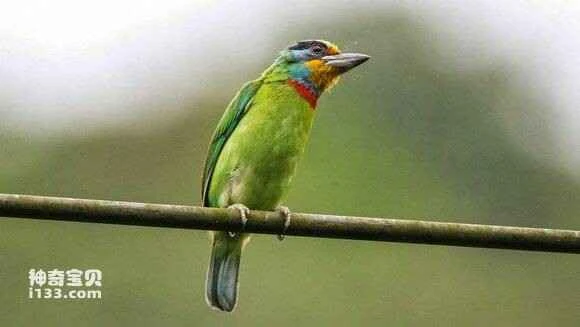
Except for its head and throat, which are yellow, red, blue, and black, its entire body is emerald green, hence it is also known as the Five-Colored Bird.
Distribution and Habitat
The Taiwan woodpecker is found only in Taiwan, China.
The Taiwan woodpecker prefers to live in areas with dense foliage in broad-leaved forests or parks from plains to mid-to-high altitudes, and is also relatively easy to spot in gardens where foliage is less dense.
Appearance
The male and female Taiwan Barbet are identical in appearance. They have a golden-yellow forehead, red lores, a black eyebrow line above the eyes, and a thick, black beak. The crown gradually transitions from yellow to sky blue, the ear coverts and upper neck are sky blue, there is a red patch on the back of the neck, the sides of the neck and back are bright green, and the tail feathers are pale green, with the inner petals of all feathers except the central tail feathers being dark brown. The chin and upper throat are golden-yellow, there are red spots on the upper chest, and the lower chest is bright yellowish-green.
Tarsus and toes are lead-gray.
Size measurements: Weight: ♂ 59~64 g, ♀ 51~64 g; Bill length: ♂ 24~25 mm, ♀ 22~26 mm; Wing length: ♂ 97~101 mm, ♀ 90~98 mm; Tail length: ♂ 60~74 mm, ♀ 62~65 mm; Tarsus length: ♂ 28 mm, ♀ 26~33 mm. (Note: ♂ male; ♀ female)
Detailed introduction
The Taiwan Barbet, scientifically known as *Psilopogon nuchalis* or *Megalaima nuchalis*, is endemic to Taiwan. Originally considered one of the five subspecies of the Black-browed Barbet (*Megalaima oorti*), Feinstein et al. (2008), after analyzing the genetic material of each subspecies using molecular biology techniques, determined it to be endemic to Taiwan and restored the original species name given by Gould (1863).
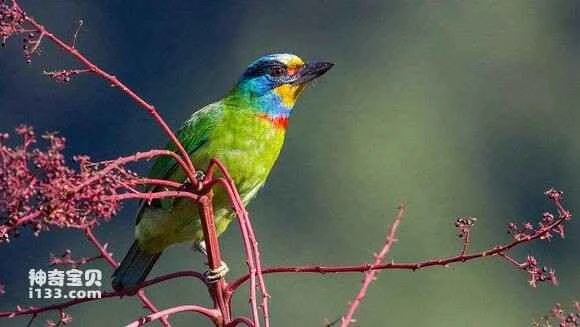
The Taiwan Barbet is a resident bird, unable to fly for extended periods or over long distances, and usually lives alone or in flocks in trees. It feeds on wild fruits, nuts, and small amounts of insects. The Taiwan Bluebird is a generalist and essential fruit-eating animal, and also an opportunistic forager. The higher the forest density or the higher the fruit biomass of a species, the higher the proportion of fruit the Bluebird consumes, with forest density having a greater impact. Furthermore, the Bluebird shows varying degrees of preference for different types of fruit; among the top 15 species consumed most frequently, the Hengchun Chinese bayberry shows the highest preference.
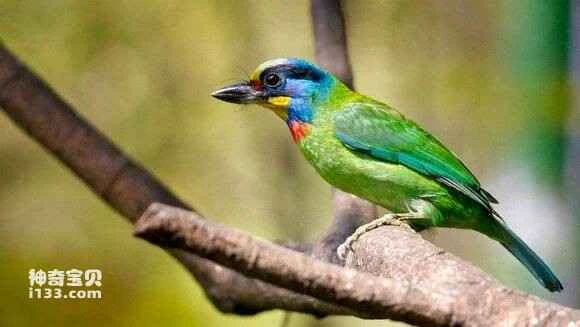
The Taiwan Barbet can combine single notes such as "cluck, cluck, cluck" into approximately four different rhythms and pitch variations in its calls. Its first call at dawn changes depending on the time of sunrise. Additionally, it emits a continuous cooing sound when startled or on alert.
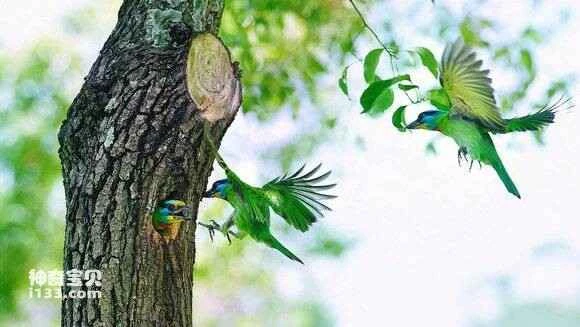
The breeding season for the Taiwan Barn Woodpecker is from March to August, peaking in June and July. They will dig nest holes in trees themselves, utilizing a higher proportion of deadwood. A single suitable tree can have up to 11 nest holes. On Yangmingshan Mountain, nest density ranges from 0.25 to 1.6 nests per hectare. Within an 8.2-hectare area of the Taipei Botanical Garden, 12 trees have nest holes. The task of digging the nest holes appears to be entirely the responsibility of the male. The nest holes are 2 to 13 meters above the ground, averaging 5.82 meters. A pair of adult birds may dig several holes per season, but not every tree hole is used. The branch diameter at the nest hole location is 10 to 37 centimeters, the hole is bag-shaped, 22 to 42 centimeters deep, and the horizontal depth of the hole entrance is 9 to 13 centimeters.
The overall population of the Taiwan woodpecker is not quantified, but it is described as a common species (del Hoyo et al. 2002). There are approximately 10,000 to 100,000 breeding pairs in Taiwan (Brazil 2009).
Listed as Least Concern (LC) on the IUCN Red List of Threatened Species, 2012 assessment.
Protect wild animals and ban the consumption of wild game.
Maintaining ecological balance is everyone's responsibility!