Basic Information
Scientific classification
- Chinese name: Blue-throated Barbet
- Scientific name: Psilopogon asiaticus, Megalaima asiatica, Blue-throated Barbet
- Classification: Climbing birds
- Family and genus: Entomomorpha, Pterygomorphaceae, Pterygomorpha
Vital signs data
- Body length: 19-23 cm
- Weight: 70-90g
- Lifespan: No verification data available.
Significant features
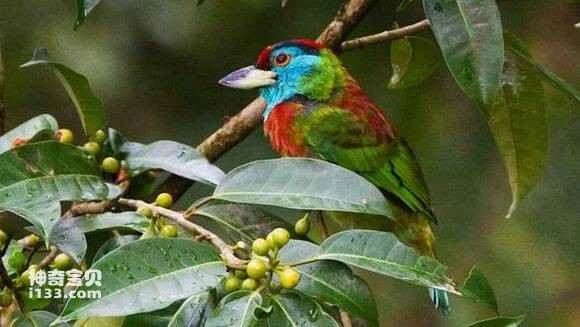
The forehead to the top of the head was bright red, with a broad black horizontal band dividing the red area into two parts.
Distribution and Habitat
Global distribution: Found in China, India, Myanmar, Thailand, Laos, Vietnam, and Indonesia.
Distribution in China: Found in western, central, southern and southeastern Yunnan, as well as Guizhou and Guangxi.
The Blue-throated Barbet mainly inhabits evergreen broad-leaved forests in low and medium mountains, hills, valleys, and plains at the foot of mountains below 2,000 meters in altitude. It also appears on trees at forest edges and near villages.
Appearance
The Blue-throated Barbet has a scarlet forehead, which turns golden yellow, with a blue or black horizontal band on the crown; a scarlet nape, and the front of the crown and the base of the lower beak are also scarlet; there is also a scarlet spot on each side of the lower throat. There is a black longitudinal stripe on each side of the red crown; the supercilium, sides of the head, chin, and throat are bright copper-blue. The upperparts are grass-green, with a brighter nape; the back and shoulders are tinged with olive yellow, and the wings are blackish-brown, but the upper surface of the wings is also grass-green and darker than the back. The outer coverts are tinged with blue, the primary flight feathers are black, except for the first and second primary flight feathers, the outer webs of the remaining primary flight feathers are blue-green at the base and pale yellow at the tip; the tail feathers are dark grass-green, and the breast, abdomen, and other underparts are pale yellowish-green with a slight copper-blue tinge.
The iris is brown or reddish-brown, the bare skin around the eyes is orange, the corners of the mouth are brown or horn-green with a nearly black tip and a pale yellow base, the feet and toes are grayish-green or yellowish-green, and the claws are black.
Size measurements: Weight ♂ 70-87 g, ♀ 70-90 g; Body length ♂ 199-231 mm, ♀ 205-227 mm; Bill length ♂ 22-25 mm, ♀ 23-26 mm; Wing length ♂ 100-106 mm, ♀ 99-104 mm; Tail length ♂ 68-76 mm, ♀ 62-75 mm; Tarsus length ♂ 24-27 mm, ♀ 24-26 mm.
Detailed introduction
The Blue-throated Barbet, scientifically known as *Psilopogon asiaticus* or *Megalaima asiatica*, has three subspecies: 1. the nominate subspecies *Psilopogon asiaticus asiatica*; 2. the Yunnan subspecies *Psilopogon asiaticus davisoni*; and 3. the Thai subspecies *Psilopogon asiaticus chersonesus*.
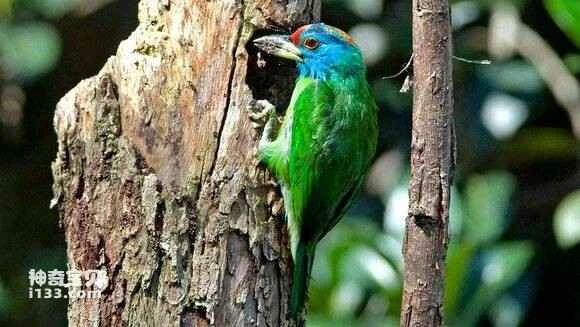
Blue-throated barbets are usually solitary or in pairs, but occasionally seen foraging in small groups, especially in areas with abundant food. After feeding, they often hide among the branches and leaves of trees, constantly emitting a clear and loud call, "Godoro, Godoro, Godoro." Their diet consists mainly of plant matter such as the fruits, seeds, and flowers of banyan and other trees, but they also eat small amounts of insects and other animal matter.
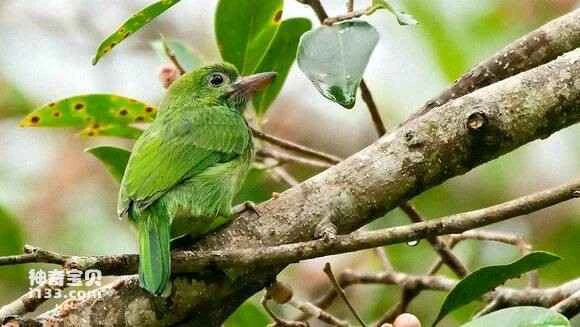
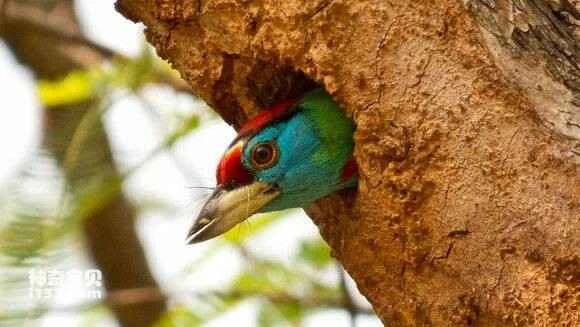
The Blue-throated Barbet's breeding season is from April to June. They typically nest in dense forests, but sometimes also in trees along forest edges with sparse trees or near farmland. The nests are burrows, dug by the parents themselves, usually in dead or decaying trees. The burrow entrance is 3-15 meters above the ground. Each clutch contains 3-4 eggs, sometimes up to 5. The eggs are white, measuring 27-30 mm × 19-22 mm. Both parents incubate the eggs; the chicks are altricial.
The Blue-throated Barbet has a small distribution area and is not widespread in China.
It is listed in the "List of Terrestrial Wild Animals of Beneficial or Important Economic and Scientific Research Value under State Protection" issued by the State Forestry Administration of China on August 1, 2000.
Listed as Least Concern (LC) on the IUCN Red List of Threatened Species (IUCN 2016 ver 3.1).
Protect wild animals and ban the consumption of wild game.
Maintaining ecological balance is everyone's responsibility!