Basic Information
Scientific classification
- Chinese name: Common Kingfisher
- Scientific names: Goby, Kingfisher, Golden Bird, Great Kingfisher, Blue Kingfisher, Alcedo atthis, Common Kingfisher, European Kingfisher, Kingfisher, Martin-pêcheur d'Europe, رفراف شائع
- Classification: Climbing birds
- Classification and genus: Order Coraciiformes, Family Kingfisher, Genus Kingfisher
Vital signs data
- Body length: 15.3-17.5 cm
- Weight: 23-36g
- Lifespan: No verification data available.
Significant features
It is a common small bird, and because of its simple and unremarkable appearance, it is called "common".
Distribution and Habitat
Breeding grounds: Afghanistan, Armenia, Bangladesh, Bhutan, Bosnia and Herzegovina, Cambodia, China, Georgia, India, Indonesia, Japan, Kazakhstan, South Korea, North Korea, Kyrgyzstan, Laos, Malaysia, Mongolia, Montenegro, Myanmar, Nepal, Norway, Pakistan, Papua New Guinea, Russia, Serbia, Solomon Islands, Sri Lanka, Tajikistan, Thailand, Turkmenistan, Uzbekistan, and Vietnam.
Seasonal uncertainty: Macau, China.
Resident birds: Albania, Algeria, Andorra, Austria, Azerbaijan, Belarus, Belgium, Brunei, Bulgaria, Croatia, Cyprus, Czech Republic, Denmark, Egypt, Estonia, Finland, France, Germany, Greece, Hungary, Iran, Iraq, Ireland, Israel, Italy, Jordan, Kuwait, Latvia, Lebanon, Libya, Liechtenstein, Lithuania, Luxembourg, Moldova, Morocco, Netherlands, North Macedonia, Philippines, Poland, Portugal, Romania, Singapore, Slovakia, Slovenia, Spain, Sweden, Switzerland, Syria, East Timor, Tunisia, Turkey, Ukraine, UAE and United Kingdom.
Non-breeding areas: Bahrain, Gibraltar, Malta, Oman, Palestine; Qatar, Saudi Arabia, and Sudan.
Wandering (non-breeding grounds): Yemen.
Wandering: Guam and Maldives. Origin uncertain: Micronesia and Palau.
They inhabit waterways such as streams, creeks, lakes, and irrigation canals with shrubs or sparse forests and clear, slow-flowing water. They mainly inhabit forest streams, plain valleys, reservoirs, ponds, and even the banks of paddy fields.
Appearance
The male common kingfisher has a dark green forehead, crown, nape, and hindneck, densely covered with narrow, turquoise-blue horizontal bars. The lores and eye stripe are dark brown. The sides of the forehead, cheeks, behind the eyes, and ear coverts are chestnut-reddish-brown, with a white spot behind the ear. The malar stripe is turquoise-greenish-black, and the back to the upper tail coverts is bright turquoise-blue. The tail is short, dark blue-green on the surface and dark brown on the underside. The shoulders are blue-green, and the flight feathers, except for the first primary feather which is entirely dark brown, are dark brown, with dark blue edges on the outer webs. The wing coverts are also dark blue with turquoise-blue markings; when the wings are folded, the surface is blue-green. The chin and throat are white, the breast is greyish-brown, and the belly to the undertail coverts are reddish-brown or chestnut-brown, sometimes paler in the center.
The female's upperparts are slightly paler than the male's, mostly blue with less green. The crown is grayish-blue rather than greenish-brown. The breast and abdomen are reddish-brown, but paler than the male's, and the breast lacks gray. Juveniles have paler plumage, less blue sheen on the upperparts, paler underparts with more brown tinge, and a dirty white center on the abdomen.
The iris is brownish-brown, the mouth is black, the feet and toes are vermilion, and the claws are black.
Size measurements: Weight: ♂ 24-32 g, ♀ 23-36 g; Body length: ♂ 153-175 mm, ♀ 159-175 mm; Bill length: ♂ 32-40 mm, ♀ 35-41 mm; Wing length: ♂ 67-74 mm, ♀ 68-74 mm; Tail length: ♂ 30-36 mm, ♀ 31-37 mm; Tarsus length: ♂ 8-11 mm, ♀ 8-12 mm. (Note: ♂ male; ♀ female)
Detailed introduction
The common kingfisher, scientifically known as *Alcedo atthis*, also called Common Kingfisher, European Kingfisher, Kingfisher, Martin-pêcheur d'Europe, has seven subspecies: 1. the nominate subspecies *Alcedo atthis atthis*; 2. the common subspecies *Alcedo atthis bengalensis*; 3. the East Timor subspecies *Alcedo atthis floresiana*; 4. the Sulawesian subspecies *Alcedo atthis hispidoides*; 5. the European subspecies *Alcedo atthis ispida*; 6. the Solomon Islands subspecies *Alcedo atthis salomonensis*; and 7. the South Asian subspecies *Alcedo atthis taprobana*.
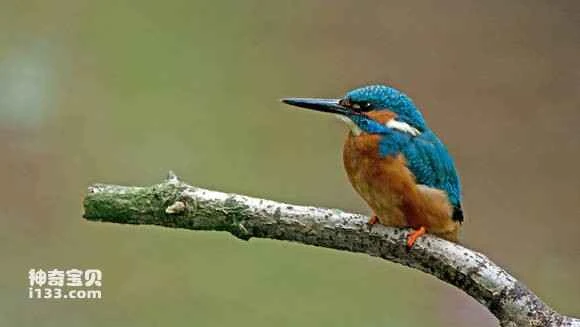
The common kingfisher is a resident bird. It usually lives alone, generally perching on tree stumps and rocks along riverbanks, and sometimes on the low branches of small trees near the river. It often stares motionlessly at the water's surface for long periods, and upon spotting fish or shrimp, it immediately plunges into the water with extreme speed and ferocity to catch them with its beak. Sometimes it also hovers in the air, flapping its wings and looking down at the water's surface; upon seeing prey, it immediately dives in and quickly captures it. It usually carries its prey back to its roost, beats it on branches or rocks until the fish dies, and then eats it whole. Sometimes it also flies low and straight along the water's surface at very high speeds, often calling out as it flies.
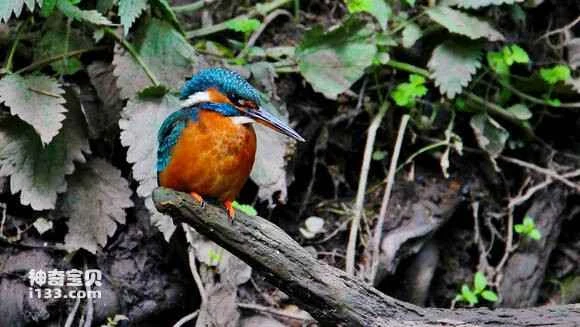
The breeding season for the common kingfisher is from May to August. They typically nest in burrows dug into steep earthen or sandstone cliffs near water's edge. The burrows are circular, tunnel-like, with an entrance diameter of 5-8 cm and a depth of 50-70 cm. The end of the burrow widens into a nest chamber 10-15 cm in diameter and 10 cm high, without any lining, only some loose sand. They breed once a year, laying 5-7 eggs per clutch. The eggs are nearly round or oval, white, smooth, and spotless, measuring 20-21 mm × 17-19 mm and weighing 3.2-4.0 grams. Both parents take turns incubating the eggs for 19-21 days. The chicks are altricial, and after hatching, they are cared for by their parents for 23-30 days before leaving the nest to fly.

The global population of the common kingfisher is estimated to be less than 600,000 individuals (2001). European populations are estimated at 97,500–167,000 pairs, equivalent to 195,000–334,000 mature individuals (2015). Europe accounts for approximately 25% of the global population; therefore, a preliminary estimate of the global population size is 780,000–1,340,000 mature individuals, although further validation is needed. Total population estimates include: approximately 100–100,000 breeding pairs in China, approximately 50–10,000 migratory individuals, and 10,000–100,000 breeding pairs. Approximately 10,000–100,000 breeding pairs in Taiwan; approximately 100–10,000 breeding pairs and 50–1,000 individuals in South Korea; approximately 10,000–100,000 breeding pairs and 50–1,000 individuals in Japan; and approximately 100–100,000 breeding pairs and 50–10,000 individuals in Russia (2009). In Europe and the EU27, the estimated species size has decreased by 30–49% over 13.2 years (three generations) (BirdLife International 2015). Population trends elsewhere are unknown.

Listed as Least Concern (LC) in the IUCN Red List of Threatened Species 2016 ver3.1.
It is listed in China's National List of Terrestrial Wild Animals with Important Ecological, Scientific and Social Value.
Protect wild animals and ban the consumption of wild game.
Maintaining ecological balance is everyone's responsibility!