Basic Information
Scientific classification
- Chinese name: American Nighthawk
- Scientific name: Common Nighthawk (Chordeiles minor)
- Classification: Climbing birds
- Genus and family: Order Noctuidae, Family Noctuidae, Genus *Hemiberlesia*
Vital signs data
- Body length: 15-40 cm
- Weight: 25-120g
- Lifespan: Approximately 20 years
Significant features
Its plumage is mottled, primarily in shades of brown, light yellow, cinnamon, gray, and black, providing excellent camouflage.
Distribution and Habitat
Distributed in Anguilla, Antigua and Barbuda, Argentina, Aruba, Bahamas, Barbados, Bermuda, Plurinational State of Bolivia, Bonaire, Saint Eustachians and Saba, Brazil, Cayman Islands, Colombia, Cuba, Dominica, Dominican Republic, Ecuador, Guadeloupe, Guatemala, Haiti, Honduras, Jamaica, Martinique, Mexico, Montserrat, Nicaragua, Panama, Paraguay, Peru, Puerto Rico, Saint Kitts and Nevis, Saint Lucia, Saint Martin (French part), Saint Pierre and Miquelon, Saint Vincent and the Grenadines, Saint Martin (Dutch part), Turks and Caicos Islands, and Bolivarian Republic of Venezuela.
The American nightjar has low requirements for its habitat, which includes forests (temperate, subtropical, and tropical humid mountains), grasslands (temperate, subtropical, and tropical seasonal humid grasslands), wetlands (inland swamps and peatlands), intertidal zones (sandy coasts, beaches, sandbars, and pebble coasts), coastal areas (coastal dunes), and land (fields, pastures, and urban areas).
Appearance
The American Nightjar resembles a large, soft moth, measuring 15-40 cm in length and weighing 25-120 grams. Its plumage is mottled, primarily brown, pale yellow, cinnamon, gray, and black, providing excellent camouflage. The tail and head have spots; relatively conspicuous white or black-and-white spots are generally hidden under the folded wings and the inside of the tail or on the upper throat, but the male displays them during a show. The wings are long and pointed, and the tail is long and broad. Females typically differ from males in that they have less white on their wings and head. The American Nightjar has a very wide beak, capable of swallowing large moths whole, and lacks bristles around the base of the beak.
Detailed introduction
The Common Nighthawk, scientifically known as *Chordeiles minor*, has nine subspecies. In Louisiana, USA, this species is called "flying toad" by descendants of French immigrants; while in Virginia, they are called "bat." However, the most common name is "nighthawk."
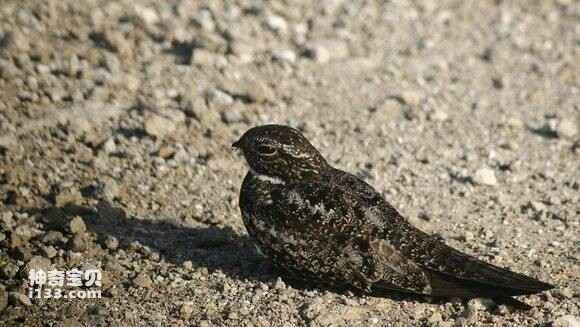
American nightjars are almost unable to walk on the ground because of their small size and particularly far-set legs. Therefore, they cannot stand upright and often rest chest-to-chest or lean against a tree branch, thus they perch sideways when in trees. However, they can easily fly down, perching on branches or fences, and sometimes even landing on rooftops or root sheds.
The American nightjar's flight is smooth, light, and remarkably long; it can fly all day even in dim, cloudy weather. It remains in sight for most of the day, even on clear, sunny days, before returning to its nest to rest shortly after dusk.
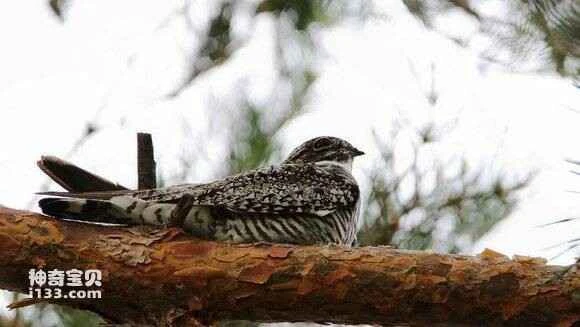
Around April 1st, American nightjars appear in the low-lying areas of Louisiana, continuing their eastward migration. Their return from the central states varies depending on seasonal temperature changes, beginning around August 15th and lasting until the end of October. Their migration covers a wide area, flying across much of the United States, from the Mississippi River estuary to the Rocky Mountains, from the south to beyond the eastern border. Finally, American nightjars breed and disperse throughout the western and eastern states, from South Carolina to Maine.
The diet of the American Nightjar consists mainly of various insects, especially beetles, but they also prey on moths and caterpillars, and are particularly adept at catching crickets and locusts. When flying swiftly at low altitudes, close to the water's surface, they will occasionally sip water, drinking in a manner similar to that of a swallow. They possess a loud, repetitive call, and the male will emit a whistle.
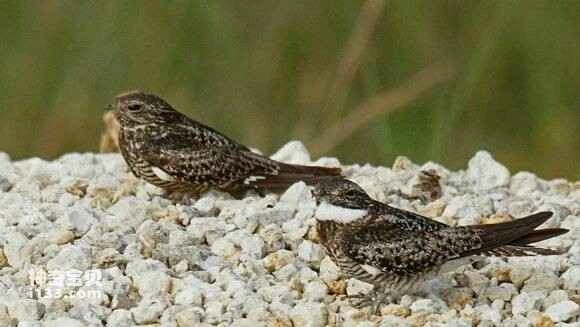
The male American Nightjar swoops down from a high altitude over the breeding grounds, then swoops back up very close to the female. During this descent, the soft inner feathers of some of its wing feathers produce a rumbling sound due to the airflow—a courtship behavior. The American Nightjar lays two eggs. They are not particularly particular about their nesting sites. The eggs are almost oval and speckled. Some are laid on bare ground, some on the edges of cultivated fields, and some even on bare rocks. Sometimes they will lay their eggs on bare or open ground outside the forest, but they never lay them deep within the forest.
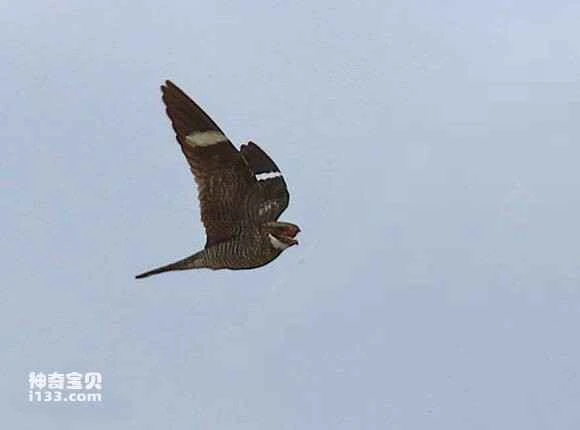
American nightjars never build nests. For a period, the chicks are covered in soft, dark brown down, providing excellent camouflage. If the female is disturbed during incubation, she will attempt to escape, feigning lameness, flapping her wings, and struggling until she is certain you have ignored her eggs or chicks. She will then fly away and only return after you have left. However, if well-hidden, it is difficult to spot her even if you are less than a meter away from her eggs. During incubation, both the male and female take turns nesting. Once the chicks reach a certain size, they no longer need food from their parents, who will then usually come to a nearby location and quietly perch on a fence, railing, or tree.
In 2016, it was listed as Least Concern (LC) on the IUCN Red List of Threatened Species.
Protect wild animals and ban the consumption of wild game.
Maintaining ecological balance is everyone's responsibility!