Basic Information
Scientific classification
- Chinese name: Great Forest Owl
- Scientific name: Nyctibius grandis, Great Potoo
- Classification: Climbing birds
- Family: Nighthawks, Wood Owls, Corinthus
Vital signs data
- Body length: No verification information available.
- Weight: No verification information available.
- Lifespan: No verification data available.
Significant features
Distribution and Habitat
It is distributed in Central America, including Guatemala, Belize, Honduras, El Salvador, Nicaragua, Costa Rica, Panama, the Bahamas, Cuba, Haiti, Jamaica, Dominican Republic, Antigua and Barbuda, Saint Vincent and the Grenadines, Saint Lucia, Barbados, Grenada, Trinidad and Tobago, and other countries and regions; South America, including Colombia, Venezuela, Guyana, Suriname, Ecuador, Peru, Bolivia, Paraguay, Brazil, Chile, Argentina, Uruguay, and the Falkland Islands; and also in tropical Asia.
Appearance
This bird has many feathers around its eyes, and its body patterns are mainly brown, making it look like a piece of dead wood.
Detailed introduction
The Great Potoo, scientifically known as *Nyctibius grandis*, has two subspecies.

The Great Woodcock is a nocturnal animal, only coming out at night to forage, while sleeping soundly in a secluded spot during the day. Its call sounds like a ghostly wail; there was a funny incident in Colombia where a woman was frightened by a Great Woodcock.
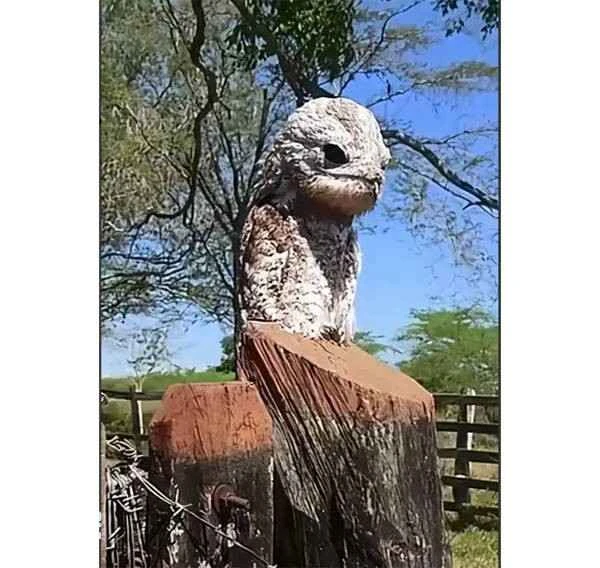
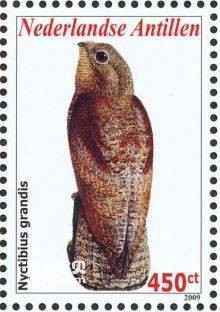
To date, two countries and regions in the world have issued a total of three stamps featuring owls: two stamps featuring the Great Owl and one stamp featuring a regular owl. The Great Owl stamps were issued by Suriname on January 31, 2001, and by the Dutch Antilles on April 20, 2009.
Protect wild animals and ban the consumption of wild game.
Maintaining ecological balance is everyone's responsibility!