Basic Information
Scientific classification
- Chinese name: Australian petrel
- Scientific name: Puffinus huttoni, Hutton's Shearwater, Pardela de Hutton
- Classification: Waterfowl
- Family and genus: Procellariiformes, Procellariiidae, Procellarii
Vital signs data
- Body length: Approximately 38 centimeters
- Weight: 242-378g
- Lifespan: No verification data available.
Significant features
It is a medium-sized brown and white seagull.
Distribution and Habitat
The Australian petrel breeds in the Seaward Kaikoura Range in the northeastern part of New Zealand's South Island. This includes two main settlements located 10–18 km inland: Kowhai Valley and Shearwater Stream. Population and distribution within the Kaikoura Range have declined; eight of the ten known settlements in the 21st century are now extinct (Cuthbert 1999). Six of the eight settlements found in the Upper Kaikoura Range are likely extinct due to wild boar, which still pose a potential threat to the remaining two settlements (Harrow 2009). A third population on the Kaikoura Peninsula has been established through chick translocation due to detected rapid extinction of bee colonies (Anon 2007, Ombler 2010). Outside the breeding season, the birds migrate to waters near southern, western, and northwestern Australia.
This species inhabits burrows dug on gentle to steep slopes, under grass, or under low alpine shrubs at altitudes of 1,200–1,800 meters. From September to March of the following year, the Australian shelduck is found in nearshore waters near Kaikoura.
Appearance
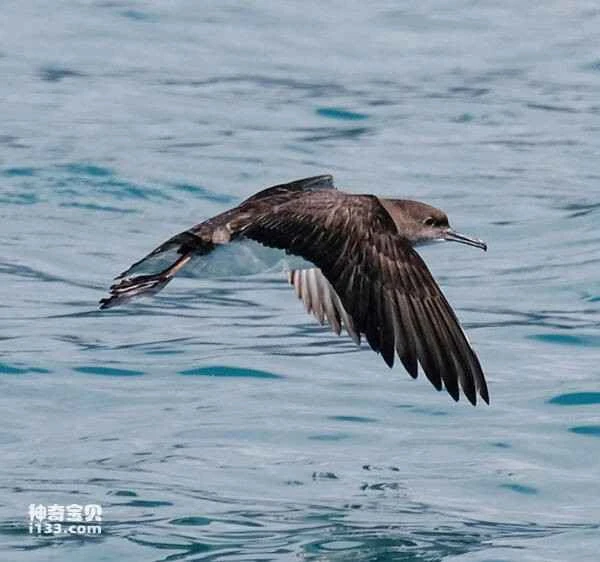
The Australian petrel is 38 cm in length, with a wingspan of 72-78 cm and a weight of 242-378 grams. It is a medium-sized brownish-white gull, typically black on top and white on the bottom. They have a uniformly dark brown head and upper body. A broad, dark, mottled collar stripe extends from the neck down to the chin and throat, contrasting sharply with the rest of the white underparts. The greyish-white underwings blend into the dark border, particularly at the wingtips and the distinctly dark "armpits." Brown patches are present on the sides of the chest and thighs. The underwings are grey with a dark brown trailing edge. The beak is long and slender, and dark grey. The iris is black, and the legs and feet are pink to brown with dark webbed feet. In flight, the feet extend beyond the tail.
Detailed introduction
The Australian Shearwater (scientific name: Puffinus huttoni), also known as Hutton's Shearwater or Pardela de Hutton, has no subspecies.
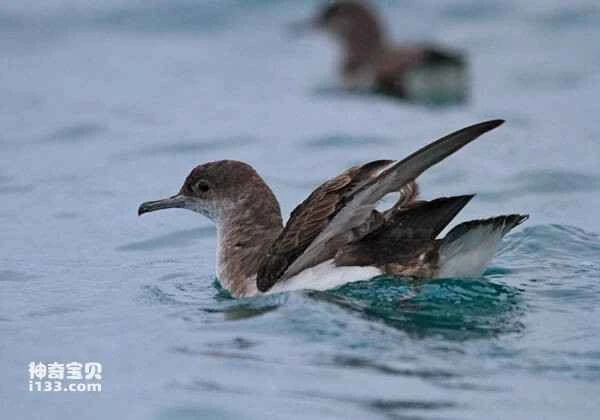
During the summer breeding season, flocks of Australian shearlings gather off the coast of Kaikoura, visible both on land and at sea. These birds fly in groups close to the water's surface to feed or rest. A flock of foraging birds may include those that dive to hunt crustaceans at the surface, and those that fly low to dive into the water in search of small fish. These dives, propelled by partially folded wings, can take the birds to depths of 20-30 meters. Breeding birds fly in and out of their alpine colonies under the cover of darkness. Birds arriving early in the season often find the flocks covered in snow, but later in the year, the colonies become warmer and drier. Non-breeding birds are frequently found in the waters surrounding Australia.
The Australian petrel primarily feeds on small fish and krill. They forage for chicks as far south as the Otago Peninsula and frequently fish near the Banks Peninsula bay. Kapiti Island and the Cook Strait are common foraging areas in the north, and foraging individuals have also been recorded near the Chatham Islands. Australian petrels often dive to depths of about 25 meters to forage, with records showing depths reaching up to 36.6 meters. Studies indicate that adult Australian petrels forage 100-300 km south of Kaikoura and 250 km offshore. Foraging trips average 7 days, with an average diving depth of 4.7 meters. They are generally quiet at sea, but noisy in their habitat and overhead, emitting a loud, cawing call similar to that of the brown-billed petrel.
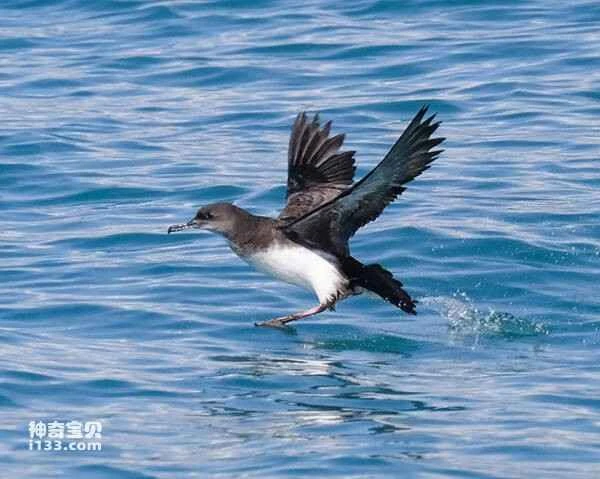
The Australian petrel breeds on steep, grassy slopes with deep, brittle soil. Burrow density varies across subpopulations, averaging 0.5 burrows per square meter. Peak egg-laying occurs in early November, with an incubation period of 50 days. Chicks are raised for a longer period than other species in the genus, averaging 83 days before hatching. This may be due to limited food availability or the energy costs associated with breeding at high altitudes of up to 1200 meters.
It is well known that introduced stoats prey on burrowing seabirds, and the continued presence of the Australian petrel in two remaining communities is a major concern for the species' future survival (Sherley 1992RH). Initially, the stoat was considered the primary cause of the species' decline; however, long-term studies have shown that only a small fraction of adults are captured, and the impact on reproductive success is likely negligible. Predation and disturbance by wild boars and wildcats are considered major potential threats, but they are generally not present within the breeding range. Habitat destruction and predation by domestic pigs, along with the large-scale foraging by a range of introduced herbivores, are likely the cause of the complete destruction of some subpopulations, significantly contributing to habitat loss and range shrinkage. During 1998–1999, at least one domestic cat was present in the Khoai Valley community, but no cats were present in that community, so cats appear to have only occasionally contributed to the species' mortality.
Accidental catches by fixed nets and nearshore longline fishing have also been reported, with up to 80 Australian petrels caught in a single net (Harrow 2009). Furthermore, long-term overfishing of certain nearshore fish species could impact prey availability for the Australian petrel and potentially have serious consequences (Taylor 2000). Models indicate that populations are most vulnerable to losses of breeding adults; therefore, maintaining high survival rates is crucial (Cuthbert et al., 2001).
Juvenile Australian petrels are banned from flying due to light pollution; however, the proportion of birds affected remains below 1% on average each year, and 80% of stranded juveniles are rescued and subsequently released (Deppe Man, 2017).
Due to its limited geographical distribution, climate change poses a potential threat to this species; its altitudinal distribution lies entirely within the range of the highest mountain peak (2,885 meters) and below 2,000 meters. Breeding at high altitudes also makes the species vulnerable to adverse effects from abnormal snowfall amounts or timing; heavy snow can collapse burrows, while later snow accumulation can delay or prevent breeding (Taylor 2000).
Listed as Endangered (EN) in the IUCN Red List of Threatened Species 2019 ver3.1.
Protect wild animals and ban the consumption of wild game.
Maintaining ecological balance is everyone's responsibility!