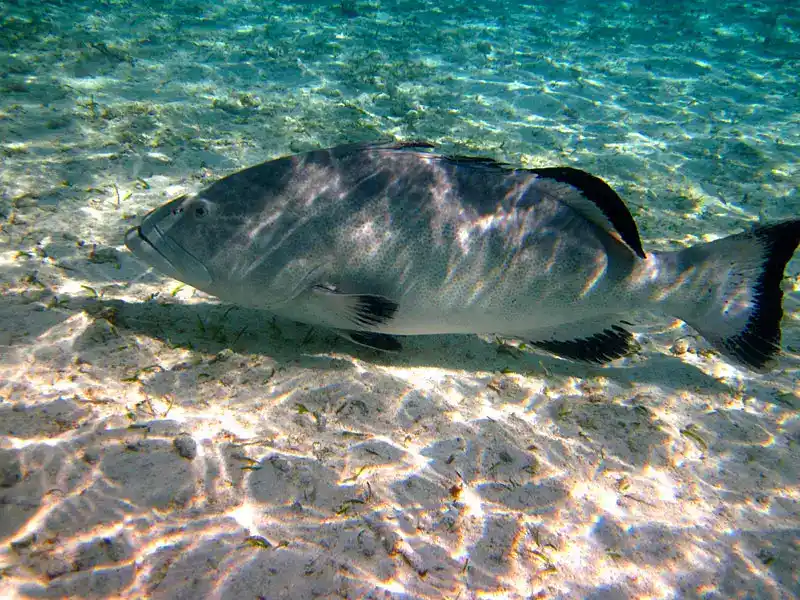
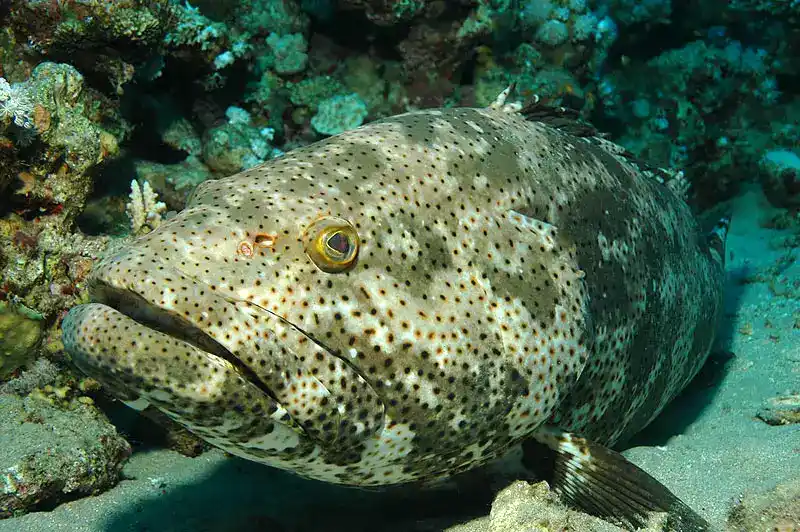
Basic Information
Scientific classification
- Chinese name: grouper
- Scientific name: Epinephelus sp.
- Classification: Medium-sized fish
- Family and Genus: Serranidae Epinephelus
Vital signs data
- Body length: Mostly 30–120 cm; large ones can reach 200 cm+
- Weight: Mostly 1–30 kg; giants can reach tens/hundreds of kg
- Lifespan: Approximately 10–40 years or more (depending on the species)
Significant features
They are benthic predators that ambush prey on others; females lay eggs before males; they spawn in seasonal groups; they mature late, have long lifespans, and are sensitive to fishing.
Distribution and Habitat
Hard-bottomed environments such as coral reefs and rocky reefs in the tropical and subtropical oceans; a few mangrove forests at river mouths.
Appearance
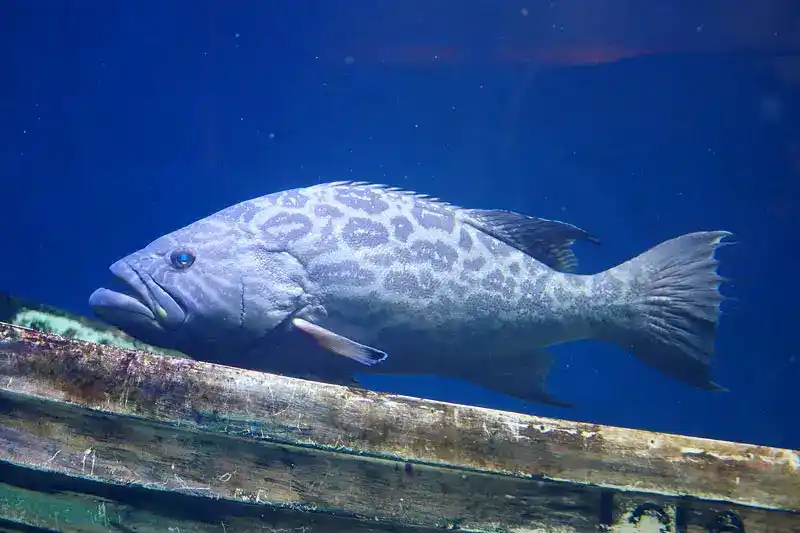
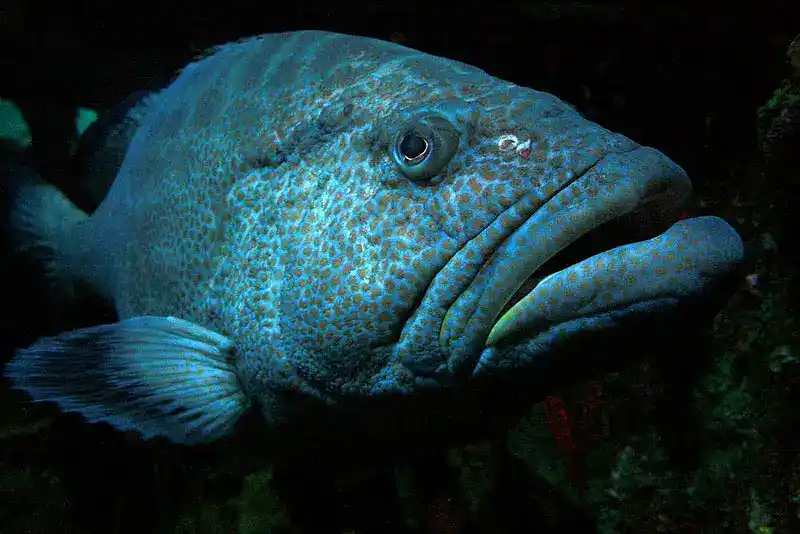
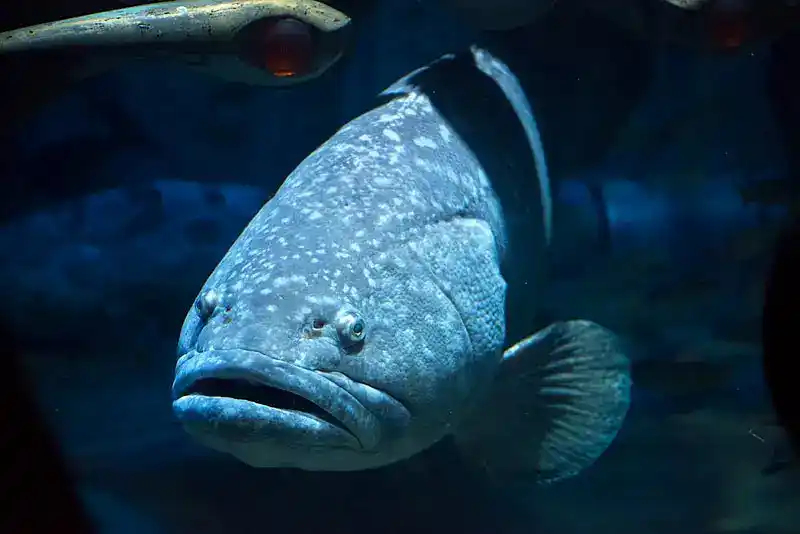
Robust body shape, large mouth with protruding lower jaw; spots/patches/reticulations on the sides; spines and soft rays on the dorsal fin.
Detailed introduction
Grouper ( Epinephelus ) belongs to the family Serranidae in the suborder Perciformes. It is one of the most representative benthic large predatory fish groups in tropical and subtropical waters, commonly known as "stone grouper," "scalloped grouper," or "spotted fish." Most members of this genus inhabit nearshore reefs and rocky reefs , and have both high economic value and an important ecological role.
Ecology and Biology
Diet: A typical ambush predator , feeding on fish, crustaceans, and cephalopods.
Reproduction: Mostly hermaphrodites that reproduce by female-to-male birth ; they often reproduce in seasonal egg-laying colonies .
Behavior: They seek shelter in caves/crevices and are active at dawn/dusk; some species exhibit clear territoriality .
Growth: Growth rate and size vary greatly, ranging from medium to giant (such as giant grouper); they generally mature late and have a long lifespan .
Morphology and Recognition
The body is robust, spindle-shaped to elongated oval , with a large mouth and a protruding lower jaw; spots/patches/reticulations are commonly seen on the trunk; the dorsal fin has spines and soft rays , and the caudal fin is rounded or truncate. Species identification requires combining characteristics such as body coloration and markings, scale count, fin pattern, and the spines on the lower jaw and preopercle .
Body size and lifespan
Body length: Mostly 30–120 cm ; larger species can reach 200 cm+ .
Weight: Mostly 1–30 kg ; giant species can reach tens to hundreds of kilograms .
Lifespan: Commonly 10–40 years or more (depending on species).
Distribution and Habitat
Widely distributed in the tropical to subtropical Atlantic, Indian and Pacific Oceans , primarily in hard-bottom environments such as coral reefs, rocky reefs, shipwrecks and continental shelf edges , with a few invading mangrove/estuary areas.
Human interaction and management
Fisheries and aquaculture: This genus has high economic value; overfishing and spawning mass capture will lead to resource depletion.
Key management points: It is recommended to implement minimum body length restrictions, fishing bans/restrictions on fishing gear during the breeding season, marine protected areas and catch quotas ; trace sources and prevent illegal trade.
IUCN: This article is a genus-level overview , and the assessments of different species vary greatly (LC–EN, etc.); the overviews at this site are marked as unassessed (NE) .
Frequently Asked Questions
Q1: How to distinguish it from sea bream or snapper? Grouper has a more robust body, a larger head and a wider mouth, and a slightly protruding lower jaw; the front half of the dorsal fin has hard spines, and round spots/nets are commonly seen on the sides of the body.
Q2: Why is fishing often best at dusk? Many groupers are active predators at twilight , and they are more likely to leave their burrows to forage at this time.
Q3: Is it safe to eat? There is a risk of ciguatera poisoning in some tropical waters. Local health and fisheries advice should be followed (this is a science tip, not medical advice).
Q4: Why should we protect spawning colonies? Most of the species in this genus lay their eggs in groups, with the females laying eggs first and the males later . Capturing these colonies would quickly weaken their ability to replenish their supplies.