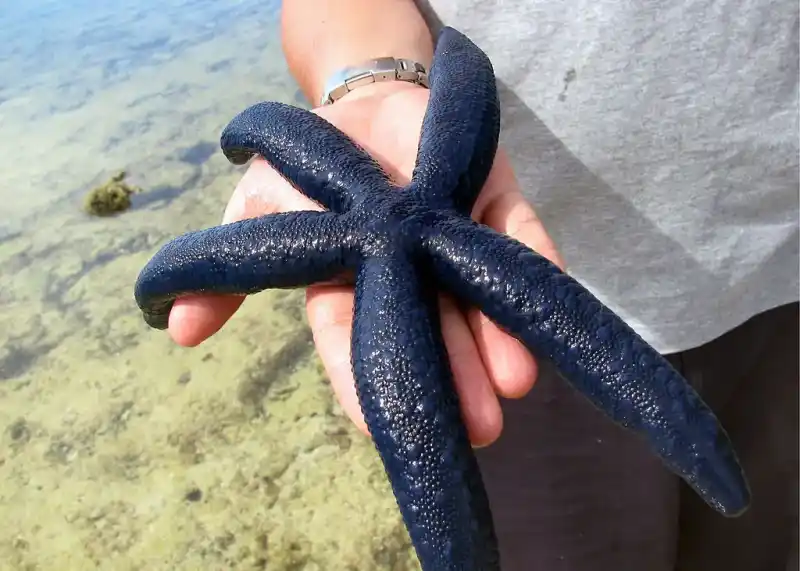
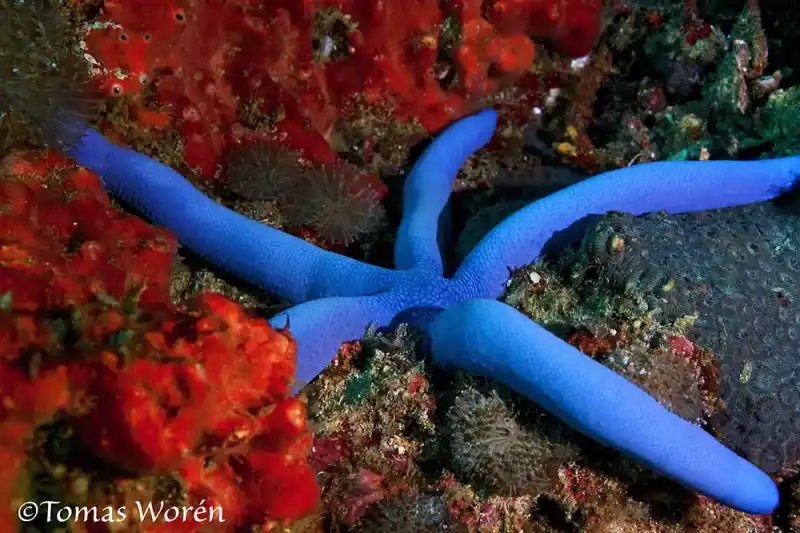
Basic Information
Scientific classification
- Chinese name: Blue Starfish (Linckia laevigata)
- Scientific name: Linckia laevigata
- Classification: Echinoderms
- Genus and family: Ophidiasteridae Linckia
Vital signs data
- Body length: 15–30 cm in diameter
- Weight: Varies from person to person, there is no uniform data.
- Lifespan: Several years (environment-dependent)
Significant features
Bright blue; slender cylindrical arms; feeds on biofilms and debris; regenerates severed arms and forms comet-like structures; broadcasts egg-laying.
Distribution and Habitat
Tropical Indo-Pacific shallow reefs and lagoons with hard/broken coral bottoms, 1–25+ m.
Appearance
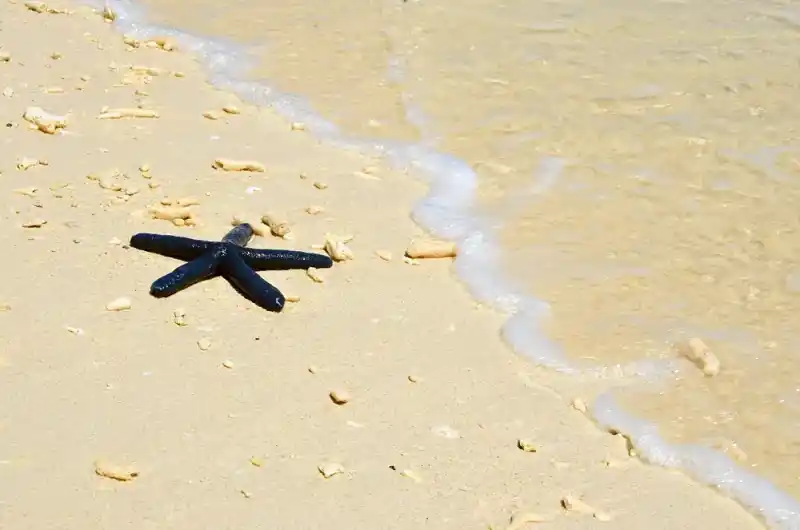
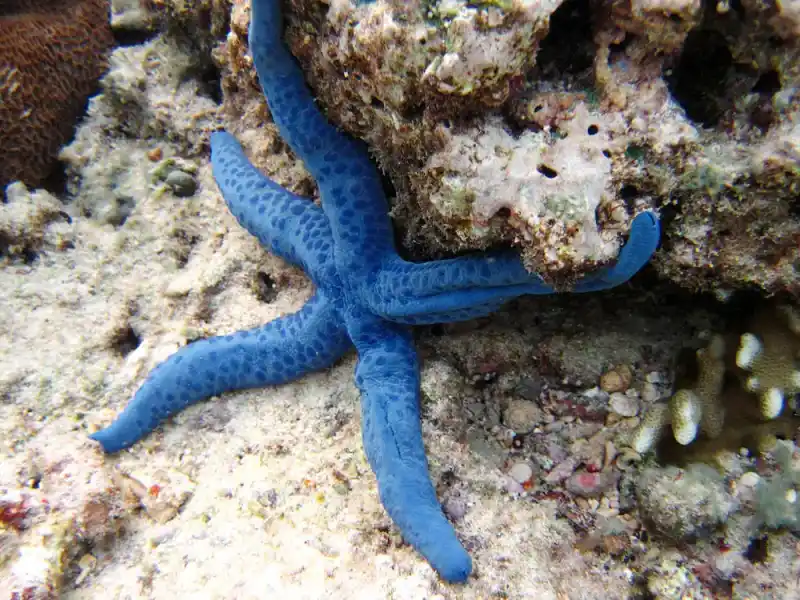
The five arms are slender and blunt, with a relatively smooth back; the ambulatory groove and tube feet are clearly visible on the ventral side; the body color is mainly blue.
Detailed introduction
The blue starfish ( Linckia laevigata ), also known as the blue finger starfish , belongs to the phylum Echinodermata, class Asteridae, order Ophidiasteridae, family Ophidiasteridae . Its most distinctive feature is its vibrant blue body (purple, green, brown, or mottled individuals are also observed), making it highly recognizable in tropical Indo-Pacific coral reefs. Ecologically, it is primarily a forager/harvester , consuming biofilms, microalgae, and organic detritus; it also possesses the well-known ability to regenerate its limbs/comet form .
Ecology and Biology
Diet: Primarily feeds on biofilms, algal films, debris, and small benthic organisms ; occasionally scavenge dead tissue.
Reproduction: Primarily through broadcasting of eggs ; it can also reproduce by self-severing its arms and regenerating bodies from the ends of the arms ("comet bodies").
Regeneration: The arm is easy to self-cut and has strong regeneration ability, making it a classic subject of starfish regeneration research.
Morphology and Recognition
Typical five-spoked symmetry , with slender , cylindrical arms that end in blunt rounded shapes; the dorsal surface is relatively smooth (laevigata means "smooth") , while the ambulacral groove and tube feet are visible on the ventral surface. The body color is most commonly cobalt blue/cyan , but variations in hue and mottled patterns also exist.
Body size and lifespan
Body length: The diameter from arm tip to arm tip is usually 15–30 cm .
Lifespan: Usually several years , depending on the environment.
Distribution and Habitat
Widely distributed in the tropical Indo-Pacific (Indian Ocean-Southeast Asia-West Pacific), it is often found on the hard bottom or coral debris bottom of shallow reefs, reef slopes and lagoons , at depths of about 1–25+ m .
Human-to-human interaction and conservation
Viewing and collecting: Do not hold the individual out of the water for an extended period of time or squeeze it; viewing, collecting and improper transportation can lead to stress and amputation .
Conservation tips: Due to habitat degradation and the ornamental trade, the principle of non-touch and sustainable management are encouraged.
IUCN: This entry is primarily for science education and is marked as Not Evaluated (NE) . The specific assessment will be based on the species level.
Frequently Asked Questions
Q1: Why is there a "comet-like" shape? After the arm is severed, the arm segment can regenerate the torso and other arms, forming a "comet" shape with the arm dragging a small disk.
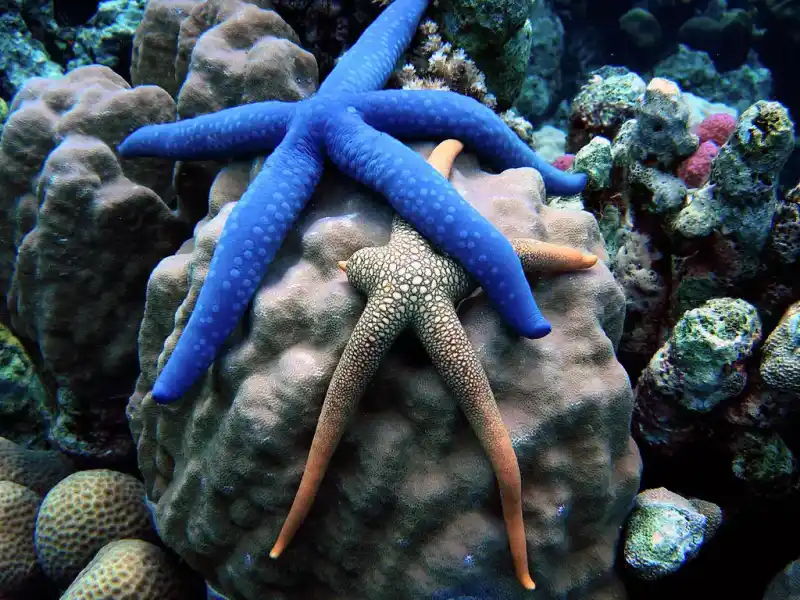
Q2: Is the color all blue? Blue is the most common, but purple, turquoise, brown, or mottled colors can also be seen; the color is related to the individual and the sea area.
Q3: Can it be kept as a pet? It is highly dependent on water quality stability and bottom microorganisms, and is subject to great stress during transportation. It is not recommended for beginners to keep or collect it.
Q4: Is it safe to touch? Avoid touching and keeping it out of water; its skin is easily damaged and will be severely stressed, which may lead to amputation and death.