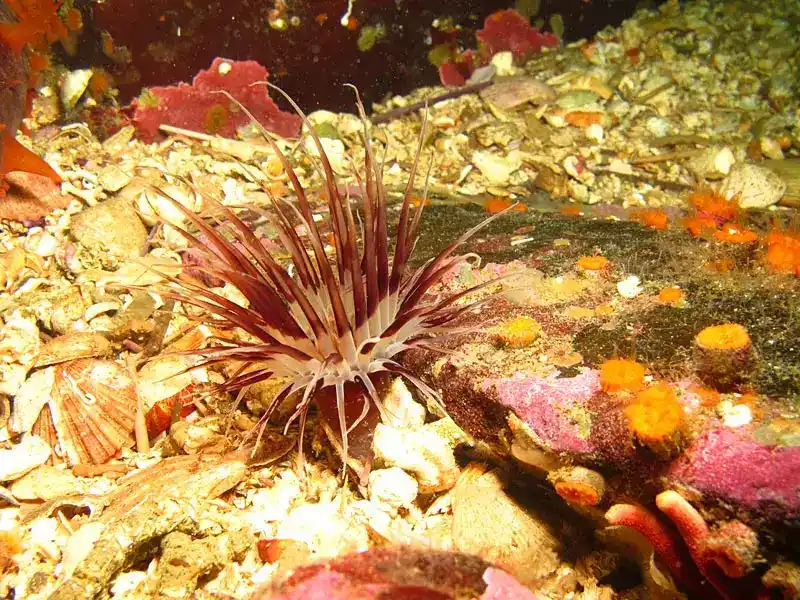
Basic Information
Scientific classification
- Chinese name: Tubular anemone (or tube anemone)
- Scientific name: Cerianthus membranaceus
- Classification: Echinoderms
- Family: Anemone, order Anemone, genus Anemone
Vital signs data
- Body length: tube + body can exceed 30 cm; tentacles open diameter is commonly 10–25 cm
- Weight: Small to medium-sized benthic invertebrate; there is currently no publicly available, standardized weight data.
- Lifespan: Perennial, sedentary invertebrates, with a lifespan of many years.
Significant features
They secrete flexible tubular nests and partially bury them in sand and mud; at night, they open their flower-like tentacles to ambush/filter-feed small prey.
Distribution and Habitat
Low wave energy areas in the shallow sandy and muddy bottoms, seagrass bed edges, lagoons/bays, etc. of the eastern Mediterranean and Northeast Atlantic.
Appearance
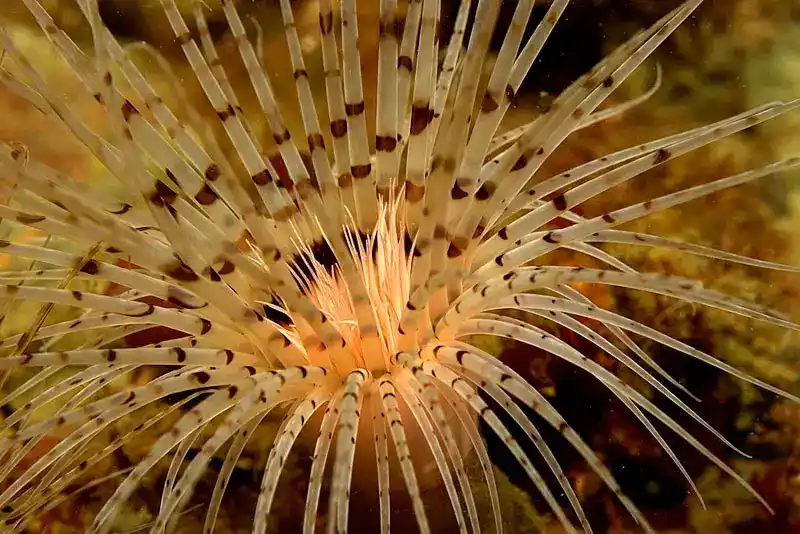
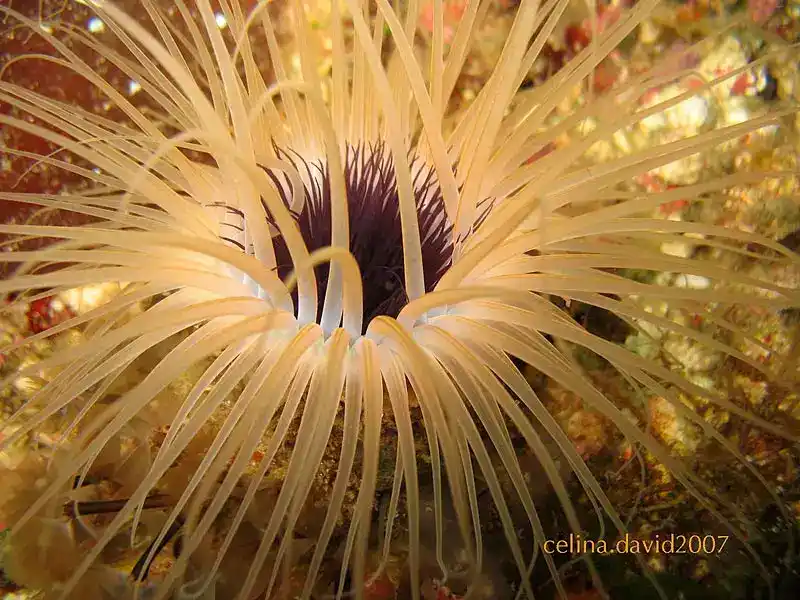
Double-ring tentacles: the outer ring is long and flowing with various colors; the inner ring is short and tightly enclosed; the whole thing looks like a sea flower.
Detailed introduction
The membranous anemone ( Cerianthus membranaceus ) is a typical cnidarian anemone belonging to the class Anthozoa, subclass Octozoa, order Ceriantharia, and family Cerianthidae . Unlike ordinary sea anemones that directly adhere to rock surfaces, it "plants" its body in flexible, tubular nests that it has created, partially burying itself in sediment at the edge of sand or seagrass beds. Therefore, it is often called a "tubular anemone" or "tube-shaped anemone."
Ecology and Behavior
Sedentary lifestyle: Individuals stay in a fixed location for a long time, with only their tentacle crowns protruding above the ground; when startled, they will instantly retract into their tubes.
Predation method: It is an ambush-filter feeding type of small predator . Its outer long tentacles capture small crustaceans, juvenile fish and planktonic debris, and then deliver them to its mouth via its inner short tentacles.
Tube-forming ability: It secretes mucus and filaments to bind sediment particles, expelled nematocysts, etc., into a tough organic tube , which gradually extends downwards, like a "deeper soft shell".
More active at night: They often fully extend their tentacles to hunt in low light or at night.
Morphology and Recognition
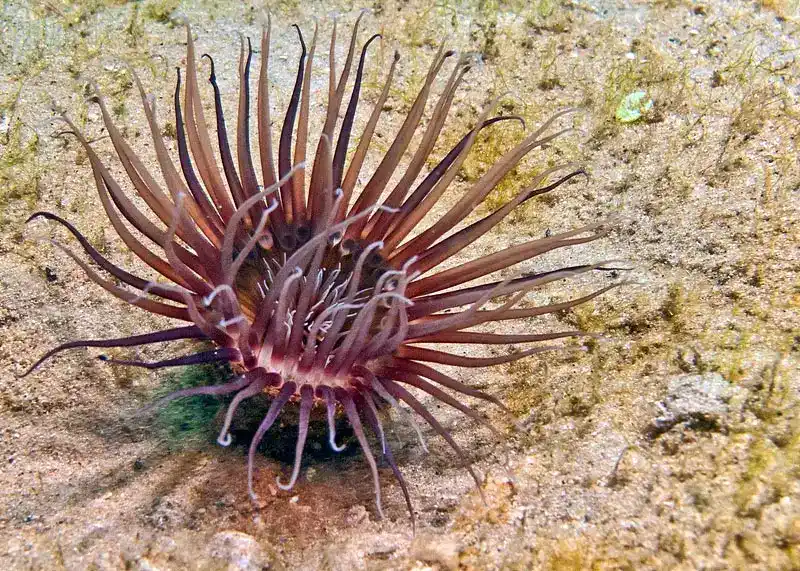
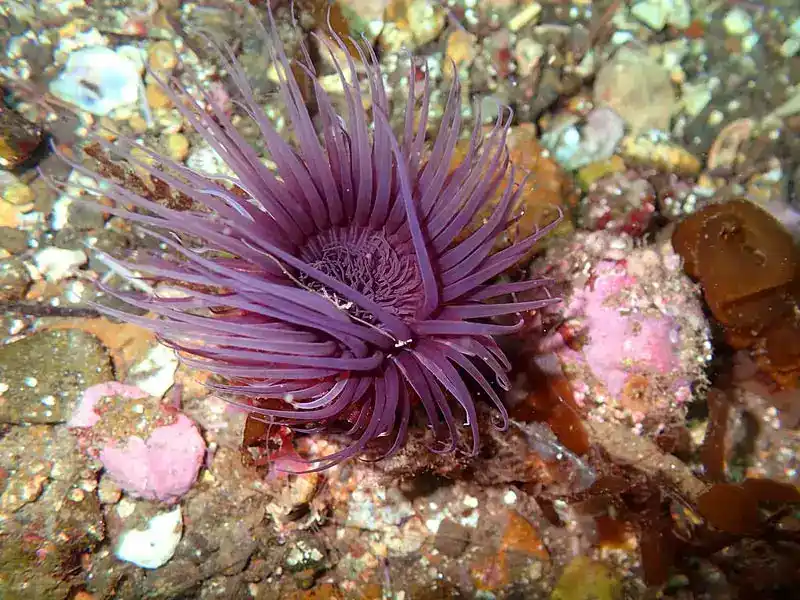
Its body consists of a tentacle-like corolla and an embedded columnar structure . Two concentric rings of tentacles are usually visible: the outer ring is long and thin, resembling a layer of petals spreading outwards; the inner ring is shorter and denser, surrounding the mouth and responsible for bringing food into it. The tentacles exhibit extremely varied colors, including yellow, orange, pink, brown, purple, white, or translucent, and may also have stripes or bi-color gradients, making them a very eye-catching "underwater flower" in many diving photos.
Body size and lifespan
Tentacle opening diameter: Commonly 10–25 cm, but may be larger.
Overall length (tube + body): can exceed 30 cm, or even 40+ cm, as the tube continues to extend downwards.
Lifespan: Considered a perennial, sedentary invertebrate ; the specific lifespan varies depending on the environment, and there is no uniform standard value.
Distribution and Habitat
The siphonophore is native to the Mediterranean Sea and the eastern coast of the northeastern Atlantic Ocean (including the waters near Italy, the western Mediterranean Sea, and the Adriatic Sea). It prefers shallow, sandy, muddy bottoms, the edges of seagrass beds, lagoons, or harbors—environments with low wave energy— but can also exist in slightly deeper (tens of meters) sedimentary seabeds. It buries its siphonophores firmly in the sediment and extends its tentacles to intercept prey in the currents.
Ecological significance and threats
Small ambush predators: help regulate the populations of small benthic crustaceans and fish larvae, and are an important component of seagrass beds/soft-bottom communities.
Habitat stress: Nearshore pollution, trawls, anchoring, coastal engineering, and eutrophication can all damage or bury its tube nesting environment.
IUCN: Currently, they are generally classified as Unassessed (NE) , and there is no unified global red list classification. However, local habitat degradation may lead to a decline in local populations.
Frequently Asked Questions
Q1: Is it a coral? It belongs to the phylum Cnidaria, but it is not a stony coral; it is a "tuberose" (order Tuberose), and usually lives as a single individual.
Q2: Why does it retract? Once startled, it will slide entirely back into the flexible tube, like entering a hole, disappearing almost instantly.
Q3: Will it sting? The tentacles have thorn sacs, which are effective weapons against small prey; if a person touches them with bare hands, it may cause stinging or allergic reactions, so it is not recommended to touch them.
Q4: Can it be kept in an aquarium? Some players have tried, but it's difficult: it requires a stable sandy substrate, a gentle water flow, and a continuous supply of small pellet food.
It is easy for the tube to die if it is damaged or the substrate is not right.


