Basic Information
Scientific classification
- Chinese name: Peacock
- Scientific name: Pavo (also known as the Southern Bird, the Kongjue, or the Kong Bird)
- Classification: Landfowl
- Family and genus: Galliformes, Phasianidae, Peacock (blue peacock, green peacock)
Vital signs data
- Body length: 0.86-2.12 meters
- Weight: 2.7-6 kg
- Lifespan: 20-30 years
Significant features
The peacock is known as the "King of Birds," symbolizing kindness, beauty, and nobility, and is a symbol of good fortune.
Distribution and Habitat
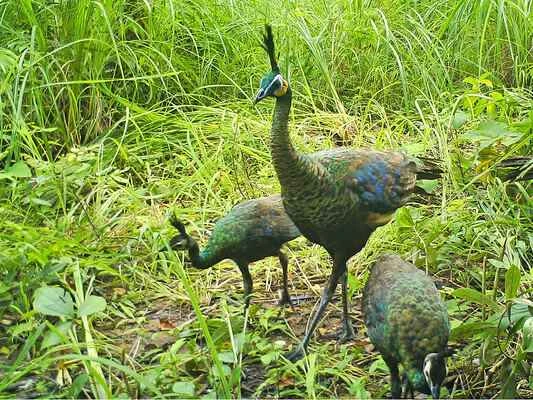
Peacocks inhabit open areas of sparse grasslands, shrublands, bamboo thickets, and coniferous and broad-leaved forests below 2000 meters in altitude, and especially prefer to be active in areas near streams and rivers. Green peacocks inhabit tropical and subtropical evergreen broad-leaved forests, deciduous broad-leaved forests, mixed coniferous and broad-leaved forests, and sparse forests and grasslands at altitudes of 136 to 1500 meters.
Appearance
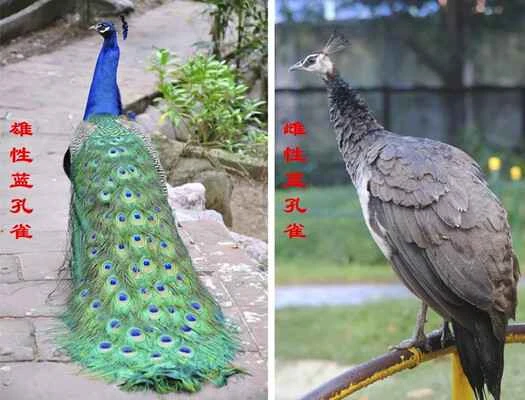
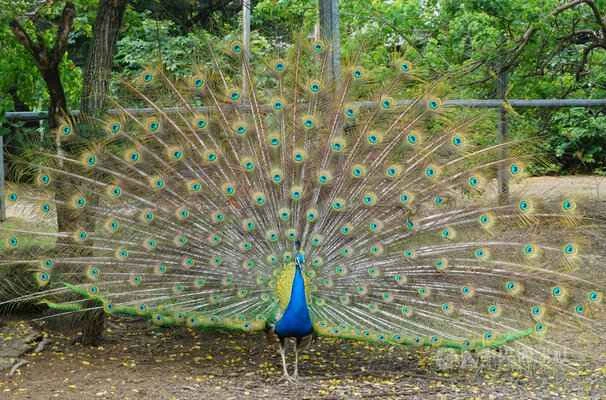
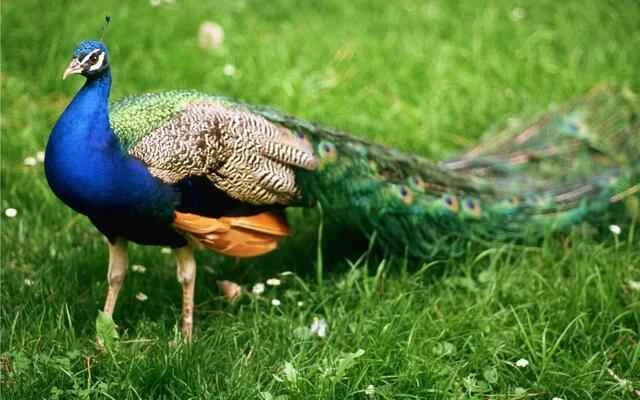
Peacocks are among the larger birds of the pheasant family, exhibiting significant sexual dimorphism and coloration. They have short, strong legs, making them adept at running, but their wings are short and rounded, hindering their flight. Peacocks have strong beaks with the upper beak slightly curved downwards, and males possess sharp, long spurs on the back of their legs. The most striking feature of the male peacock is its magnificent tail feathers, composed of 100-150 elongated tail feathers, reaching twice its body length when spread, covered with iridescent, five-colored patterns, dazzlingly beautiful. The tail feathers are slender, like golden-green velvet, gradually transitioning to a brassy color at the tips. Some of the upper tail coverts form eye-like patterns at the tips, each spot having a small purple kidney-shaped or round spot in the center. Female peacocks lack a tail feathers; their back feathers are dark brown with a slight grayish-green tinge, their plumage far less vibrant than the male's.
Detailed introduction
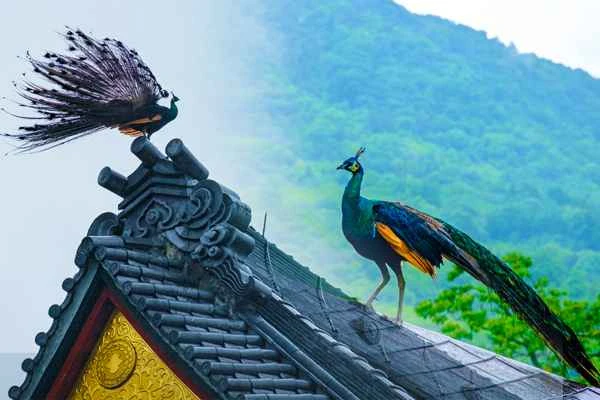
Peacocks belong to the class Aves, order Galliformes, family Phasianidae, and genus Pavo in zoological classification. Currently, only two species of peacocks have been named. The green peacock (Pavo muticus), also known as the Javanese peacock, has three subspecies: the Yunnan subspecies (Pavo muticus imperator), the Indian subspecies (Pavo muticus spicifer), and the nominate subspecies (Pavo muticus muticus). The blue peacock (Pavo cristatus), also known as the Indian peacock.
Green peafowl are found in Yunnan and Tibet, China, and in Bangladesh, Myanmar, the Indochina Peninsula, and even Java, Indonesia; blue peafowl are found in India and Sri Lanka.
Peacocks are omnivorous birds, primarily feeding on plant-based foods. They enjoy fruits such as pears and wild raspberries, but also consume rice, sprouts, and seeds. In addition, peacocks prey on small animals such as termites, locusts, crickets, grasshoppers, moths, frogs, and lizards. Peacocks' foraging activities are highly regular, typically concentrated at dawn and dusk. At dawn, peacocks go to water sources to drink and preen their feathers, then enter the woodland to forage; during the hot midday, they choose to rest in the cool shade of the forest; and at dusk, they venture out to forage again.
Cluster
Peacocks are often found in pairs or small groups of three to five. Typically, a male peacock will form a group with 3-5 females, with the male leading the way, the chicks in the middle, and the females bringing up the rear. While walking, the peacocks will frequently nod their heads up and down and stretch their necks to look around. The size of green peacock flocks varies with the seasons; in winter they usually gather in large flocks, while in other seasons they disperse into smaller family groups.
Peacocks are naturally agile and prefer quiet, comfortable environments. Once startled, they often won't reappear in the same spot for several days. Peacocks are excellent runners; when in danger, they will dash away at high speed, escaping into dense bushes to hide from pursuers. In emergencies, peacocks can also perform short flights, usually not exceeding 10 meters in altitude, and descending slowly. Vipers are the peacock's main predators, and clouded leopards occasionally prey on them as well.
Peacocks practice polygamy, where a male can have two or more female mates, but each female peacock mates only with a specific male. The breeding season for wild peacocks is from mid-February to May, with the peak breeding season from March to May; under artificial breeding conditions, the breeding season can be earlier or longer.
The term "peacock" first appeared in the *Classic of Mountains and Seas*, specifically in the section on "Seas Within": "There are peacocks," where "kong" means large. The *Record of Strange Things* by Yang Fu of the Eastern Han Dynasty describes peacocks in Lingnan: "The peacock is as large as a wild goose but with long legs; its feathers are all patterned and colorful. If caught and kept, it will dance when clapping its hands." In classical Chinese, the peacock was also written as "kongjue" ("jue" being the same as "que"), or called "kongniao," "yueniao," or "nanke." The peacock is considered one of the prototypes of the phoenix, a mythical bird in ancient Chinese legend.
Peacocks have a long evolutionary history, but due to the difficulty in preserving bird fossils and the scarcity of Galliformes fossils, their exact origin time remains unclear. It is known that Galliformes birds diverged into new populations as early as 26 million years ago. In 2003, a peacock fossil discovered in Ethiopia from the mid-to-late Pliocene (approximately 26-27 million years ago) provided conclusive evidence for the origin time of peacocks.
As of 2018, both the blue peafowl and the green peafowl were listed on the IUCN Red List of Threatened Species, with the green peafowl listed as Endangered (EN) and the blue peafowl as Least Concern (LC). In 2021, China listed the green peafowl as a Class I protected wild animal. In 2023, the Convention on International Trade in Endangered Species of Wild Fauna and Flora (CITES) added the green peafowl to Appendix II and the blue peafowl to Appendix III.
Frequently Asked Questions
1. Does a peacock display its tail feathers to attract a mate?
Yes! Male peacocks displaying their tail feathers is a typical courtship behavior. When they display their tail feathers, the feathers spread out to form magnificent "eye spots," which can attract the attention of females. Female peacocks usually choose males with brightly colored feathers, many eye spots, and graceful tail-displaying postures as their mates.
2. Do all peacocks display their tail feathers?
No. Only male peacocks display their plumage; female peacocks do not have such elaborate tail feathers. Males typically display their plumage frequently only during the breeding season to demonstrate their health and reproductive dominance.
3. Can peacocks fly?
Yes! Although peacocks are large and have long tail feathers, they are still capable of flight, especially when escaping short distances or perching in trees. They mostly choose to roost in tall trees at night to avoid predators.
4. Are peacocks pheasants?
Yes. Peacocks belong to the genus Pavo in the family Phasianidae, and are related to birds such as chickens and pheasants. The most common peacock species are the blue peacock (Indian peacock), green peacock, and Congo peacock.
5. Why do peacocks have such vibrant colors?
The color of peacock feathers primarily comes from structural coloration rather than pigmentation. The microstructure of the feathers refracts and interferes with light, creating a dazzling blue-green metallic sheen. This vibrant color plays a crucial role in evolution, serving to attract the opposite sex and intimidate predators.