Basic Information
Scientific classification
- Chinese name: Red-necked Woodpecker
- Scientific name: Campephilus rubricollis, Red-necked woodpecker
- Classification: Climbing birds
- Family and genus: Order Piliformes, Family Pilidae, Genus *Red-headed Woodpecker*
Vital signs data
- Body length: No verification information available.
- Weight: No verification information available.
- Lifespan: No verification data available.
Significant features
Distribution and Habitat
The red-necked woodpecker is found in South America, including Colombia, Venezuela, Guyana, Suriname, Ecuador, Peru, Bolivia, Paraguay, Brazil, Chile, Argentina, Uruguay, and the Falkland Islands (also known as the Malvinas Islands).
It is found in primary and secondary evergreen forests in low mountains, but is rare in the north.
Appearance
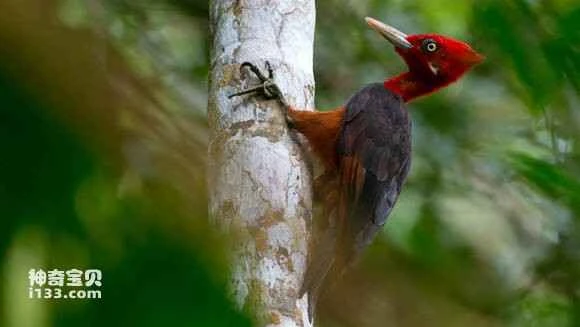
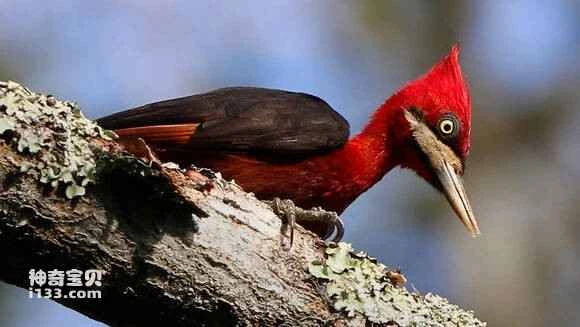
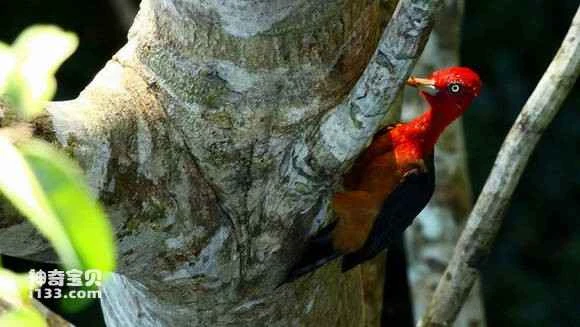
The adult male has a dark grey forehead tinged with green. The lores are pale reddish-brown, and the rest of the head is pale green. The crown and nape are generally deep red, with the bases of the basal feathers mainly dark grey, the tips of which are reddish and speckled with fine black dots; these grey and black parts are often visible on the surface. A deep red collar runs from the nape down the sides to the center of the breast, though the red is paler and brownish on the breast, and the collar is wider there. A malar stripe runs from the base of the bill to the red collar, slightly greyish, and speckled with deep red at its rear. The upperparts, including the scapulars and lesser wing coverts, are generally glossy dark green, with the dark grey base of the back feathers often visible. The median and greater wing coverts are the same as the back feathers, but with a brassy sheen. The lesser wing coverts and primary coverts are blackish-brown, with paler edges and a greenish tinge; the outer vanes of the lesser wing coverts also have small white horizontal bars. The wing edges are white, speckled with fine brown dots. The flight feathers are mostly blackish-brown, with white spots mixed on both the inner and outer vanes of the primary flight feathers. The same is true for the inner vanes of the secondary flight feathers; the outer secondary flight feathers also have faint pale spots on their outer vanes. The outer edges of all secondary flight feathers turn bronze-green, the same as the outer coverts. The tail feathers are blackish-brown with stiff shafts; the inner vanes of the central pair have faint, short, pale transverse bars; the outer edges of the bases of each pair of feathers on the surface are narrowly tinged with yellowish-brown.
The chin and throat are greenish-white, with slight white longitudinal stripes on the throat. The upper chest is green, fading towards the rear, with fine white and darker green spots scattered on the abdomen. The flanks are also green, with white and gray rachis and pale green edges tinged with yellow. The undertail coverts are greenish-brown. The axillaries and underwing coverts are white, covered with coarse blackish-brown spots. The bill is black, with a yellowish-green base to the lower mandible; the tarsi and toes are grayish-green.
Detailed introduction
The Red-necked Woodpecker, scientifically known as Campephilus rubricollis, has unknown habits.
Listed in the IUCN Red List of Birds, version 3.1, 2009.
Protect wild animals and ban the consumption of wild game.
Maintaining ecological balance is everyone's responsibility!