Basic Information
Scientific classification
- Chinese name: Hector's beaked whale
- Scientific name: Mesoplodon hectori
- Order: Cetacea
- Family and genus: Beaked whale (family Beaked whales)
Vital signs data
- Body length: Adults are usually about 4 meters long, with the largest recorded length being about 4.2–4.3 meters; newborn calves are about 1.9–2.0 meters long.
- Weight: Estimated weight is around 1 ton (may vary considerably between individuals and depending on body condition).
- Lifespan: Reliable data on lifespan are lacking, but it is generally estimated to be several decades; the age of sexual maturity and the interval between reproduction are still unclear.
Significant features
Beaked whales in the cold temperate deep seas of the Southern Hemisphere are rarely recorded and mainly feed by diving; current knowledge is mostly based on stranded individuals, and there are still many gaps in ecological information.
Distribution and Habitat
It is found in the cold temperate waters of the Southern Hemisphere at approximately 35°–55° south latitude, with records mostly around New Zealand, and also reported in Australia, South Africa and South America; it mainly inhabits deep waters of the open ocean, near continental slopes and seamounts.
Appearance
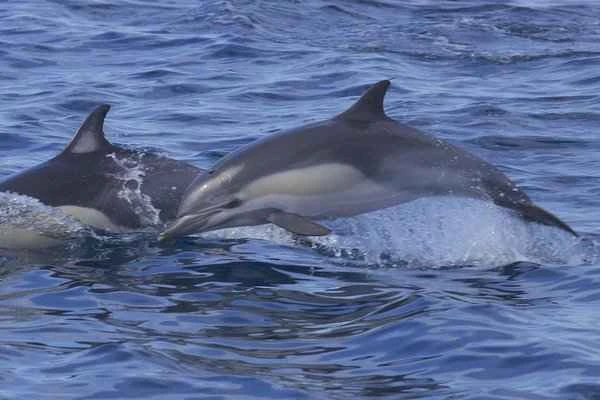
It has a slender body, a short beak, a dark gray to brownish-gray back, and a lighter belly; the dorsal fin is small and located at the rear of the body, and males often have linear or circular scars.
Detailed introduction
The Hector's beaked whale ( Mesoplodon hectori ) is an extremely mysterious and rarely documented toothed whale. It inhabits the colder temperate waters of the Southern Hemisphere, typically far from the coast, operating on continental slopes and in deep-sea environments. It is adept at deep-diving for food, making it almost impossible for ordinary vessels or coastal observers to spot. Current scientific knowledge primarily comes from stranded individuals, occasional fisheries/survey records, and a very limited number of maritime sightings.
Within the beaked whale family, the Hector's beaked whale is relatively small: adults typically reach about 4 meters in length, with the largest recorded at 4.2–4.3 meters; its weight is estimated to be in the 1-ton range. Its appearance is unassuming, unlike killer whales or humpback whales, and it rarely breaches the surface. Because of its rarity, significant gaps remain in crucial ecological information regarding its population, migration patterns, and breeding season.
Classification and nomenclature
The Hector beaked whale belongs to the class Mammalia, order Cetacea, suborder Odontoceti, family Ziphiidae, and genus Mesoplodon . The English name "Hector" is related to its early classification history (it is also often referred to as "New Zealand beaked whale" or "skew-beaked whale"). This species was first described based on specimens from New Zealand, and while it has experienced classification disputes, it is currently generally considered a valid and independent species.
Appearance features
The Hector's beaked whale has a slender body, a low forehead, and a relatively short, well-defined beak. Its back is mostly dark gray to brownish-gray, with a lighter underside; there is significant color variation between individuals. Some adult males may have lighter or even whitish areas on their snout or the front of their head.
Linear scars common in beaked whales may also appear in this species: fights between males, fang marks from other males, and circular/oval scars from biscuit sharks, etc., can all leave "white marks" on the skin. Like most beaked whales, the dorsal fin is small and located at the rear of the body, with an overall low profile.
Distribution range and habitat
This species is believed to have a wide but sparse circumpolar distribution in the cold temperate waters of the Southern Hemisphere, roughly between 35° and 55° south latitude. More frequently recorded areas include the waters around New Zealand, with reports also of occurrences in parts of Australia, South Africa, and South America. Due to the limited number of recorded samples, distribution maps often resemble scattered dots and do not necessarily indicate that it only appears in these locations.
Habitat preferences are speculated to be similar to other beaked whales: they mostly inhabit deep waters of the open ocean, near continental slopes, seamounts, or trenches, relying on deep-sea food resources. Occasional sightings near shore are mostly related to strandings caused by individual disorientation, disease, or environmental stress.
Lifestyle Habits and Behaviors
Data on the daily behavior of Hector's beaked whales is very limited, but common characteristics of beaked whales can be referenced: they usually live in small groups (1–5 individuals) or alone, spend short periods at the surface, have long dive intervals, and can dive deep and feed for extended periods in deep water. Due to their "low salience" and deep-diving habits, their detection rate in marine surveys is very low.
Regarding environmental sensitivity, beaked whales are generally considered to be sensitive to strong underwater noise (especially mid-frequency active sonar), and historical mass strandings of beaked whales in various locations also highlight this risk. Direct evidence for the Hector's beaked whale is limited, but it is typically included in risk assessments as a "potentially highly sensitive marine mammal" for conservation purposes.
feeding habits
It is known or presumed that beaked whales primarily feed on deep-sea cephalopods (squid, octopus, etc.), but may also consume deep-sea fish and crustaceans. They often use echolocation to locate prey in deeper waters and complete most of their feeding activities during deep dives.
Reproduction and life cycle
The reproductive ecology of this species is almost unknown. It is generally assumed to be similar to that of most medium-sized toothed whales: females are mostly single-birthing, and the calves are about 1.9–2.0 meters long at birth; the lactation period may last from several months to about a year. The gestation period is usually around 11–12 months in beaked whales, but more samples are needed to confirm this for the Hector's beaked whale.
Reliable data on lifespan is also lacking. As a medium-sized toothed whale, it is generally estimated that it can live for decades, but its actual lifespan, age of sexual maturity, and reproductive interval cannot be accurately given at present.
Relationship with humans
Hector's beaked whales rarely come into close contact with humans and are not a common subject of whale watching tourism. Human impact on them primarily stems from indirect pressures: the risk of bycatch from offshore fishing activities, marine pollution (plastics and chemical pollutants), ship and sonar noise, and the potential impact of climate change on deep-sea food webs.
Protecting the status quo and threats
Due to insufficient basic data, the Hector's beaked whale is typically assessed as Data Deficient (DD) by the IUCN: this does not mean it is "not threatened," but rather that there is a lack of sufficient information to determine its true level of risk. Current conservation efforts often focus on reducing "preventable risks" and improving monitoring capabilities, such as: improving the sampling and identification of stranded individuals, strengthening offshore surveys, assessing the impacts of noise and fishing activities, and promoting more environmentally friendly marine management measures in key areas.
Frequently Asked Questions
Q1: Why are Hector's beaked whales so hard to see?
It typically lives in deep waters of the open ocean, is adept at long-duration deep dives for food, stays on the surface for short periods and rarely leaps out of the water, so sightings at sea are extremely rare, and many records come from stranded individuals.
Q2: Where are Hector's beaked whales mainly distributed?
It is believed to be mainly distributed in the cold temperate seas of the Southern Hemisphere (roughly 35°–55° south latitude), with relatively more records around New Zealand, and also reported in parts of Australia, South Africa and South America.
Q3: What does it eat?
They primarily feed on deep-sea cephalopods (such as squid), but may also consume deep-sea fish and other invertebrates.
Q4: What is its protection level?
Due to insufficient data, the IUCN typically assesses this as Data Deficient (DD). Current priorities include reducing risks such as accidental catches and noise pollution, and strengthening offshore surveys and grounding sampling monitoring.


