Basic Information
Scientific classification
- Chinese name: Golden-backed Three-toed Woodpecker
- Scientific name: Dinopium javanense, Common Flameback
- Classification: Climbing birds
- Genus and family: Order Vulpecula, Family Pilidae, Genus *Golden-backed Three-toed Woodpecker*
Vital signs data
- Body length: 28-30 cm
- Weight: 57-100g
- Lifespan: No verification data available.
Significant features
Distribution and Habitat
The Golden-backed Three-toed Woodpecker is distributed in Bangladesh, Brunei Darussalam, Cambodia, India, Indonesia, Lao People's Democratic Republic, Malaysia, Myanmar, Philippines, Singapore, Thailand, Vietnam, and Xishuangbanna in southern Yunnan, China.
The Golden-backed Three-toed Woodpecker inhabits secondary forests, sparse woodlands, deciduous shrublands, and mangroves, and is also found in teak forests and high-altitude pine forests. It particularly favors coconut plantations, cultivated land, gardens, parks, and golf courses. It is distributed at varying altitudes from low to medium. They can be seen at altitudes of 1000 meters in the Greater Sunda Islands, up to 1500 meters in Southeast Asia, and even as high as 1700 meters in India.
Appearance
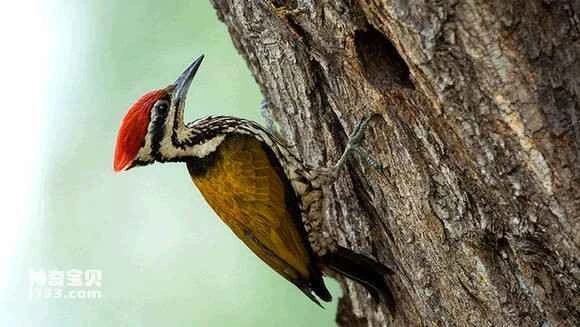
The Golden-backed Three-toed Woodpecker is a medium-sized, brightly colored woodpecker, measuring 28-30 cm in length and weighing 57-100 grams. Its forehead, crown, nape, and crest are black; its face has black and white stripes; its back is golden-yellow tinged with orange-yellow; and its rump is bright red. The male has a red crown and crest; a black forehead, crown, nape, and crest; a golden-yellow back tinged with orange-yellow; and a bright red rump. It has only three toes. The adult female has a black forehead, crown, nape, and crest, with white edges on the inner vanes of each feather; a large white stripe above and below the eye extending to the neck; a large black stripe behind the eye extending to the neck; and another large black stripe below the white stripe below the eye; a golden-yellow back tinged with orange-red; a bright red rump; black tail feathers; blackish-brown flight feathers, with the outer vanes of the secondary flight feathers tinged with greenish-gold, and the coverts also tinged with greenish-gold, similar to the outer vanes of the secondary flight feathers. The chin and throat of the underparts are tinged with yellowish-white, with a thick black longitudinal stripe in the center; the chest, abdomen, and flanks are tinged with yellowish-white, with black edges or parts of the chest feathers, while the feathers on the abdomen and flanks have black herringbone patterns. The iris is brownish-brown; the beak is black.
The bill is approximately the same length as the head; the culmen is slightly curved; the nasal ridge is not very developed and is closely connected to the culmen; the nostrils are bare. The big toe or inner hind toe is very small or absent; the third and fourth toes are approximately the same length. The wings and tail are the same length as those of the Chestnut Woodpecker genus; the outer tail feathers are longer than the upper tail coverts. Both sexes have a red nape crest; the male's crown is also red, while the female's crown is black with white spots.
Size measurements: body length 280-310 mm, bill 27-30 mm, wing 127-165 mm, tail 84-102 mm, tarsus 24 mm.
Detailed introduction
The golden-backed three-toed woodpecker, scientifically known as *Dinopium javanense*, or Common Flameback, has six subspecies.
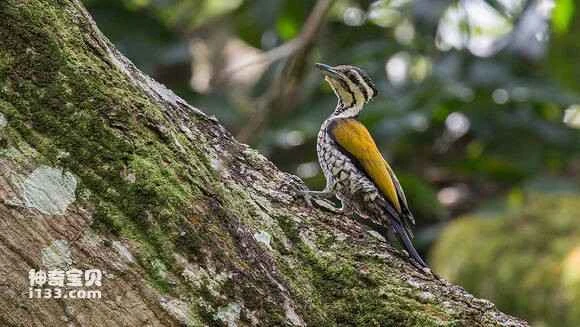
The Golden-backed Three-toed Woodpecker is usually found alone or in pairs, frequently calling to each other. It forages and moves about on tree trunks and branches, but also on fallen logs. Its flight is undulating, often accompanied by calls. It primarily feeds on insects and invertebrates, including ants, insect larvae, small scorpions, cockroaches, wood-boring insects, and other species. Its calls include a harsh, drawn-out trill "churrrr" and a soft "chee chee" between partners, and a harsh "kluuk, kluuk, kluuk" sound while in flight.
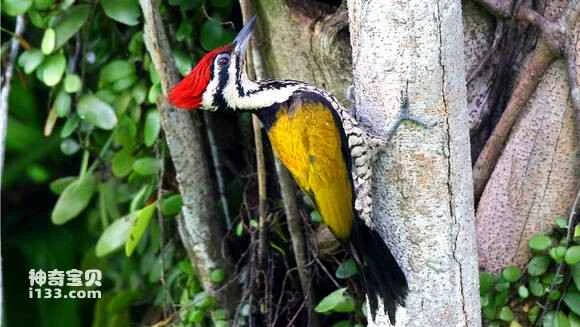
The egg-laying season varies by region. In India, it's from February to April; in Thailand, it begins in June; in the Malay Peninsula, from January to July; and in Borneo, from April to December. Nests are built in tree cavities, typically in open, sparse forests on the trunks of living or dead trees. The parents pry the cavities themselves, and the entrance varies in height from 2 to 10 meters above the ground. They are usually placed under an old tree stump, about 5 meters above the ground. Fruit trees or palm trees are the most common locations. Each clutch contains 2-3 eggs, sometimes only 1. The eggs are white and measure 27-31 × 18-23 mm.
Protect wild animals and ban the consumption of wild game.
Maintaining ecological balance is everyone's responsibility!