Basic Information
Scientific classification
- Chinese name: Dugong
- Scientific name: Dugong dugon
- Classification: Mammals
- Family and genus: Dugongaceae, Dugong
Vital signs data
- Body length: Adults are typically about 2.4–3.3 meters in length, and their tail fin is forked in a "whale tail" shape, which is an important distinguishing feature from manatees.
- Weight: Most individuals weigh around 250–400 kg, with a few individuals weighing even more; body condition is closely related to the abundance of seagrass resources.
- Lifespan: Lifespan can reach several decades, often considered to be around 50–70 years; sexual maturity takes many years, and the reproductive rate is low.
Significant features
Typical "seagrass eater", highly dependent on shallow seagrass beds, with a downward-curving snout suitable for scrambling for seagrass, and a forked whale tail fin; low reproductive rate and sensitive to habitat degradation and human disturbance.
Distribution and Habitat
They are distributed in the tropical coastal areas of the Indian Ocean and the western Pacific Ocean, preferring shallow waters, bays, lagoons, straits, and protected waters behind coral reefs with abundant seagrass. Their range varies with the abundance of seagrass and the seasons.
Appearance
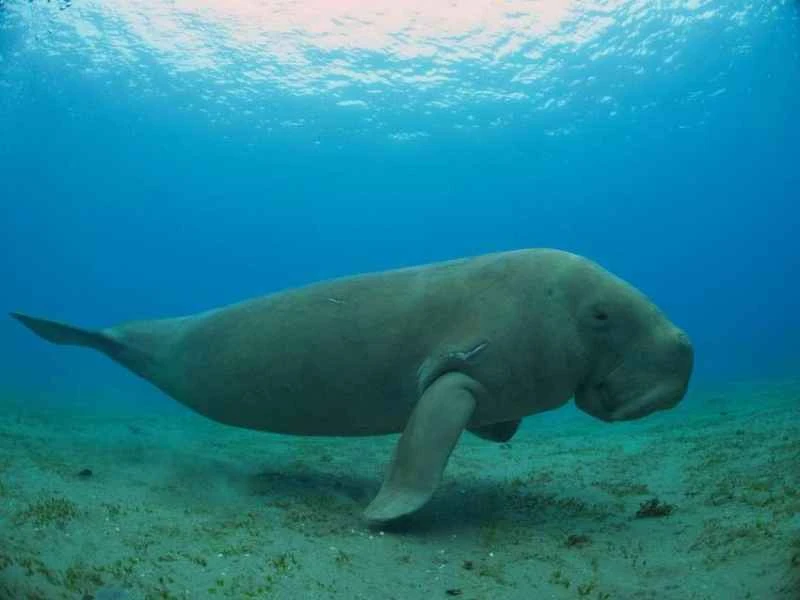
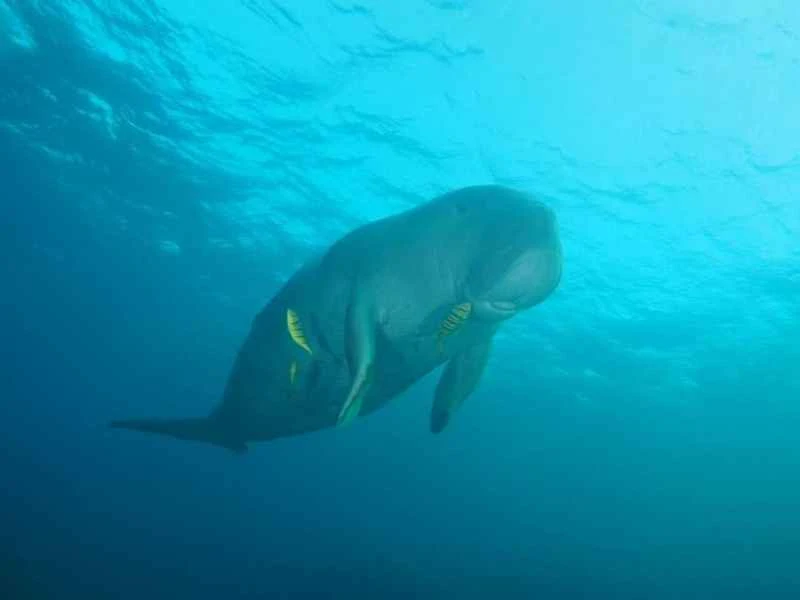
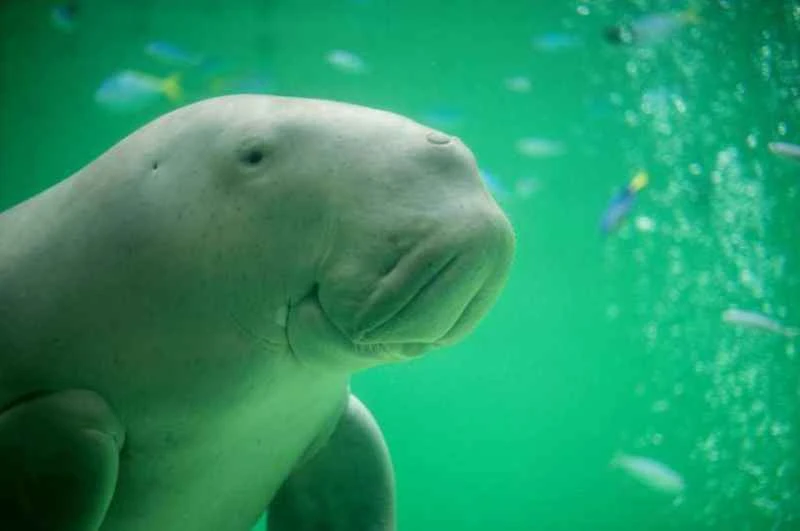
It has a robust body, grayish-brown to dark gray skin, a thick, downward-curving snout with whisker-like bristles; forelimbs are paddle-shaped flippers, and the tail fin is forked in the shape of a whale tail; males may have short, thick incisors (ivory-like).
Detailed introduction
The dugong (scientific name * Dugong dugon* ) is the only extant species in the family Dugongidae within the order Sirenia, and a typical seagrass eater. It resembles a gentle giant living in the sea: robust in build, with thick, smooth skin, and moves slowly but with great endurance. Dugongs are mainly distributed in the tropical shallow seas of the Indian and western Pacific Oceans, relying heavily on seagrass beds for food and activity, hence their common name "gardeners of seagrass beds." They promote seagrass regeneration through grazing and overturning, helping to maintain the structure and productivity of the seagrass ecosystem.
Compared to manatees, dugongs have a distinctly "whale tail" (forked tail) tail fin, and their downward-curving snout is better suited for foraging for seagrass on the seabed. Dugongs have low reproductive rates and long juvenile periods, and are highly sensitive to habitat quality and human disturbance. Factors such as seagrass bed degradation, entanglement in fishing gear, ship collisions, and illegal hunting can all cause population stress, thus they are considered a marine mammal requiring key protection in many regions.
Classification and nomenclature
Dugongs belong to the class Mammalia, order Sirenia, family Dugongidae, and genus Dugong . They are the only extant species in the genus Dugong. The English name "dugong" originates from a Malay/Filipino word meaning "sea lady/woman," and is also related to early seafarers' imagination of "humanoid sea creatures."
In Chinese contexts, dugongs are sometimes associated with the legend of "mermaids," but in reality, dugongs are not mythical creatures, but real marine mammals that rely heavily on seagrass beds.
Appearance features
Dugongs are large and sturdy animals, with adults typically measuring 2.4–3.3 meters in length and weighing around 250–400 kilograms, though some individuals can be even larger. Their skin ranges from grayish-brown to dark gray, often bearing scars and mottled patterns. They have relatively small heads, small eyes, and exposed ear openings without external auricles.
One of its most distinctive features is its thick, downward-curving snout (upper lip), covered with tentacle-like bristles that allow it to "touch, grasp, and pull up" seaweed on the seabed. Its forelimbs are paddle-like flippers used for steering and support; its tail fin is a forked "whale tail" shape, a key differentiator from manatees. Adult males may develop short, thick incisors (ivory-like), primarily related to social interaction and competition.
Distribution range and habitat
Dugongs are mainly distributed in the tropical and subtropical coastal waters of the Indian and western Pacific Oceans, with records ranging from East Africa, the Red Sea, and the Persian Gulf to South Asia, Southeast Asia, northern Australia, and the areas surrounding some Pacific islands. They are highly dependent on shallow seagrass beds and are often found in shallow, flat or gently sloping bays, lagoons, straits, and protected waters behind coral reefs where seagrass is abundant.
Dugongs' range changes with the seasons, seagrass abundance, and sea conditions: when a seagrass bed degrades or is disturbed, they may migrate to new feeding grounds. Because seagrass beds are often located near human-developed coastal areas, habitat sustainability is closely linked to human management.
Lifestyle Habits and Behaviors
Dugongs forage mostly during the day or at dusk, and in some areas they are also nocturnal to avoid disturbance from ships and humans. They usually live alone or in small groups, often as mothers and their offspring or a few individuals walking loosely together; in areas with abundant food, they may also briefly gather into larger groups.
Dugongs need to surface periodically to breathe, typically every few minutes to a dozen minutes (the exact frequency varies depending on their activity level). They are not fast swimmers, but they can move continuously for extended periods. When disturbed, they will speed away or dive into deeper waters for brief refuge.
feeding habits
Dugongs feed almost entirely on seagrass, making them one of the few marine mammals that primarily consume seagrass. They use their downward-curving snouts to nibble on seagrass leaves on the seabed, and also uproot and consume the underground stems and roots, leaving behind typical "feeding trenches." Their preferred seagrass species vary depending on the sea area; they typically choose tender, more nutritious, and easily digestible seagrass.
Dugongs contribute to the renewal and nutrient cycle of seagrass beds through moderate feeding and rotting; however, when seagrass beds degrade on a large scale, dugongs often find it difficult to quickly find equivalent alternative resources, thus affecting their physical condition and reproduction.
Reproduction and life cycle
Dugongs have low reproductive rates and long generation cycles. The gestation period for females is approximately 13–15 months, with a typical litter of one offspring. Lactation can last for over a year, and the mother-child bond is often maintained for an extended period. The long intervals between births (often several years under natural conditions) between females contribute to the slow recovery of the population.
Sexual maturity takes many years, and an individual's lifespan can reach several decades (often thought to be around 50–70 years). This "long-lived, low-productivity" life history strategy makes dugongs extremely sensitive to continuous human-caused death (such as brute force or collisions).
Relationship with humans
Dugongs hold symbolic significance in many coastal cultures and are closely associated with mermaid legends. Today, their greater value lies at the ecosystem level: they are indicator species for healthy seagrass beds. When observing dugongs, the principle of minimal disturbance should be followed: slow down, maintain distance, avoid chasing or following them for extended periods, and exercise extreme caution, especially near mothers and calves.
In some areas, dugongs have been hunted for meat, oil, or traditional uses; modern conservation emphasizes reducing illegal hunting through laws, marine protected areas, and community co-management, and combining fisheries management and waterway planning to reduce collateral damage.
Protecting the status quo and threats
Dugongs are generally assessed as Vulnerable (VU) globally. Major threats include: seagrass bed degradation and loss (coastal development, increased turbidity, extreme weather/heat waves causing seagrass death), fishery overcrowding and entanglement (especially gillnets), ship collisions, illegal fishing, and plastic and chemical pollution.
Conservation priorities typically revolve around the overall system management of "seagrass beds + dugongs": protecting and restoring seagrass beds, regulating fishing gear and operating times and spaces, establishing low-speed navigation zones and avoidance channels, strengthening law enforcement and community involvement, and assessing population trends and key habitats through aerial/drone surveys, acoustic monitoring and tagging studies.
Frequently Asked Questions
Q1: What is the difference between dugongs and manatees?
Both belong to the order Sirenia, but the dugong's tail fin is forked and "whale tail" shaped, its snout is more curved downwards, and it feeds more on seaweed; the manatee's tail fin is mostly round and paddle-shaped, and its habitat types and distribution are also different.
Q2: Why is the dugong called the "gardener of the seagrass bed"?
They feed mainly on seagrass, and their grazing and overturning promote seagrass renewal and nutrient cycling, which plays an ecological role in maintaining the structure and productivity of seagrass beds.
Q3: What do dugongs mainly eat?
They feed almost entirely on seaweed, including the leaves, and may also pull up the rhizomes and roots to eat, often leaving typical feeding trenches on the seabed.
Q4: What are the main threats facing dugongs?
Degradation and loss of seagrass beds, mixed catches and entanglements (such as gillnets), ship collisions, illegal hunting, and pollution are all contributing factors. Due to the low reproductive rate, any sustained human-caused mortality can have a significant impact.


