Basic Information
Scientific classification
- Chinese name: Cuvier's beaked whale
- Scientific name: Ziphius cavirostris
- Order: Cetacea
- Family and genus: Glossopteris, family Glossopteris
Vital signs data
- Body length: Adults are usually about 5-7 meters long, with a sturdy, torpedo-shaped body and a small dorsal fin that is positioned towards the rear.
- Weight: Weight can reach several tons (commonly around 2–3 tons or more), depending on gender and individual physical condition.
- Lifespan: Lifespan can reach several decades, often considered to be around 40 years or even longer; sexual maturity takes many years.
Significant features
Deep-sea "masters of deep-sea diving" are widely distributed but extremely difficult to observe at the sea surface; they mainly feed on deep-sea squid, have short periods of time surfacing to breathe, and are often found in small groups.
Distribution and Habitat
They are found in almost all temperate to tropical seas around the world, preferring deep-sea environments such as the outer edge of the continental shelf, continental slope, submarine canyons and the area around seamounts. They often live in the deep sea edge where the terrain is complex and the prey is abundant.
Appearance
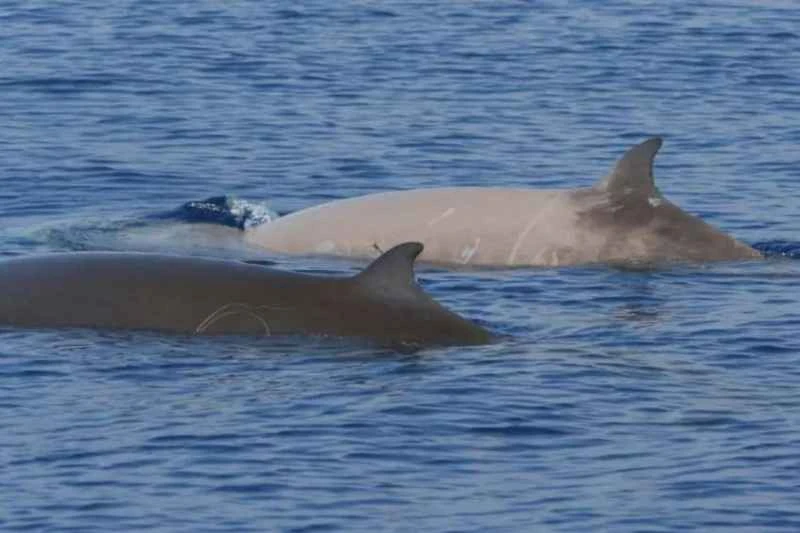
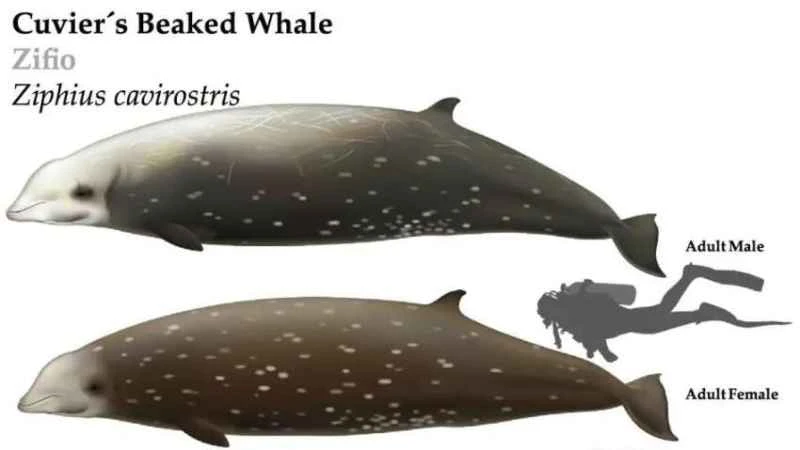
Medium to large in size, with a short and sturdy snout, and a dark gray to brownish-gray body color with great individual variation; small and rear-positioned dorsal fin; adult males have a pair of teeth visible on the front of their lower jaw, and their head and back are often covered with white scars left by competition among their own kind.
Detailed introduction
The Cuvier's Beaked Whale ( Ziphius cavirostris ) is one of the most widely distributed and mysterious beaked whales in the world, belonging to the family Ceratocetiidae. They inhabit the edge and slope of the deep sea year-round, rarely lingering near the shore, making them much harder for the average person to encounter at the surface than dolphins or humpback whales. The Cuvier's Beaked Whale is renowned as a "master of deep-sea diving": they can dive for extremely long periods, primarily preying on squid and deep-sea fish in the dark depths. Due to their long-term deep-sea activities, short surfacing times, and lack of curiosity about ships, much about their behavior and population dynamics remains unknown.
On the surface, Cuvier's beaked whales often only briefly take a breath before diving again, frequently observed with only their backs and small, rear-mounted dorsal fins exposed. Adult males often have noticeable scars near their heads, mostly from competition among themselves or interactions with other whales/sharks, reflecting that they are not "quiet and peaceful" in the deep-sea world.
Classification and nomenclature
The Cuvier's beaked whale belongs to the class Mammalia, order Cetacea, suborder Odontoceti, family Ziphiidae, and genus Ziphius . Common characteristics of beaked whales include a prominent beak, elusive behavior, a preference for deep-sea environments, and reliance on echolocation for hunting in the deep sea. The English name "beaked whale" refers to its beak-like snout; "Cuvier's" is a commemorative title given to scientists who studied and named the species.
Appearance features
Cuvier's leaf-beaked whale is medium to large in size, with a sturdy, torpedo-shaped body, a slightly raised head, and a short, strong snout. Adults typically reach 5–7 meters in length and can weigh several tons; females are often slightly larger than males. Their body color is mostly dark gray, brownish-gray, or chocolate brown, with a lighter underside; there is significant individual variation, with many individuals covered in light-colored scratches and spots.
The dorsal fin is small and positioned far back, which helps reduce drag during long deep dives. Adult males usually have a pair of visible teeth on the front of their lower jaw (beaked whales' teeth are more used for competition among themselves than for hunting), and males often have dense scars on their heads and backs; females and juveniles are generally "cleaner," but may also have scattered scratches.
Distribution range and habitat
Cuvier's beaked whales are found in temperate to tropical waters of almost every ocean in the world, making them one of the most widely distributed beaked whales. They prefer deep-water environments and are commonly found in areas with complex topography, upwelling currents, or rich food chains, such as the outer edge of the continental shelf, continental slope, submarine canyons, and around seamounts. Unlike typical nearshore dolphins, Cuvier's beaked whales do not usually stay in shallow bays or nearshore waters for extended periods.
Because they rely on deep-sea ecosystems for foraging, they are highly sensitive to seafloor topography, deep-water mass structure, and seasonal changes in prey (deep-sea squid/fish). While some sea areas may have relatively stable "hotspots," their overall spatial utilization remains difficult to fully reveal through routine observations.
Lifestyle Habits and Behaviors
Cuvier's beaked whales are highly skilled at deep diving, typically employing a series of short breaths before embarking on extended descents to use echolocation to locate prey in the deep sea. When surfacing for air, they tend to remain discreet: they rarely leap dramatically, their jets are low, and they usually form small groups (commonly solitary individuals, mother-and-calves pairs, or small groups).
Their social structure is considered relatively loose, but relatively stable groupings of individuals have been observed in certain areas. Adult males may compete for mating opportunities, and the "white scratches" commonly seen on males are visible traces of this process. Due to their short time at the surface, many behaviors can only be inferred indirectly through acoustic recordings, satellite tagging, and studies of stranded individuals.
feeding habits
Cuvier's beaked whales primarily prey on deep-sea squid, but also consume deep-sea fish and other mid-to-deep-sea organisms. They typically hunt at depths of several hundred to several thousand meters, using echolocation to locate their prey and quickly sucking it in. Unlike biting their prey with their teeth, beaked whales often rely more on "sucking" and negative pressure in their mouths to capture soft cephalopods.
The distribution of deep-sea prey is influenced by ocean currents, seabed topography, and diurnal vertical migration, which also makes the foraging routes of Cuvier beaked whales exhibit a distinct "deep-sea rhythm".
Reproduction and life cycle
Beaked whales generally have a slow reproductive pace; Cuvier's beaked whales typically give birth to one calf per litter. Specific breeding seasons and gestation periods may vary in different sea areas, but overall they employ a strategy of "few births and a long nursery period." The calf learns breathing, diving, and foraging skills in the presence of its mother, and the mother-child bond is maintained for a considerable period.
Their lifespan can reach several decades (often thought to be around 40 years or even longer), and they take many years to reach sexual maturity. Due to their long lifespan and low reproduction rate, local populations may recover slowly if they experience continuous human stress.
Relationship with humans
Cuvier's beaked whales rarely approach the coast and are not traditionally considered "whale-watching stars," but in a few deep, near-shore areas (such as areas with submarine canyons close to the coast), they can still be a high-quality subject of observation. For researchers, they are important species for understanding deep-sea ecology and the deep-diving physiology of toothed whales.
On the other hand, beaked whales are considered to be more sensitive to strong anthropogenic noise, especially intense acoustic activity in certain frequency bands. Historically, there have been discussions about mass strandings of beaked whales related to acoustic disturbances in various locations; therefore, the assessment and management of deep-sea acoustic activities are of great significance for reducing risks.
Protecting the status quo and threats
Cuvier's beaked whale is generally assessed as Least Concern (LC) globally, but this does not mean that all sea areas are "safe." Due to their deep-sea lifestyle, the main risks they face are often more insidious: deep-sea acoustic disturbances may trigger behavioral changes and stranding risks; mixed catches and fishing gear entanglement in some areas remain threats; accidental ingestion of marine plastics (especially soft plastics) and accumulation of chemical pollutants may also affect their health.
Conservation priorities typically include: strengthening the monitoring and assessment of grounding and acoustic activities, optimizing noise management in sensitive waters, reducing the risk of fishery mixed catches and entanglement, and gaining a clearer understanding of population trends in different sea areas through long-term surveys (acoustic, imagery, and tagging).
Frequently Asked Questions
Q1: Why are Cuvier's beaked whales so difficult to see?
They mainly live on the edge of the deep sea, and their time to surface for air is short, their jets are not high, and they rarely leap out of the water. They often only stay on the surface briefly before diving deep again, making them very difficult to spot.
Q2: Can they really dive very deep and for a long time?
Yes. Cuvier's beaked whales are known for their extremely long deep-sea dives, typically staying in the deep sea for extended periods to hunt squid and deep-sea fish before briefly surfacing to breathe.
Q3: What do Cuvier's beaked whales mainly eat?
It primarily feeds on deep-sea squid, but also consumes mid-to-deep-sea creatures such as deep-sea fish. It relies on echolocation to locate prey in the dark deep sea and captures them by "sucking".
Q4: What are the main threats they face?
The main risks include behavioral changes and grounding risks caused by deep-sea acoustic disturbances, mixed catches and entanglements of fish in some sea areas, as well as hidden pressures such as accidental ingestion of plastics and accumulation of pollutants.


