Basic Information
Scientific classification
- Chinese name: Western Brown Snake
- Scientific name: Pseudonaja nuchalis
- Classification: Squamata
- Family and genus: Elapidae, genus *Pseudorascar*
Vital signs data
- Body length: Adults are generally about 1–1.5 meters long, with larger individuals exceeding 1.8 meters. They have long and powerful bodies.
- Weight: Weight varies depending on body size and nutritional status, with most adult individuals weighing between several hundred grams and one or two kilograms.
- Lifespan: It is estimated that it can survive for more than ten years in the wild, but the actual lifespan is affected by the habitat and predator pressure.
Significant features
One of the most common highly venomous brown snakes in the Australian outback and western regions, it has varied body coloration, moves quickly, and is widely found in farms and desert scrub environments, playing an important role in controlling small mammals such as rodents.
Distribution and Habitat
Widely distributed in arid and semi-arid regions of western and central Australia, including red deserts, gravel plains, dry scrublands, savannas, and areas around farms and pastures, they often use burrows, rock crevices, fallen logs, and gaps in man-made structures as hiding places.
Appearance
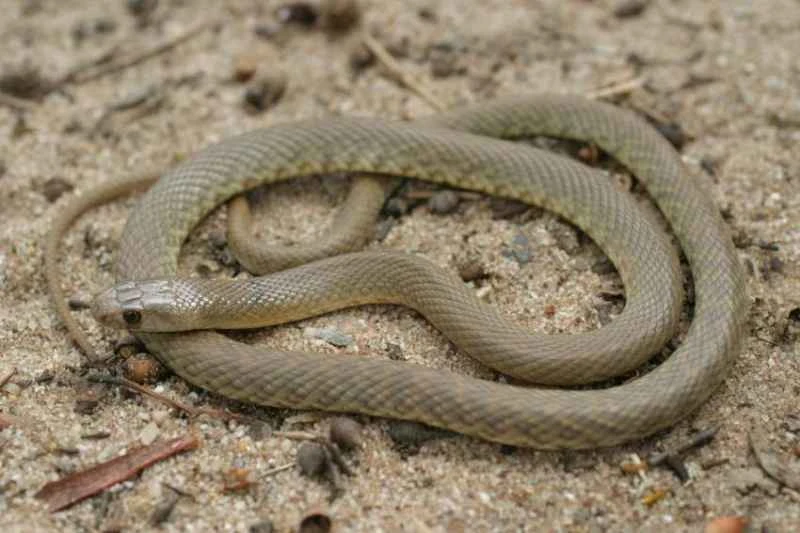
The body is slender and sturdy, with the back ranging from light yellowish-brown and sandy to dark chocolate brown and even nearly black. Some individuals have irregular dark spots or light horizontal bands, while others are almost monochromatic. The underside is lighter, being cream, light yellow, or pinkish-gray. The head is relatively small and transitions smoothly to the neck. The eyes are medium-sized, and the overall appearance gives the impression of a "swift, brown snake."
Detailed introduction
The Western Brown Snake ( Pseudonaja nuchalis ) is a medium-sized, highly venomous native Australian snake belonging to the genus Pseudonaja in the family Elapidae. It belongs to the high-risk venomous snake complex within the same genus as the Eastern Brown Snake. Its body color varies greatly, ranging from light yellowish-brown to dark chocolate brown and even near black. It is one of the most common and medicinally significant venomous snakes in the Australian outback and western regions.
Classification and nomenclature
The Western Brown Snake belongs to the class Reptilia, order Squamata, suborder Serpentes, family Elapidae, and genus Pseudonaja . This genus includes several highly venomous Australian brown snakes, such as the Eastern Brown Snake and the Dugut Brown Snake, and is an important group of anterior-fanged venomous snakes in the region. Traditionally, "Western Brown Snake" generally corresponds to Pseudonaja nuchalis , but recent research suggests that the original term "Western Brown Snake" may encompass multiple morphologically and genetically differentiated species or geographic types. For educational and practical purposes, the broader concept of the Western Brown Snake will be used here for explanation.
Appearance features
The western brown snake is slender, with adults typically reaching 1–1.5 meters in total length, though larger individuals can exceed 1.8 meters. Its back coloration is highly variable, ranging from light yellowish-brown, sandy, orange-brown, chocolate brown, to dark gray or near black. Some individuals have irregular spots or faint horizontal bands, while others are almost entirely monochromatic. The neck and head are sometimes slightly darker or have a subtle "hood" of color, but this is not as pronounced as in cobras. The underside is generally lighter, often cream, light yellow, or pinkish-gray, sometimes with dark spots. The head is relatively small and flattened, less distinct from the neck than in tiger snakes. The eyes are medium-sized with round pupils. Overall, it is described as a "slender, fast-moving, and multicolored brown snake."
Distribution range and habitat
The western brown snake is mainly distributed in most of the arid and semi-arid regions of western and central Australia, including most of the inland areas of Western Australia, the central and southern Northern Territory, most of the inland areas of South Australia, and parts of the inland areas of Queensland. They are adapted to a variety of open terrestrial habitats, such as red deserts, gravel plains, dry scrubland, savanna, farmland, and pastures, and particularly prefer micro-habitats with hiding places such as cracks, burrows, piles of rocks, and fallen logs. Western brown snakes are also commonly found near roadsides, farm buildings, waste piles, and barns, utilizing the hiding places and rodent resources provided by human environments.
Lifestyle Habits and Behaviors
Western brown snakes are mostly diurnal or twilight-active, especially active during the warmer spring and summer months. During warmer periods, they may be active at dawn and dusk, retreating to burrows or shady spots to escape the midday heat. Known for their speed and agility, they often quickly flee into the nearest burrow or crevice when startled. If cornered or subjected to persistent provocation, they will raise their forebody, slightly flatten their neck, and hiss, and may launch a rapid bite if necessary. Due to their potent venom and swift bite, they are considered one of the most dangerous snakes in the Australian outback.
feeding habits
The western brown snake is a carnivorous, high-altitude predator, primarily feeding on small mammals (especially rodents and other rodents), but also preying on lizards, other small snakes, birds and bird eggs, and sometimes frogs and large insects. In farmland and pasture environments, they are frequently found in grain silos, chicken coops, and feed storage areas, where they prey on large numbers of rodents, thus helping to control rodent populations to some extent. However, this "help" comes with a significant risk of snakebites, and humans and livestock must exercise extreme caution when in the same environment.
Reproduction and life cycle
Unlike most Australian cobras, the western brown snake is an oviparous species. The breeding season typically occurs in spring and early summer, during which males actively seek out females and may engage in fights. After mating, the female lays dozens of soft-shelled eggs in burrows, rock crevices, or gaps in man-made structures, with clutches usually ranging from 10 to 25 eggs. The eggs incubate in a warm, relatively dry but not completely arid environment, and the young snakes hatch after several weeks to two months. Although the newborn juveniles are small, their venom glands and fangs are fully developed, and their venom should not be underestimated. Western brown snakes are estimated to live for over ten years in the wild.
Relationship with humans
Because the western brown snake is widely distributed around farms, pastures, and rural settlements, opportunities for contact with humans are not uncommon. In the Australian outback, it is one of the leading causes of snakebite poisoning. Its venom is primarily neurotoxic, myotoxic, and causes coagulation disorders; severe cases can lead to paralysis, respiratory distress, rhabdomyolysis, and kidney failure, and can be fatal without prompt treatment. Therefore, people working or living in western brown snake habitats (such as farm workers, ranchers, and road maintenance workers) are generally advised to receive relevant safety education and first aid training. If you encounter a suspected western brown snake, keep your distance and allow it to leave on its own; never attempt to capture or kill it. If a bite occurs, immediately apply pressure and bandage, and seek medical attention as soon as possible.
Protecting the status quo and threats
The western brown snake complex, broadly defined, is generally considered a widely distributed and generally stable species in current assessments, approaching the IUCN "Least Concern" category. While some local populations may still be affected by habitat degradation, roadkilling, human hunting, and invasive predators such as domestic cats and foxes, the western brown snake demonstrates greater adaptability to arid and semi-arid environments compared to many snakes whose habitats are highly dependent on wetlands. Key measures for protecting this species and related brown snake groups include: maintaining inland scrubland and savanna ecosystems; preserving natural rock mounds and burrows as habitats for protozoa in agricultural and pastoral production; and reducing indiscriminate fear and hunting of snakes through public education.
Frequently Asked Questions
Q1: What are the differences between the western brown snake and the eastern brown snake?
Both belong to the genus *Pseudococcus* and are highly venomous. The Eastern Brown Snake is mainly distributed in eastern and parts of southern Australia, while the Western Brown Snake is widely distributed in the western and inland arid regions, and there are also some regional differences in body color and patterns.
Q2: How dangerous is the venom of the western brown snake?
The venom of the western brown snake contains potent neurotoxins and myotoxins, and affects the coagulation system. If not treated promptly after being bitten, it can lead to serious consequences such as paralysis, difficulty breathing, rhabdomyolysis, and kidney damage. It is a venomous snake with extremely high medical significance.
Q3: What should I do if I encounter a western brown snake on a farm or in the countryside?
Remain calm, keep a safe distance from the snake, and allow it to leave on its own. Do not attempt to catch, drive away, or strike it. If the snake appears in a high-risk location, contact local professional snake catchers or wildlife agencies for assistance.
Q4: What role does the western brown snake play in the ecosystem?
The western brown snake is an important mid-to-high-altitude predator in inland scrubland and pastoral areas, mainly preying on rodents, lizards and other small vertebrates. It helps control rodent populations and maintain food web balance, while also providing a food source for birds of prey and large reptiles.


