Basic Information
Scientific classification
- Chinese name: Yellow-bellied sea snake
- Scientific name: Hydrophis platurus
- Classification: Squamata
- Family and genus: Elapidae, genus *Senecio*
Vital signs data
- Body length: Adults are generally about 80–100 cm in total length, with large individuals exceeding 1.2 meters, and have a slender body shape.
- Weight: Weight varies from person to person and nutritional status, with most adult individuals weighing around several hundred grams.
- Lifespan: There is no precise data on lifespan in the wild, but it is generally estimated that it can survive for about ten years or longer.
Significant features
One of the most widely distributed sea snakes in the world, with a dark brown back, a bright yellow belly, and a highly laterally compressed, paddle-shaped tail, it spends almost its entire life in the sea and is a typical fully marine, highly venomous sea snake.
Distribution and Habitat
Widely distributed in the outer and nearshore surface waters of the tropical and subtropical Indian and Pacific Oceans, they mostly float or swim in the high seas tens to hundreds of kilometers from the coastline, and may also appear in some nearshore harbors, lagoons, and the outer edges of coral reefs. They rarely come ashore, usually only being washed ashore by storms or abnormal currents.
Appearance
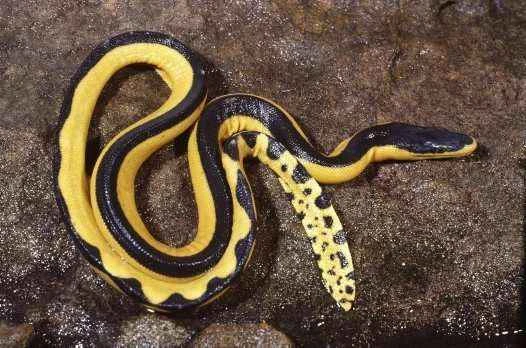
The body is slender, with a black or dark brown back and upper sides, and a bright yellow to yellow-orange lower sides and belly, creating a striking contrast. The tail is highly laterally compressed and paddle-shaped for efficient swimming; the scales are small and smooth; the head is slightly small and flat, with medium-sized eyes and a mouth that extends slightly backward.
Detailed introduction
The yellow-bellied sea snake (scientific name *Hydrophis platurus* , formerly known as *Pelamis platurus* ) is a medium-sized, highly venomous marine snake belonging to the genus *Hydrophis* in the family Elapidae. It is one of the most widely distributed sea snakes in the world, found almost throughout the tropical and subtropical Indo-Pacific waters. It spends its entire life in the sea surface and nearshore waters, rarely venturing ashore.
Classification and nomenclature
The yellow-bellied sea snake belongs to the class Reptilia, order Squamata, suborder Serpentes, family Elapidae, and genus Hydrophis . It was previously classified under the monotypic genus *Pelamis* , known as *Pelamis platurus* , but based on molecular systematics and morphological studies, most scholars have now placed it under the genus *Hydrophis *. Its English name, Yellow-bellied Sea Snake, directly describes the bright yellow banded markings on its sides and belly, making it one of the most representative sea snakes of the tropical open seas.
Appearance features
The yellow-bellied sea snake has a slender body, with adults typically reaching 80–100 cm in total length, though larger individuals can exceed 1.2 meters. The back and upper sides are mostly black or dark brown, while the lower sides and belly are a bright yellow to yellowish-orange, creating a striking contrast. Some individuals also exhibit irregular, wavy demarcation along their sides. The tail is highly laterally compressed, resembling a paddle blade, a typical "paddle tail" that aids in efficient swimming in seawater. The scales are small and smooth, and the body surface has an oily secretion that reduces water resistance and prevents immersion. The head is slightly small and flattened, with medium-sized eyes and round pupils; the mouth is slightly elongated posteriorly, and the upper jaw possesses fixed anterior groove fangs, a typical structure for sea snake fangs.
Distribution range and habitat
The yellow-bellied sea snake is recognized as one of the most widely distributed sea snakes, found extensively in the tropical and subtropical waters of the Indian and Pacific Oceans. Its range extends from the coast of East Africa and the Red Sea, through the Indian Ocean, the Southeast Asian archipelago, the South China Sea, and the northern and eastern waters of Australia, all the way to the central Pacific and the Pacific coast of Central and South America. They primarily inhabit the surface waters of open and nearshore waters, often active in the high seas tens or even hundreds of kilometers from the coastline, and can also be found in some nearshore harbors and lagoons. Yellow-bellied sea snakes spend most of their time floating near the surface, moving using ocean currents and wind direction, and rarely come ashore. Even if pushed ashore by storms or currents, their survival time on land is very limited.
Lifestyle Habits and Behaviors
Yellow-bellied sea snakes are typical marine snakes, spending most of their time at or a few meters below the surface. They are adept at "floating" on the sea surface and are often observed "floating in groups" or gathering in large numbers with ocean currents. Yellow-bellied sea snakes can hold their breath for extended periods, diving for tens of minutes at a time, obtaining oxygen through auxiliary gas exchange via their lungs and skin. They often swim near the surface or drift semi-passively with the waves and currents. Once they spot prey or feel threatened, they rapidly move their bodies and flattened tails to accelerate. Although yellow-bellied sea snakes are highly venomous, they generally do not attack humans proactively; most bites occur during accidental contact or fishing operations.
feeding habits
Yellow-bellied sea snakes primarily feed on small fish, especially slender ones and fry, such as eel larvae and small bottom-dwelling fish. They mostly inhabit the water's surface or shallow layers, using their sight and sense of smell to locate schools of small fish. They then swiftly pounce and bite, paralyzing their prey by injecting venom before swallowing them whole. Due to their relatively small size, they typically choose slender, easily swallowed fish and rarely prey on larger animals.
Reproduction and life cycle
Yellow-bellied sea snakes are viviparous, completing almost their entire life cycle in the sea and never needing to come ashore to lay eggs. The breeding season varies depending on the sea area and water temperature, generally occurring during the warmer months. After mating, the embryo develops inside the female for several months, eventually being born directly as a young snake fully adapted to marine life. A litter typically consists of several to more than ten offspring. Newborn snakes can swim and prey on small fish immediately after birth. Precise data on the lifespan of yellow-bellied sea snakes in the wild is unknown, but it is generally estimated that they can live for about ten years or even longer.
Relationship with humans
Yellow-bellied sea snakes are widely distributed in major shipping and fishing areas. They are occasionally entangled in fishing nets, longlines, or drifting debris, and may also be washed ashore after storms. Their venom is highly neurotoxic and myotoxic; experimental studies show it to be extremely potent. However, yellow-bellied sea snakes are generally docile and do not attack unprovoked. Human bites often occur when attempting to remove sea snakes from fishing nets or boats, or when accidentally grasping or stepping on an individual. For those working at sea, it is recommended to wear protective gloves, avoid handling unidentified sea snakes with bare hands, and immediately apply pressure to the wound and seek medical attention as soon as possible if a bite occurs.
Protecting the status quo and threats
In current global assessments, the yellow-bellied sea snake is generally considered a widely distributed species with relatively stable populations, approaching the IUCN "Least Concern" category. However, in certain marine areas, the species may still be affected by factors such as bycatch, marine plastic entanglement, seawater pollution, and changes in sea surface temperature. As a typical offshore sea snake, it is highly sensitive to the health of marine ecosystems. Measures to conserve the yellow-bellied sea snake include: reducing bycatch and marine plastic pollution, strengthening monitoring of nearshore and offshore ecosystems, and raising public awareness of sea snake diversity and the importance of marine conservation through public education.
Frequently Asked Questions
Q1: Will the yellow-bellied sea snake actively attack humans?
Yellow-bellied sea snakes are generally docile and will not attack humans unless provoked. Most bites occur during fishing operations when people try to catch or rescue the sea snakes from fishing nets. If you do not touch them when you encounter them at sea, they will usually swim away on their own.
Q2: Is the venom of the yellow-bellied sea snake very strong?
Yes, the venom of the yellow-bellied sea snake has strong neurotoxic and myotoxic effects, and its toxicity is extremely high from an experimental perspective. However, since it rarely bites people actively and the number of bite cases is relatively limited, the actual risk of human exposure mainly comes from fishery workers and people working at sea.
Q3: Do yellow-bellied sea snakes need to come ashore?
The yellow-bellied sea snake is an almost entirely marine species that can mate, reproduce, and complete its entire life cycle in seawater, without needing to come ashore to lay eggs. Even if it is pushed ashore by waves or storms, it is unlikely to survive for long.
Q4: What role does the yellow-bellied sea snake play in the marine ecosystem?
Yellow-bellied sea snakes primarily prey on small fish and are important mid-water predators in offshore and nearshore food webs, helping to regulate the population of small and medium-sized fish. At the same time, they also provide food sources for large fish, seabirds, and some marine mammals, playing a significant role in maintaining the structure and energy flow of marine ecosystems.