Basic Information
Scientific classification
- Chinese name: Philippine Three-Toed Kingfisher
- Scientific name: Ceyx melanurus, Philippine Dwarf-kingfisher
- Classification: Climbing birds
- Genus and species: Order Coraciiformes, Family Kingfisher, Genus *Tripterygium*
Vital signs data
- Body length: No verification information available.
- Weight: No verification information available.
- Lifespan: No verification data available.
Significant features
It is a small forest kingfisher with very bright colors.
Distribution and Habitat
The Philippine Three-Toed Kingfisher is distributed across the Pacific islands (including the Philippines, Brunei, Malaysia, Singapore, Sumatra and Java in Indonesia, and Papua New Guinea).
The Philippine Three-Toed Kingfisher typically inhabits dense forests and riverbanks near water.
Appearance
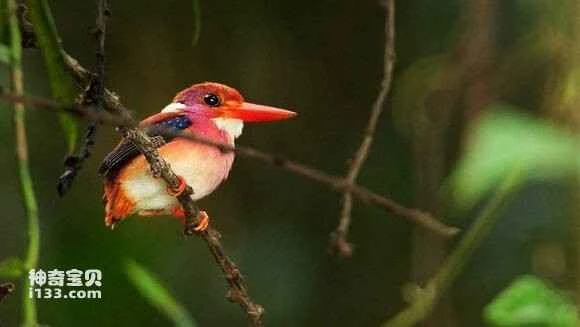
The Philippine Three-Toed Kingfisher has an orange-red head, forehead, neck, chest, and back; a long white stripe on each side of the back of the neck; greyish-brown wings with dark blue edges on the feather tips; white rump and belly; orange-red tail feathers; white chin and throat; purplish-red ear coverts with a reflective sheen; and darker undertail coverts. The bird's body is brilliantly colored. The iris is brown; the beak and legs are red.
It has only three toes; its tail is shorter than its beak; its wings are pointed and long; its plumage is not black or white. Its beak is thick, straight, long, and strong, with a rounded ridge; its nasal groove is not prominent; its wingtips are long, with the first primary flight feather being slightly shorter and the third and fourth feathers being the longest; its tail is short and rounded; its body plumage is bright and glossy, often with blue or green hues.
Detailed introduction
The Philippine three-toed kingfisher, scientifically known as *Ceyx melanurus*, has three subspecies: (1. *Ceyx melanurus melanurus*, distributed in Luzon, Polynesia, Alabat, and Catanduanes in the Philippines; 2. *Ceyx melanurus samarensis*, distributed in Samar and Leyte in the Philippines; 3. *Ceyx melanurus mindanensis*, distributed in Mindanao and Basilan in the Philippines).
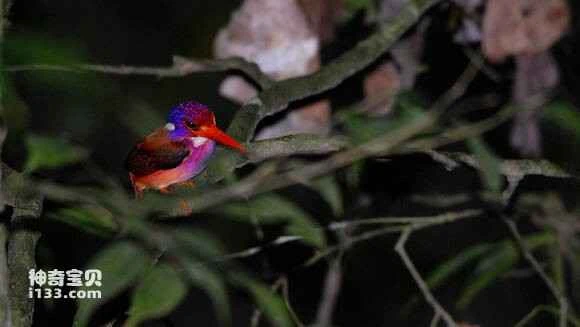
The Philippine Three-toed Kingfisher typically hunts alone or in pairs. Like most forest kingfishers, it is entirely carnivorous, searching for prey in leaves or mud. Its main diet consists of insects such as crickets, spiders, scorpions, and snails. It also eats various aquatic animals. Although it frequently spends time near water and bathes often, it does not fish, only occasionally catching small frogs.

The Philippine Three-toed Kingfisher typically nests on earthen cliffs or river embankments, using its beak to dig tunnel-like burrows that are usually unlined. Eggs are laid directly on the ground within the nest. Some also burrow into tree trunks to make nests.
Listed as Vulnerable (VU) in the IUCN Red List of Threatened Species (ver 3.1: 2008).

Protect wild animals and ban the consumption of wild game.
Maintaining ecological balance is everyone's responsibility!