
Basic Information
Scientific classification
- Chinese name: Three-toed Kingfisher
- Scientific name: Three-toed Kingfisher (Ceyx erithaca)
- Classification: Climbing birds
- Genus and species: Order Coraciiformes, Family Kingfisher, Genus *Tripterygium*
Vital signs data
- Body length: 13-14 cm
- Weight: 14-20g
- Lifespan: No verification data available.
Significant features
Only 3 toes
Distribution and Habitat
The Three-Toed Kingfisher is found in Bangladesh, Bhutan, Brunei Darussalam, Cambodia, China, India, Indonesia, Lao People's Democratic Republic, Malaysia, Myanmar, Philippines, Singapore, Sri Lanka, Thailand, and Vietnam.
The three-toed kingfisher inhabits the banks of streams and rivers in evergreen broad-leaved forests below 1500 meters in altitude, and is a typical forest stream-side bird. It lives in evergreen primary and secondary forests, generally active on small hills or in low-lying vegetation areas.
Appearance
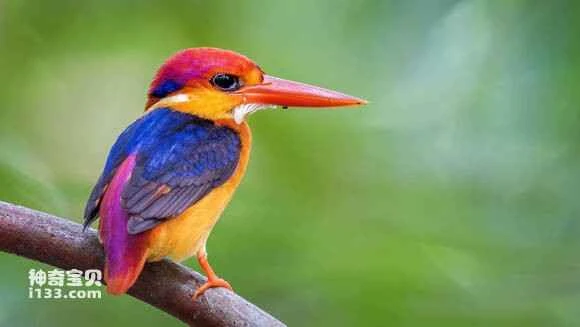
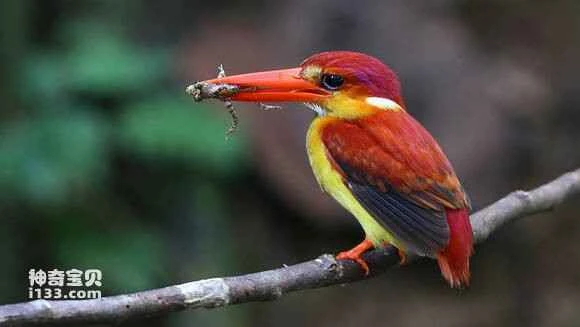
The Three-Toed Kingfisher is very small, measuring 13-14 cm in length. Males weigh 14-20 grams, and females weigh 14-16 grams. It is a reddish-yellow kingfisher. Its forehead is black; head and neck are orange-red; shoulder feathers are greyish-brown with dark blue edges; upper back is dark blue; lower back, rump, upper tail coverts, and tail feathers are orange-red, except for the tail feathers, which are purplish-red in the center with a reflective sheen. Wings are greyish-brown. Chin is white; throat is pale egg-yolk white; ear coverts are purplish-red with a reflective sheen; from below the bill to the breast, abdomen, and undertail coverts are egg-yolk yellow, darker below the bill to the breast and undertail coverts, and lighter on the abdomen. Iris is brown; bill and legs are red.
It has only three toes; its tail is shorter than its beak; its wings are pointed and long; its plumage is not black or white. Its beak is thick, straight, long, and strong, with a rounded ridge; its nasal groove is not prominent; its wingtips are long, with the first primary flight feather being slightly shorter and the third and fourth feathers being the longest; its tail is short and rounded; its body plumage is bright and glossy.
Size measurements: Weight: ♂ 12-16 g, ♀ 14-18 g; Body length: ♂ 128-130 mm, ♀ 132-141 mm; Bill length: ♂ 32-34 mm, ♀ 32-33 mm; Wing length: ♂ 51-57 mm, ♀ 54-58 mm; Tail length: ♂ 23-26 mm, ♀ 25-27 mm; Tarsus length: ♂ 8-10 mm, ♀ 8-10 mm. (Note: ♂ male; ♀ female)
Detailed introduction
The Three-toed Kingfisher, scientifically known as *Ceyx erithaca*, has three subspecies: (1) the nominate subspecies *Ceyx erithacaerithaca*, distributed in southwestern India (Mumbai), Sri Lanka, Bhutan, China (Yunnan and Hainan), Sumatra, and neighboring islands; (2) the Andaman subspecies *Ceyx erithacamacrocarus*, distributed in the Andaman Islands, Nicobar Islands, and Sumatra; and (3) the Borneo subspecies *Ceyx erithacamotleyi*, distributed in the Philippines, Borneo, Java, Sumbawa, and Flores.
The three-toed kingfisher is a migratory bird. It migrates from August to September and returns north in March. It usually hunts alone or in pairs. Solitary by nature, it typically perches alone on branches or rocks near water, waiting to hunt. Its diet consists mainly of small fish, supplemented by crustaceans, various aquatic insects and their larvae, as well as small frogs and a small amount of aquatic plants. It often perches upright on low branches and reeds near water, or on rocks, waiting to catch fish and shrimp. Even when submerged, the kingfisher maintains excellent vision because its eyes can quickly adjust to the visual contrast caused by light underwater. Therefore, its hunting skills are almost always accurate. Like most forest kingfishers, it is entirely carnivorous. It often searches for prey in leaves or mud. Its main diet consists of insects, locusts, flies, and spiders, but it also eats various aquatic animals such as water beetles, small crabs, frogs, and small fish.
The breeding season for the Three-toed Kingfisher is June in Sri Lanka, July to September in southwestern India, April and May in northeastern India, May in Malaysia, December to May in Java, and March in Sumatra. They nest in earthen cliffs or river embankments, digging tunnel-like burrows with their beaks, 25 cm deep, 13-15 cm wide, and 5-7 cm in diameter and height. These burrows are generally unlined. The female lays 3 to 7 eggs directly on the ground in the nest. Some also burrow into tree trunks to nest; the eggs measure 18-20 mm × 14-16 mm.

Listed as Least Concern (LC) on the IUCN Red List of Threatened Species 2013 ver 3.1.
Protect wild animals and ban the consumption of wild game.
Maintaining ecological balance is everyone's responsibility!


