Basic Information
Scientific classification
- Chinese name: Inland Taipan
- Scientific name: Oxyuranus microlepidotus
- Classification: Squamata
- Family and genus: Elapidae, taipan
Vital signs data
- Body length: Adult snakes are generally 1.8–2.5 meters in total length, belonging to medium to large-sized snakes, with slender and powerful bodies.
- Weight: Weight varies depending on individual size and nutritional status, with most adults weighing several kilograms.
- Lifespan: It is estimated that it can survive for more than ten years or even longer in the wild, and sexual maturity usually takes several years.
Significant features
Native to the semi-arid regions of the Australian outback, this highly venomous snake is considered one of the most venomous land snakes in the world. However, it is generally elusive and timid, rarely making contact with humans.
Distribution and Habitat
They mainly inhabit the arid inland black soil plains and semi-arid grasslands and shrublands of central and eastern Australia. They prefer micro-habitats with fissured clay, rodent burrow systems, rock piles, and farmland edges where they can hide. They are most active in the early morning and evening when the temperature is suitable.
Appearance
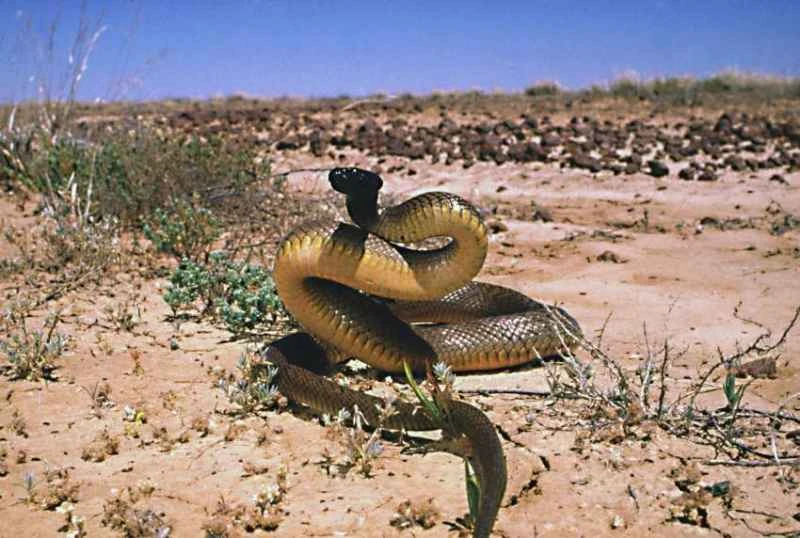
With a slender body, adults can reach over two meters in length. Their body color varies with the seasons, ranging from light yellowish-brown to dark brown. The scales on their trunks are dense and have alternating light and dark edges, giving them a delicate net-like or scale-like effect. The underside is lighter in color, mostly pale yellow or milky white. The head is slightly angular, with medium-sized eyes and well-developed anterior groove fangs.
Detailed introduction
The Inland Taipan (scientific name *Oxyuranus microlepidotus *) is a highly venomous snake belonging to the genus *Oxyuranus* in the family Elapidae. Native to the arid inland regions of central Australia, it is widely considered one of the most venomous land snakes in the world, and is often referred to as the "Fierce Snake." However, Inland Taipans are typically elusive and cautious, rarely making contact with humans, and bites from them in the wild are extremely rare.
Classification and nomenclature
The inland taipan belongs to the class Reptilia, order Squamata, suborder Serpentes, family Elapidae, and genus Oxyuranus . The genus Oxyuranus contains only a few species of large Australian venomous snakes, including the common coastal taipan and the inland taipan with its limited distribution. The specific epithet * microlepidotus * means "small scales," describing the densely packed scales on its body. Due to its extremely potent venom, in English, besides *Inland Taipan*, it is also commonly known as Fierce Snake or Small-scaled Snake.
Appearance features
The inland taipan is a medium to large-sized snake with a long and powerful body. Adults typically reach a total length of 1.8–2.5 meters, with some larger individuals approaching or slightly exceeding 2.5 meters. Body color varies with the season and individual condition: in summer, it is lighter in color, ranging from yellowish-brown, olive-brown, or light brown; in winter, it tends to darken, approaching dark brown or chocolate, which helps it absorb more heat. The scales on the body often have alternating light and dark edges, giving the overall appearance of a fine reticulated or scaly pattern. The ventral surface is lighter, ranging from pale yellow to milky white, often with a faint orange or pink tinge. The head is slightly prismatic, with medium-sized eyes and round pupils. The anterior part of the upper jaw has fixed anterior-slotted fangs, typical of anterior-slotted fanged snakes in the Elapidae family.
Distribution range and habitat
The inland taipan is primarily distributed in the arid inland regions of central and eastern Australia, including southwestern Queensland, northwestern New South Wales, and parts of the inland basins of South Australia. Their typical habitats are dry black soil plains, open semi-arid grasslands, and scrublands, often associated with the Gibson Plain or cracked clay plains. Inland taipans tend to frequent fissured soils, abandoned burrows, rock piles, and farmland edges, and also utilize extensive rodent burrow systems as cover. During periods of extreme heat or drought, they mostly retreat to underground nests to escape the heat and hibernate, only venturing out when temperatures are suitable.
Lifestyle Habits and Behaviors
The inland taipan is a diurnal snake, active primarily at dawn and dusk, especially when temperatures are cooler. During the hot daytime, they typically hide in burrows, under rocks, or in crevices to avoid overheating. Contrary to its reputation for ferocity, wild inland taipans are usually extremely timid and alert. Upon detecting humans or large animals, they will quickly retreat to their burrows or move away. They will only resort to defensive attacks when cornered, directly threatened, or accidentally stepped on. When attacking, the inland taipan rapidly raises its forebody and delivers a series of rapid bites, demonstrating astonishing speed and accuracy.
feeding habits
The inland taipan primarily preys on small to medium-sized mammals, especially various native rodents and invasive rodents such as house mice and brown rats. They are adept at utilizing rodent burrow systems, tracking prey both on the surface and underground. When hunting, the inland taipan often delivers multiple rapid bites, injecting a large amount of highly toxic venom into its prey, before quickly releasing its grip and withdrawing to allow the venom to take effect and avoid injury from a counterattack. The venom contains potent neurotoxins, hemagglutinins, and myotoxins, capable of paralyzing and killing small mammals within a short time. By controlling rodent populations, the inland taipan plays a regulatory role in semi-arid ecosystems.
Reproduction and life cycle
The inland taipan is an oviparous snake, with its breeding season occurring primarily during the warmer months in the region. During courtship, males may engage in non-venomous entanglement fights near the nest or habitat to compete for the female. After mating, the female lays a clutch of approximately 10–20 eggs in a secluded, dry location with relatively stable temperatures (such as deep caves, rock crevices, or under fallen logs), the exact number depending on the female's size and nutritional status. Incubation depends entirely on ambient temperature and humidity, and the young snakes hatch several weeks later. Newly hatched tapans possess venom similar to that of adults, but their smaller size makes them more vulnerable to predation by birds of prey, other snakes, and medium-sized mammals. Those that survive reach sexual maturity after several years of growth and are estimated to live for over ten years in the wild.
Relationship with humans
Because the inland taipan's habitat is primarily in sparsely populated, remote inland areas, and due to its extreme elusiveness and alertness, the chances of encountering it are very low. Therefore, despite its highly toxic venom, the number of confirmed bite cases is far lower than many other Australian venomous snakes found in areas bordering urban and rural areas. Modern snake prevention knowledge and the use of antivenom mean that if timely medical treatment is received after a bite, the risk of serious consequences can be significantly reduced. In Australia, all wild snakes are protected by law, and the general public is prohibited from arbitrarily capturing or killing them, including the inland taipan.
Protecting the status quo and threats
In the IUCN Red List, the inland taipan is generally assessed as "Least Concern" due to its relatively wide distribution, largely undeveloped habitats, and the absence of observed rapid overall population decline. However, localized areas may still face challenges such as habitat destruction, agricultural expansion, the effects of rodent-controlled poison bait (indirect poisoning), and habitat quality degradation caused by extreme weather events. Furthermore, its reputation as one of the world's most venomous snakes poses potential pressure on the population from individual reptile enthusiasts and illegal wildlife collection. Conservation of the inland taipan hinges on maintaining the integrity of its semi-arid black soil plains and natural grassland ecosystems, the proper management of farmland and grazing areas, and enhanced public science education to reduce misunderstandings and unnecessary hunting of snakes.
References
Cogger, H. (2000) "Australian Reptiles and Amphibians", Reed New Holland Publishing.
Greer, AE (2006) "Encyclopedia of Reptiles in Australia: Elapidae", Australian Museum
Ehmann, H. (1992) "The Australian Animal Encyclopedia: Reptiles", Australian Museum, Angus & Robertson Publishing.
Mirtshin, P. and Davis, R. (1991), “Dangerous Snakes of Australia,” revised edition, Ure Smith Press.
Wilson, S. and Swan, G. (2008), “The Complete Guide to Reptiles in Australia,” Reed New Holland Publishing.
Frequently Asked Questions
Q1: Is the inland taipan really "the most venomous snake in the world"?
Based on the lethal dose ( LD50 ) of venom per unit weight in experimental animals, the venom of the inland taipan is extremely toxic among terrestrial snakes, hence it is often referred to as "the most venomous terrestrial snake in the world." However, the actual level of danger is also affected by various factors such as the frequency of encounters, attack tendencies, the amount of venom injected, and medical conditions.
Q2: Why are there so few records of taipan snake bites in inland areas?
On the one hand, its natural distribution area is located in remote inland areas with low human density; on the other hand, inland taipans are generally cautious and timid, preferring to flee rather than attack. Therefore, they have fewer opportunities to come into contact with humans, and there are far fewer bite records than other venomous snakes distributed around cities.
Q3: What should I do if I am bitten by an inland taipan?
Immediately remain calm, restrict limb movement, apply a pressure bandage to the affected limb, and call for help or transfer the patient to a qualified medical facility as soon as possible. Do not cut the wound or suck out the venom. Modern medicine primarily relies on antivenom and supportive care to reduce the risk of poisoning.
Q4: What role does the inland taipan play in the ecosystem?
The inland taipan is a high-altitude predator in semi-arid grassland and black soil plain ecosystems, mainly preying on rodents. It helps regulate rodent populations, thus buffering vegetation pressure in farmland and grasslands, and indirectly affecting disease transmission and crop losses.