Basic Information
Scientific classification
- Chinese name: Hook-billed Kingfisher
- Scientific name: MeliMelidora macrorrhinadora macrorrhina, Hook-billed Kingfishe
- Classification: Climbing birds
- Genus and species: Order Coraciiformes, Family Kingfisher, Genus Kingfisher
Vital signs data
- Body length: Approximately 27 centimeters
- Weight: 85-110g
- Lifespan: No verification data available.
Significant features
Distribution and Habitat
The hook-billed kingfisher is mainly distributed in Australia and New Guinea.
Hook-billed kingfishers are common in the lowland forests and thickets of their habitat, especially below 700 meters, though they can reach altitudes of up to 1280 meters. They are generally found in rainforests, teak plantations, or rubber plantations, and a few have even ventured into cities.
Appearance
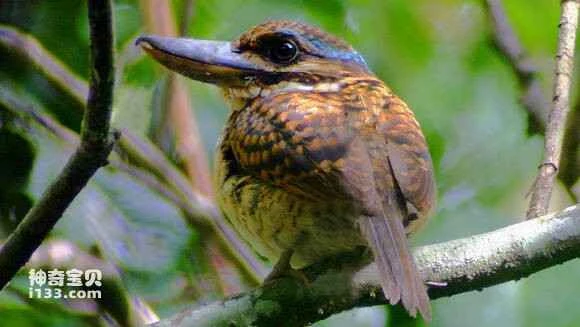
The Hook-billed Kingfisher is 27 cm in length, with females weighing 85-110 g and males 90-110 g. Its head and forehead are black, decorated with speckled sapphire-blue feathers on the sides. The bird has black lores, a white collar, and a discontinuous black ring on its neck. Its wattles, back, tail, and wings are dark brown with yellowish-scaled scales. The underparts and tail are entirely white, often with varying shades of pale yellow, pink, or yellow. Some Hook-billed Kingfishers have fine black markings on their chin, throat, and chest. The upper jaw is black. The iris is dark brownish-green, and the legs are grey. Adult females differ from males in that they have a yellowish-green stripe on their forehead and crown.
The beak is thick, straight, long, and strong, with a rounded ridge; the nasal groove is indistinct; the wingtips are long, with the first primary flight feather being slightly shorter, and the third and fourth being the longest; the tail is short and rounded; the head is large, the neck is short, the wings are short and rounded, and the tail is also mostly short; the beak is large and pointed, with a blunt cusp; the legs are very short, the toes are thin and weak, the fourth toe is mostly fused with the third toe, and only fused with the second toe at the base. The preen gland is covered with (protruding feathers). Coracoid bones are present on both sides, and there are four notches on the posterior margin of the sternum; the manubrium of the sternum is simply formed by external spines.
Detailed introduction
The Hook-billed Kingfisher, scientifically known as *MeliMelidora macrorrhinadora macrorrhina*, has three subspecies.
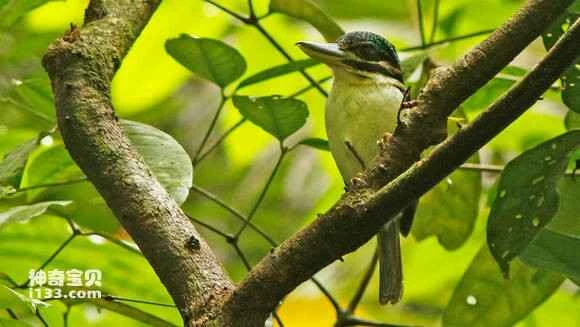
Hook-billed kingfishers are most active at dusk and night. They often call in dense forests, sometimes at night, especially before dawn. When the moon is out, their calls are incessant, often attracting other birds to respond and imitate their sounds. Hook-billed kingfishers generally perch in the tops of tall trees, usually in shady spots.
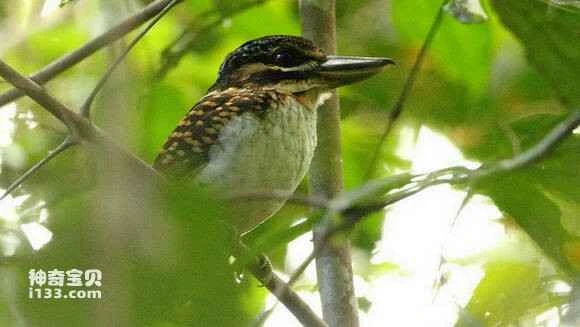
Little is known about the diet and feeding behavior of the hook-billed kingfisher, and it is often inferred by referring to the lifestyle of other kingfishers in the same region. It mainly feeds on large insects (including stick insects) and frogs.
Hook-billed kingfishers build their nests in termite-eroded tree trunks, choosing shady locations, typically 3 to 6 meters above the ground. The nest is 11 to 12 centimeters deep. The female lays two eggs at a time, with the male participating in incubation. The breeding season is generally during the dry season, from July to October.
Listed in the IUCN Red List of Birds, ver 3.1: 2008.
Protect wild animals and ban the consumption of wild game.
Maintaining ecological balance is everyone's responsibility!