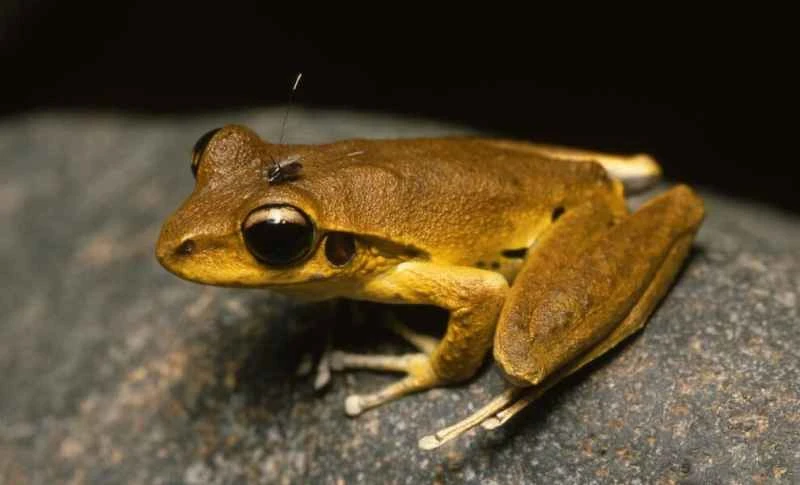
Basic Information
Scientific classification
- Chinese name: Stone Creek Tree Frog
- Scientific name: Ranoidea wilcoxii
- Order: Anura
- Family and genus: Tree frog (Rhizophora spp.)
Vital signs data
- Body length: Adults are generally about 3-5 cm in length, belonging to the small to medium-sized tree frogs with slender bodies that are adapted to stream environments.
- Weight: Individual weight usually ranges from a few grams to more than ten grams, varying slightly depending on body type and nutritional status.
- Lifespan: It is estimated that it can survive for several years in the wild, and can participate in the breeding season multiple times in areas with stable environments such as streams and surrounding woodlands.
Significant features
A typical tree frog in the clear streams of the mountains and hills of Dong'ao, it is light-bodied, adept at moving among rocks and waterside plants, and has a strong dependence on flowing water.
Distribution and Habitat
It is mainly distributed in the eastern mountainous and hilly areas from southeastern Queensland to New South Wales, and is often found in mountain streams with rocky riverbeds, rapids and pools, as well as forests or shrublands on both banks.
Appearance
It has a slender body and long limbs. Its back is olive green or brown with spots, and some individuals have a light-colored midline or dark stripes behind the eyes. The toes have suckers, and the hind feet have obvious webs, which are helpful for resting and swimming on rocks in streams.
Detailed introduction
The Stony Creek Frog is a medium-sized, native Australian frog that thrives among rocks in streams. It is typically associated with the scientific name *Ranoidea wilcoxii* (also known as *Litoria wilcoxii *). Belonging to the family Ranoidea and genus *Ranoidea*, it primarily inhabits clear streams in the mountains and hills of eastern Australia, making it a typical "mountain stream tree frog."
Classification and nomenclature
Chinese reference name: Stone Creek Tree Frog (general translation);
English name: Stony Creek Frog;
Scientific name: Ranoidea wilcoxii (some literature uses the old genus name Litoria );
Family: Hylidae → Genus: Ranoidea
Appearance and Identification Features
The rocky stream tree frog is slender and has long limbs, making it a typical stream-dwelling tree frog.
Size: Adults are typically 3–5 cm in length, with males being slightly smaller and females slightly larger;
Body shape: The body is relatively slender but not bulky, with long and thin limbs, making it suitable for jumping between rocks and waterside plants;
Back color: The back is mostly olive green, yellowish brown or grayish brown, often with small spots or fine lines of varying shades, and some individuals have slightly mottled patterns on their backs;
Side markings: There is often a dark stripe extending from behind the eye to both sides of the body; some individuals have dark patches on their sides.
Abdomen: The abdomen is mostly milky white or light yellow and is usually quite clean;
Skin texture: The back is relatively smooth or slightly granular, unlike the rough texture of a toad;
Limbs and toes: The hind limbs are well-developed, with obvious webbing between the toes and suction cup-like swellings at the toe tips, which are beneficial for climbing on wet and slippery rocks and plants.
Breeding season characteristics: During the breeding season, male frogs often have brighter yellow or orange areas on their forearms and sides, which is a subtle feature for identifying males.
Distribution range and habitat
The Stone Creek Tree Frog is mainly distributed in the eastern coastal and near-inland mountainous areas of Australia .
From southeastern Queensland, it extends south along the mountains, through parts of New South Wales, and all the way to the eastern hills;
They are commonly found in small mountain streams and forest valleys with rocky riverbeds, waterfalls, and rapids.
Typical habitat characteristics include:
Clear, fast-flowing streams and river sections, with riverbeds mostly composed of rocks or gravel;
Both sides of the river are covered with rainforests, eucalyptus forests, or dense shrublands, which are cool and humid.
Cracks in the rocks, piles of fallen leaves along the stream, fallen logs, and moss-covered rock surfaces provide important hiding places.
Lifestyle
The Stone Creek Tree Frog is a nocturnal, semi-aquatic stream-dwelling tree frog .
During the day, they mostly hide in crevices of rocks by the stream, under fallen trees, or in vegetation along the stream bank to avoid strong sunlight and dehydration.
They are most active from dusk to night, often found among stream rocks, in shallow water, and on waterside plants.
They are adept at leaping and perching on slippery rocks, and also tend to stay on low branches and leaves near streams.
vocal characteristics
Male rock bream tree frogs emit rhythmic calls during the breeding season to attract females and establish territory.
The call is often described as a series of short, clear "click, click, click" or "drip, drip, drip" sounds, with a relatively fast rhythm.
They usually call on rocks or vegetation by the water, often accompanied by the sound of flowing water in the background.
On rainy nights during the right season, the chorus of multiple male frogs blends with the sound of mountain streams, creating a typical "background sound" in the mountain stream ecosystem.
feeding habits
Like most tree frogs, the Stone Creek Tree Frog primarily feeds on small invertebrates:
Various small insects, such as ants, small beetles, moths, small flies, and mosquito gnats;
Small arthropods and larvae inhabit the leaf litter and rock crevices along streams;
They hunt for palatable prey by moving slowly through rocks and vegetation at night.
Reproduction and Development
The reproduction of the Stone Creek Tree Frog is closely related to stream water level and rainfall:
The breeding season typically falls during the warmer, rainier months in the local area.
Male frogs often call out to attract mates in shallow water or at the edge of pools with slow-moving water.
Female frogs lay their eggs in the water or attach them to underwater rocks, gravel, and aquatic plants. The egg clusters are often located in areas with relatively slow water flow.
Tadpoles develop in streams, which have certain requirements for water quality and flow rate. They need sufficient oxygen but not to be swept away by the rapid current.
After metamorphosis, the young frogs will move to the streamside and surrounding woodlands, still maintaining a certain distance from and connection with the water.
Protecting the status quo and threats
Currently, the Stone Creek Tree Frog is generally assessed as Least Concern (LC) on the IUCN Red List, and its overall population is relatively stable.
Potential threats include:
Development, water pollution, or diversion of mountain streams can all impact their breeding water bodies.
Deforestation and habitat fragmentation reduce shade and humidity along the banks of streams;
Climate change is leading to an increase in extreme droughts or torrential rains, affecting the stability of mountain stream water levels.
Protecting mountain streams and their surrounding forest vegetation, reducing water pollution and overexploitation will help maintain healthy populations of the Rock Frog and other stream-type frogs.
Frequently Asked Questions
Q1: In what environments can you mainly see the Stone Creek Tree Frog?
It is most commonly found in rocky mountain streams and forested valleys in eastern Australia, especially in sections of streams with clear water and banks lined with trees and shrubs.
Q2: What are the differences between the rocky stream tree frog and the common "pond frog"?
The rocky tree frog relies more on flowing mountain streams, its body shape is better suited for activity near rocks and rapids, and its webbed toes and suckers help it to perch on slippery surfaces.
Common pond frogs mostly live in still ponds and swamps.
Q3: Is the Stone Creek Tree Frog dangerous to humans?
It is generally believed that it poses no direct danger to humans and will not attack them unprovoked. Like other frogs, its skin secretions may slightly irritate the mucous membranes.
If a brief observation period is required, handle the item gently and wash your hands afterwards.
Q4: Can I keep a Rock Creek Tree Frog as a pet?
Whether or not it is permissible to capture and raise local wild frogs depends on the wildlife protection laws of each state or territory.
In many parts of Australia, wild amphibians are protected by law, and relevant regulations must be checked before keeping them as pets.
And the priority is to protect wild populations.


