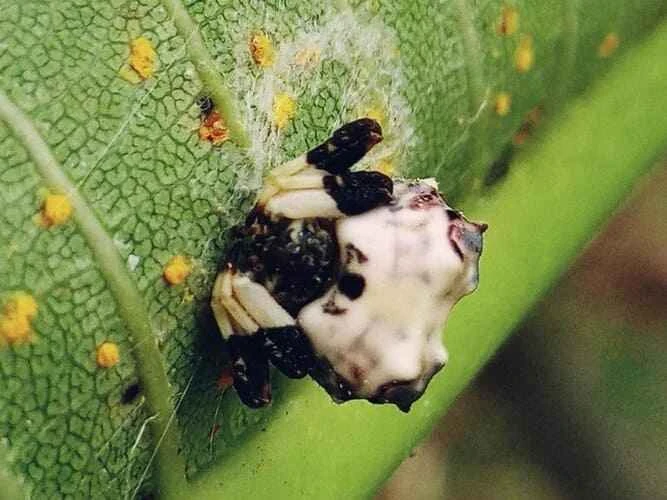
Basic Information
Scientific classification
- Chinese name: Bird guano spider
- Scientific name: Araneidae (representative: Celaenia excavata)
- Classification: Arthropoda
- Family and genus: Araneidae Celaenia
Vital signs data
- Body length: female 10–15 mm; male 2–4 mm
- Weight: Small spider; varies from individual to individual.
- Lifespan: Approximately 1–2 years (estimated)
Significant features
Bird droppings for camouflage; female spider pheromones for moth attraction; nocturnal movement and hiding; multiple camouflaged egg sacs.
Distribution and Habitat
Eastern Australia and New Zealand (C. excavata); similar mimicry groups are also found in gardens/shrublands/forest edges worldwide.
Appearance
White/gray/brown/black mottled spots; abdomen bulging with nodules; short and stout legs.
Detailed introduction
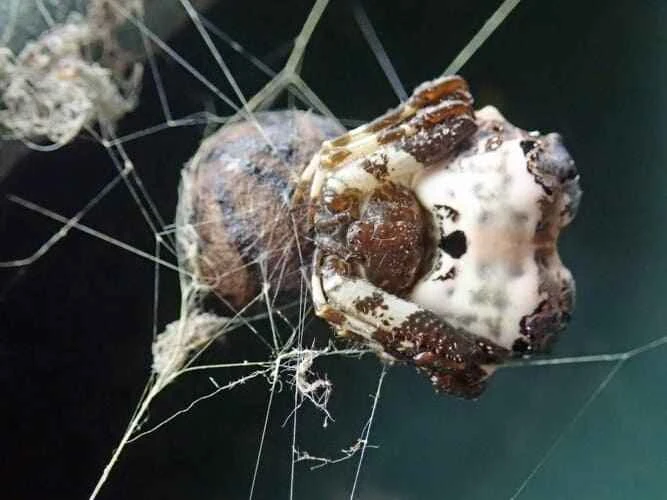
Bird- dropping spiders refer to a group of ball spiders that mimic bird droppings in appearance and color, with Celaenia excavata of the Araneidae family being the most well-known. They often lie still among branches and leaves, their appearance closely resembling fresh bird droppings, using this camouflage to avoid predators and lure nearby insects.
Ecology and Biology
Camouflage: The body surface has irregular white/gray/brown/black patches with asymmetrical outlines, which look like bird droppings from a distance.
Luring prey: female spiders feed on small moths and other small creatures; they can release sex pheromones to mimic male moths, and then entangle them with silk once they get close.
Daily routine: mostly active at night ; resting quietly during the day; setting up short capture and support wires among shrubs or branches.
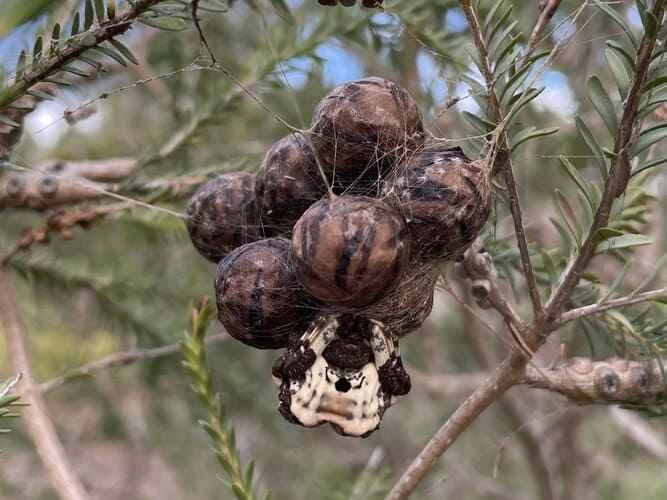
Reproduction: The female spider lays multiple spherical/pear-shaped egg sacs that hang from branches and leaves, often covered with silk and debris to enhance camouflage.
Morphology and Recognition
Body length: female 10–15 mm ; male 2–4 mm (significant sex dimorphism).
Body type: The abdomen is bulging with nodules/protrusions ; the legs are relatively short and thick, suitable for lying in ambush .
Color pattern: There are significant individual/regional differences, but all maintain the visual effect of "bird droppings".
Distribution and Habitat
C. excavata is distributed in eastern Australia and New Zealand ; similar mimicking "guano spiders" can be found in gardens, thickets and forest edges worldwide.
Humanity and Safety
Medical significance: Low medical importance to humans; accidental bites are mostly mild.
Ecological value: It preys on moths at night and participates in the regulation of insect communities.
IUCN: This entry is a general overview of taxa ; most species were not independently evaluated, and are marked as not evaluated (NE) in this overview.
Frequently Asked Questions
Q1: Will it smell like bird droppings? It's mainly visual mimicry ; some species of female spiders can release moth-like sex pheromones to lure prey.
Q2: Can you weave a large circular net? Not a typical large circular net; it's mostly a strategy of short catching wires plus surprise attacks .
Q3: Is it dangerous to people? It is usually not of medical importance ; if you encounter it, gently move it outdoors.
Q4: How to distinguish it from real bird droppings? Upon close inspection, you can see the legs/eye area/silk lines , which are mostly located on petioles or twigs.