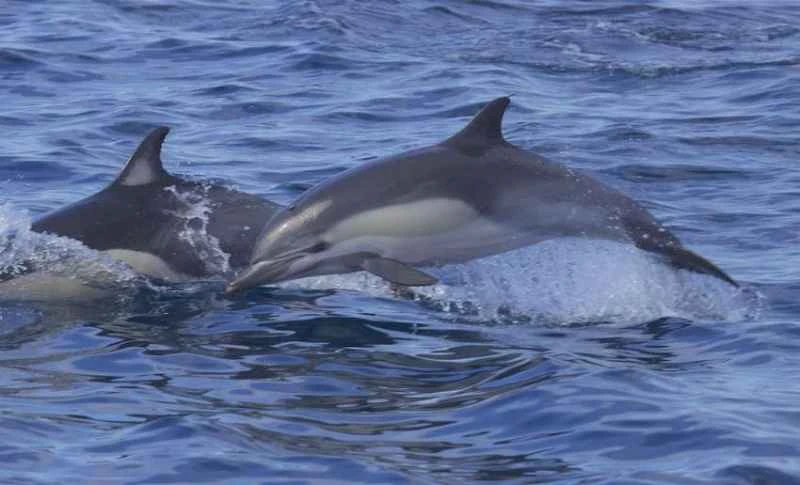
Basic Information
Scientific classification
- Chinese name: Common dolphin
- Scientific name: Delphinus delphis
- Order: Cetacea
- Family and Genus: Dolphinidae, Lithops
Vital signs data
- Body length: Adults typically measure about 1.7–2.4 meters in length; the distinctive "hourglass" pattern on the sides of the body is an important identifying feature.
- Weight: Weight is mostly in the range of about 70–235 kg, with significant differences depending on sea area, sex and nutritional status.
- Lifespan: In the wild, lifespan is typically around 20–25 years, though some individuals may live longer.
Significant features
Dolphins commonly found in temperate and subtropical waters worldwide have striking hourglass-shaped patterns on their sides. They are fast swimmers, highly social, often forming large groups and enjoying "riding the waves" with boats.
Distribution and Habitat
Widely distributed in temperate and subtropical seas worldwide, commonly found on the outer edge of the continental shelf, continental slope, and the transition zone from nearshore to offshore, it prefers areas with dense prey fish, such as ocean current fronts and upwelling currents.
Appearance
It has a streamlined body, a sickle-shaped dorsal fin, and a slender snout; its back is dark gray to black, its belly is light-colored, and its sides are yellowish-brown to gray, forming a typical hourglass pattern; its teeth are fine and dense, making it suitable for catching small fish and squid.
Detailed introduction
The Common Dolphin usually refers to the most well-known species in the genus * Delphinus *, scientifically known as *Delphinus delphis* . It is famous for its high-speed swimming, its love of riding the waves and following boats, and its social behavior of forming large groups. It is one of the most common dolphins in temperate and subtropical waters worldwide. The Common Dolphin has a well-proportioned body with a very distinctive "hourglass/cross" color pattern on its sides: a dark back, sides transitioning from yellowish-brown to gray, and a lighter belly. This strong contrast makes it particularly striking when it leaps out of the water.
Note: In some regions and sources, "common dolphin" may also include or refer to closely related species such as the "long-beaked dolphin" (different species within the same genus or population classification is controversial). This species page focuses on the most commonly used species, *Delphinus delphis* , for popular science information. Individual sizes, distributions, and conservation assessments may vary in different sea areas.
Classification and nomenclature
The common dolphin belongs to the class Mammalia, order Cetacea, suborder Odontoceti, family Delphinidae, and genus Delphinus . Its English name, "common dolphin," emphasizes its wide distribution and high sighting rate. Common Chinese translations include "common dolphin" and "true dolphin," though some also refer to it as "common true dolphin." In whale watching and fisheries observation records, it is often recorded alongside bottlenose dolphins and spotted dolphins as a common dolphin species in the nearshore-outshore boundary.
Appearance features
The common dolphin has a streamlined body, a high, slightly sickle-shaped dorsal fin, and a relatively slender snout (beak), though usually less exaggerated than that of the "long-snouted" type. Adults typically range from 1.7 to 2.4 meters in length and weigh between 70 and 235 kilograms (with significant variations depending on the sea area and sex). Its most distinctive feature is the "hourglass" pattern on its sides: the front half of its body is often light yellowish-brown or cream-colored, while the hind half is grayish, with a dark gray to black back and a white or light gray belly; this contrasting pattern makes it easily recognizable on the sea surface.
Common dolphins have numerous small teeth, which are well-suited for hunting small fish and cephalopods. Their broad, muscular tail fins give them a strong ability to swim at sustained high speeds. They often leap out of the water in groups, creating a shimmering, patterned effect when the group is in the sunlight.
Distribution range and habitat
Common dolphins are widely distributed in temperate and subtropical seas worldwide, commonly found on the outer edge of the continental shelf, continental slope, and transitional zones from nearshore to open sea. They can also be found in areas with distinct coastal currents and upwellings and abundant prey fish. They tend to forage using current boundaries, fronts, and areas where prey gathers, thus exhibiting significant migration or localized aggregation phenomena in certain seasons.
The ecological diversity of species varies considerably across different sea basins: some are more offshore, while others frequently approach the coast; sightings are often more frequent in island chains, straits, and nutrient-rich waters. Factors such as sea temperature, food distribution, fishing activities, and noise pollution influence their habitat use patterns.
Lifestyle Habits and Behaviors
Common dolphins are highly social, often forming groups of dozens to hundreds of individuals, and may even form larger "supergroups" when food is plentiful. Within these groups, they communicate and cooperate through vocalizations, body language, and physical contact. Common behaviors include synchronized swimming, collective leaping, tail flapping, and bow-riding following boats. This bow-riding behavior may be related to energy conservation, play, socialization, or using the disturbance of the boat's hull to hunt.
They are fast swimmers with high maneuverability, and when they encounter whale predators or other threats, they quickly gather and change direction. The mother and calf have a close bond; the calf swims beside or slightly behind its mother, using the water current created by the mother's body to "glide" and conserve energy.
feeding habits
Common dolphins primarily prey on small, schooling fish and cephalopods in the upper and middle layers of the ocean, such as sardines, anchovies, mackerel, and small squid. Their specific diet varies depending on the sea area and season. They often hunt in groups: by driving the fish at high speed to "compress" them into dense groups, or by using ocean currents, surface and seabed topography to lure prey into easy-to-catch positions.
In areas with upwelling currents or prominent fronts, dolphins tend to congregate and forage frequently, often appearing near "bait fish hotspots" alongside seabirds, tuna, and other prey.
Reproduction and life cycle
The breeding season for common dolphins varies regionally, with peak calving periods occurring in spring and summer in many sea areas. Gestation typically lasts about 10–12 months, and each litter usually produces one calf. After birth, the calf relies on its mother for nursing and remains highly attached for the first few months; weaning often takes about a year or longer, depending on dietary conditions and individual differences.
Sexual maturity is generally reached after several years (this may differ between males and females), and lifespan in the wild is typically around 20–25 years. Due to changes in the marine environment and the impact of human activities, the survival rate and reproductive success rate of some marine populations may fluctuate.
Relationship with humans
Common dolphins are among the most frequent and popular species in whale watching tourism: their frequent leaping and riding the waves alongside boats make them easy for tourists to observe up close. However, excessive chasing, close-range high-speed navigation, and continuous noise can cause stress, affecting their feeding and calving. Responsible whale watching should follow principles such as slowing down, maintaining distance, and limiting chasing time.
Against the backdrop of human use of marine resources, common dolphins are also affected by factors such as bycatch (mixed catch), entanglement in fishing gear, changes in prey resources, and the accumulation of marine noise and pollutants. In some areas, bycatch has historically led to population decline, and in recent years, efforts have been made to reduce risks through improved fishing gear, management measures, and monitoring.
Protecting the status quo and threats
Common dolphins are generally considered to be widely distributed and numerous globally, and are commonly classified as Least Concern (LC) in conservation assessments; however, significant differences exist between different sea areas, and local populations may still face high levels of stress. Major threats include fisheries bycatch and entanglement, fluctuations in prey fish resources, marine plastic and chemical pollution, ship noise and collision risks, and changes in sea temperature and the food chain due to climate change.
Conservation and management priorities typically include: strengthening monitoring and mitigation measures for mixed catches (such as acoustic deterrents, improved fishing gear, and time and space fishing bans), maintaining the ecological health of key foraging areas, regulating whale watching activities, and assessing population trends in different sea areas through long-term surveys.
Frequently Asked Questions
Q1: How to distinguish between common dolphins and bottlenose dolphins?
Common dolphins have very distinct hourglass/cross-shaped contrasting patterns on their sides and a relatively long and thin snout; bottlenose dolphins usually have a more uniform body color (grayish), a shorter and thicker snout, and less prominent side patterns than common dolphins.
Q2: Why do ordinary dolphins like to "ride the waves" with boats?
This may be related to energy conservation, playfulness, and socialization, or it may be that the disturbance caused by the boat makes it easier to spot or catch small fish. Riding the waves does not mean they need human assistance; whale-watching boats should slow down and avoid chasing them.
Q3: What do ordinary dolphins mainly eat?
The fish mainly consist of small, pelagic fish and cephalopods, such as sardines, anchovies, mackerel, and small squid, and often hunt schools of fish through cooperative grouping.
Q4: What is their biggest threat?
The main risks in many sea areas come from fishery mixed catches and entanglement in fishing gear, as well as changes in prey resources; in addition, marine noise, pollutant accumulation, ship collisions and climate change can also put pressure on local populations.