Basic Information
Scientific classification
- Chinese name: Common brushtail possum
- Scientific name: Trichosurus vulpecula
- Classification: Rodentia
- Family: Pseudocidae; Genus: Pseudocybe
Vital signs data
- Body length: Adults typically have a head and body length of about 32–58 cm and a tail length of about 24–40 cm, the end of which can be grasped to assist in climbing.
- Weight: The weight is mostly between 1.5 and 4.5 kg, with males generally being heavier; urban individuals with abundant food may be even larger.
- Lifespan: In the wild, the common lifespan is about 5-7 years, and a few can live up to 10 years; it may be even longer under captive conditions.
Significant features
One of the most common nocturnal marsupials in Australia, with a brush-like tail that can be gripped, it can flexibly climb between tree canopies and rooftops; adapted to urban life, it often overlaps with human settlements.
Distribution and Habitat
Widely distributed in various forests and woodlands of Australia, it is also commonly found in urban parks, suburban greenbelts and residential areas. It relies on tree holes, rock crevices or building cavities for shelter during the day and feeds on leaves, nectar and fruit in the surrounding vegetation or human environment.
Appearance
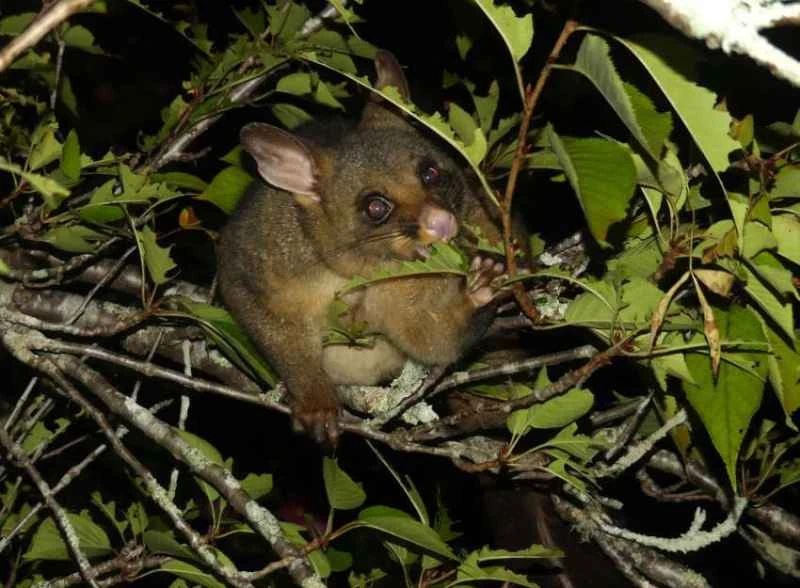
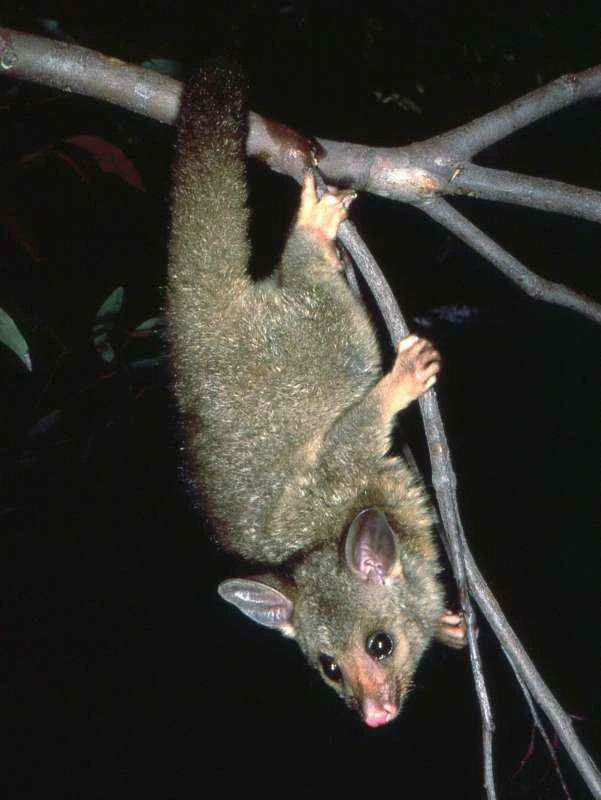
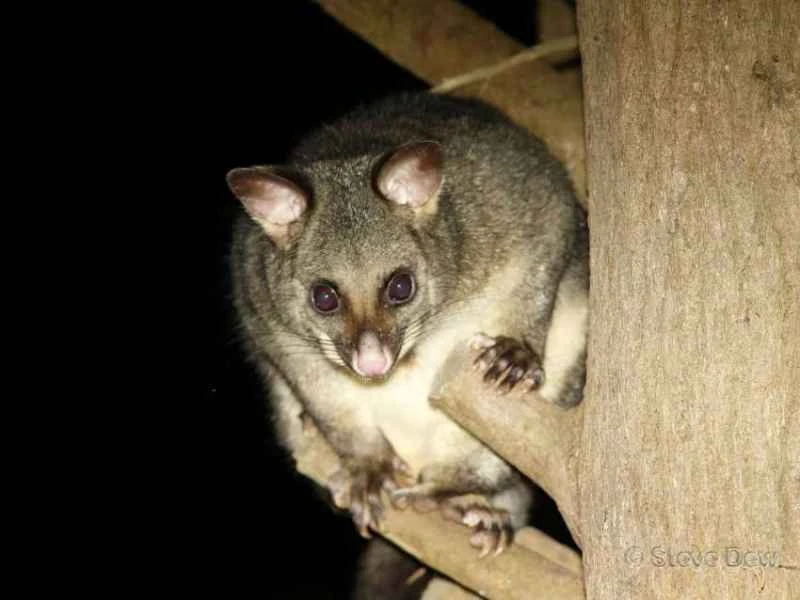
It is medium-sized and sturdy, with large, bare ears and eyes that reflect light at night. Its coat color varies greatly from gray and brown to black, with a lighter color on the belly. Its tail is thick and brush-like, with fewer hairs at the tip for easy gripping. It has strong limbs, curved claws, and anti-grasp toes on its hind feet, making it an excellent climber.
Detailed introduction
The Common Brushtail Possum ( Trichosurus vulpecula ) is one of the most common and well-adapted marsupials to urban environments in Australia, belonging to the family Trichosuridae. It is nocturnal, resting during the day in concealed places such as tree hollows, rock crevices, or rooftop cavities. With its strong limbs, curved claws, and graspable tail, it can nimbly climb between tree canopies and buildings. The Common Brushtail Possum is primarily herbivorous, but also consumes nectar, fruit, fungi, and small amounts of animal matter, making it a typical opportunistic omnivore. Due to its wide distribution and adaptability, it is generally not endangered globally, but in some areas it is still affected by factors such as habitat change, vehicle collisions, and disease.
Classification and nomenclature
The common brushtail opossum belongs to the class Mammalia, superorder Marsupia, order Diprotodontia, family Phalangeridae, and genus Trichosurus . Its English name, "brushtail," refers to the dense, brush-like hairs on its tail, while "possum" is a common Australian name for many arboreal marsupials. In Chinese, it is commonly called "brushtail opossum," and in some sources, it is also referred to as "brushtail possum."
Appearance features
The common brush-tailed opossum is a medium-sized, sturdy animal with a rounded head, a short snout, large, mostly bare ears, and eyes that reflect light at night. Adults typically have a head-to-body length of 32–58 cm and a tail length of 24–40 cm; their weight ranges from 1.5–4.5 kg, with males usually heavier. Fur color varies considerably, commonly ranging from gray and brown to black, with a lighter belly. The base of the tail is densely haired, while the tip is often sparsely haired or even slightly bare, facilitating gripping of branches and maintaining stability while climbing.
Its limbs are strong, with sharp, curved claws at the tips of its toes; its hind feet have opposing toes, giving it a strong grasping ability. The structure of its teeth is adapted for chewing leaves and fibrous plants, reflecting its feeding strategy of being primarily herbivorous but also omnivorous.
Distribution range and habitat
The common brushtail opossum is widely distributed across Australia, inhabiting eucalyptus forests, mixed forests, scrublands, and coastal woodlands, as well as urban parks, neighborhood greenbelts, and suburban residential areas. Its key habitat requirements are: safe daytime shelters (especially tree cavities) and a stable food source.
When tree cavities are scarce, they utilize building structures (roofs, attics, wall cavities) or artificial nest boxes as shelters. As a result, in cities, their populations often overlap with human activities; food is more stable and there are fewer natural predators, leading to higher population densities in some cities compared to natural woodlands.
Lifestyle Habits and Behaviors
Common brushtail opossums are typically nocturnal, venturing out to forage and move around after dusk and returning to their burrows at dawn. They are territorial, especially the males, who mark their territory with scent markings, scratch marks, and vocalizations. Low growls, hisses, or clicking sounds can often be heard at night, mostly related to disputes over territory, food, or mating.
They are adept at moving within the tree canopy, but also traverse the ground. In urban environments, rooftops and fences often serve as their "mobile corridors." When faced with danger, they typically retreat quickly into tree hollows, roof cavities, or rock crevices rather than running long distances in open areas.
feeding habits
Their diet consists mainly of plants, including eucalyptus leaves, buds, flowers, nectar, and fruits. They also eat fungi, seeds, and bark; when the opportunity arises, they may also consume insects, bird eggs, or small invertebrates. They have some tolerance to certain phytochemicals, but will still choose more easily digestible and nutritious foods depending on the season and local vegetation.
In cities, they may feed on garden plants, fruit trees, or outdoor pet food residue, which is one of the main causes of conflict with humans. Effective management typically focuses on reducing available food, protecting fruit trees, and sealing off rooftop entrances.
Reproduction and life cycle
Breeding season varies by region, with peak breeding seasons more common in spring and/or autumn in many areas. Females typically give birth to one offspring per litter (occasionally two). After birth, the offspring enters the pouch to attach to the nipples and develop, typically remaining in the pouch for about 4–5 months. After hatching, the offspring will continue to follow the mother and may ride on her back, gradually weaning and becoming independent around 7–10 months.
In the wild, their lifespan is typically 5–7 years, with a few reaching around 10 years; in captivity or low-risk environments, their lifespan may be even longer. The successful development of larvae is closely related to nest site resources, food quality, and the risks of vehicles and predation.
Relationship with humans
Common brushtail possums are typical "urban wild animals." They may nibble on garden shoots, rummage through fruit trees, make noise on rooftops, or occupy rooftop space to build nests; at the same time, they are also native wild animals and play a certain role in the ecosystem, such as influencing vegetation regeneration, participating in nectar feeding, and providing food for predators such as owls.
If you are troubled by roof possums, the safest approach is usually to first identify their entrance and ensure that the larvae are not in the nest, then block the entrance, and at the same time set up a nest box nearby as an alternative habitat to reduce repeated intrusions and disturbances.
Protecting the status quo and threats
The common brushtail opossum is generally assessed as Least Concern (LC) globally. However, it may still be affected locally by factors such as the reduction of tree cavities (removal of old trees), road vehicle collisions, predation by dogs and cats, and disease. Conservation and management often focus on human-wildlife coexistence and habitat quality maintenance: preserving old trees with cavities, providing nest boxes, reducing the risk of predation by pets, and reducing roadkill rates through road warnings and improved habitat connectivity.
Frequently Asked Questions
Q1: Is the common brushtail opossum an endangered animal?
Overall, no. Globally, it is generally classified as Least Concern (LC), with a wide distribution and strong adaptability. However, in some local areas, its status may decline due to reduced tree cavities, road impacts, and predation pressure.
Q2: Why do they live on the roof?
The roof mezzanine and wall cavities are warm and secluded, functioning similarly to tree holes. When there are not enough tree holes nearby or competition is fierce, opossums are more likely to use the building structure as a place to rest or raise their young during the day.
Q3: What do common brushtail possums eat?
Primarily plant-based, they feed on eucalyptus leaves, buds, flowers, nectar, and fruits, and also consume fungi and seeds; when the opportunity arises, they may eat small amounts of animal matter such as insects. In cities, they may also feed on garden plants or leftover pet food from open-air sources.
Q4: How to minimize the impact on the garden and roof?
Reduce triggers (timely fruit harvesting, garbage and pet food containment), and use protective netting on fruit trees; for roof issues, it is recommended to seal the entrance after confirming there are no juveniles, and set up nest boxes as alternative habitats to avoid repeated chasing and causing greater disturbance.