Basic Information
Scientific classification
- Chinese name: Koala
- Scientific name: Phascolarctos cinereus
- Classification: Mammals
- Family and genus: Koalas (family Koalaidae)
Vital signs data
- Body length: The body length is usually about 60–82 cm (there are large differences between different regions and individuals).
- Weight: Weight varies significantly by region: adult females in the north weigh about 5–6 kg and males about 6–8 kg; individuals in the south are larger, with males reaching about 12 kg and the largest reaching about 14 kg.
- Lifespan: The average lifespan in the wild is about 10–12 years; females can live up to about 18 years under good conditions, while males generally live slightly shorter.
Significant features
Eucalyptus trees are endemic to Australia and are eucalyptus species with low energy intake and a resting time of up to 20 hours per day. They are listed as endangered in parts of eastern Australia.
Distribution and Habitat
Endemic to Australia, distributed in parts of Queensland, New South Wales, Victoria and South Australia; typical habitat is open eucalyptus forests/woodlands, with the key conditions being the presence of eucalyptus trees suitable for foraging and connected canopy environments.
Appearance
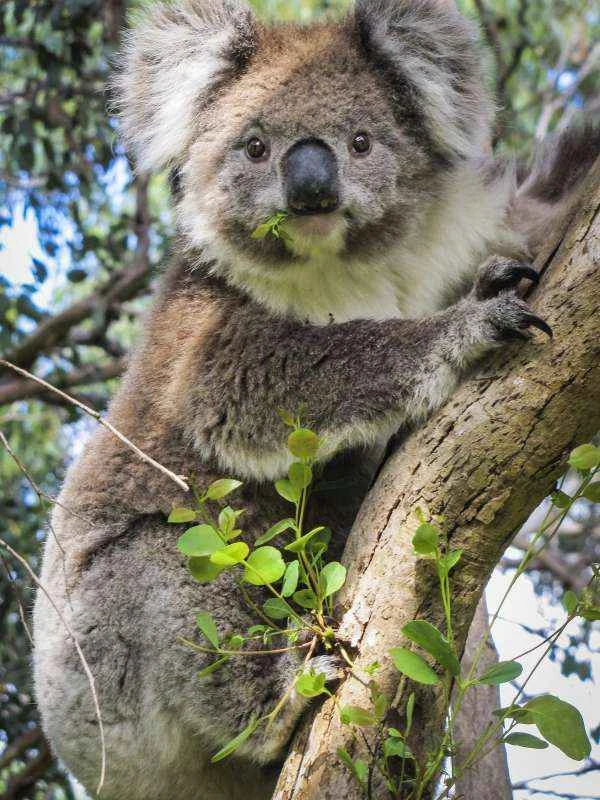
It has a sturdy build, round head, large, fluffy ears, and a prominent, broad black nose; its fur is mostly grayish-brown, with a lighter chest and abdomen, strong limbs, and sharp claws that make it easy to climb.
Detailed introduction
Koalas (scientific name: *Phascolarctos cinereus* ), also known as "tree bears," are marsupials endemic to Australia and are one of the world's most iconic wildlife images. They spend almost their entire lives in eucalyptus trees, primarily feeding on eucalyptus leaves, resulting in a low energy intake and a reputation for long periods of rest and a slow pace of life.
At the conservation level, it is necessary to distinguish between "global assessment" and "regional statutory lists": the IUCN Red List assesses koalas as Vulnerable (VU, assessment date: 2014), while the Commonwealth of Australia lists koalas as Endangered in Queensland, New South Wales and the Australian Capital Territory, reflecting the higher pressure faced by the population in some eastern regions.
Classification and nomenclature
Koalas belong to the order Marsupia, family Phascolarctidae, and genus Phascolarctos . The English word "koala" originates from an Australian Aboriginal language word and is also referred to as "tree bear" in many Chinese contexts.
Appearance features
It has a sturdy build, a large, round head, fluffy ears, and a bare, broad, spoon-shaped nose. Its fur is mostly grayish-brown to brownish-gray, often lighter on the chest and inner sides of the limbs. It has strong limbs and sharp claws, suitable for climbing; its forefeet often have a strong, thumb-like structure, which helps it grasp tree trunks and branches.
Distribution range and habitat
Koalas are endemic to eastern and southeastern Australia, with a distribution covering Queensland, New South Wales, Victoria, and a small part of South Australia. Their habitat is typically open eucalyptus forests and woodlands, with the key condition being the presence of suitable eucalyptus trees (and a few related species) for food. Densities tend to be higher in areas with abundant food tree resources, fertile soil, or proximity to water systems; on the outskirts of some cities, koalas also utilize remnants of woodland and green corridors for survival.
Lifestyle Habits and Behaviors
Koalas are mostly active at night and at dawn and dusk, often resting curled up in tree branches during the day. Because eucalyptus leaves are low in calories and have a high digestive and detoxification cost, they may sleep or rest for up to 20 hours a day. Koalas are generally solitary, but live in overlapping home networks; during the breeding season, males will "report" with a low growl and compete for mating opportunities.
feeding habits
They primarily feed on eucalyptus leaves, but also consume small amounts of leaves from related genera. They possess a unique digestive system and gut microbiota that can break down the fiber in eucalyptus leaves and process plant toxins; they also obtain most of their water from the leaves, and are only more likely to descend from the tree to find water during extreme heat or drought.
Reproduction and life cycle
Females typically begin breeding at around 2 years old, while males usually start breeding at 3–4 years old. The gestation period is short, about 35 days; after birth, the joey continues to develop in the pouch for about 6 months, after which it will move around on its mother's back for a period of time. The average lifespan in the wild is about 10–12 years, with females living up to about 18 years under good conditions, and males generally living slightly shorter.
Relationship with humans
Koalas are an important ecotourism and nature education species in Australia, but they are also vulnerable to habitat fragmentation caused by road traffic, dog attacks, and urban sprawl. Wildlife rescue and rehabilitation systems are crucial for koala conservation; the public is often advised to slow down in koala-prone areas, keep dogs under control, and protect native trees in yards and communities.
Protecting the status quo and threats
The main threats facing koalas include habitat loss and fragmentation, road injuries and canine attacks, diseases (such as chlamydia-related diseases), extreme heat and drought, and wildfires. Due to significant differences in population status across different states/regions, conservation policies are characterized by "regional management": the federal register lists them as endangered in some eastern regions and strengthens their protection, while long-term integrated measures such as habitat connectivity, conflict mitigation, and disease management are still needed.
Frequently Asked Questions
Q1: Are koalas and "tree bears" the same animal?
Yes. "Koala" is a common Chinese name for koala; its scientific name is *Phascolarctos cinereus *.
Q2: Why do koalas sleep for so long each day?
Because eucalyptus leaves are low in energy and contain various plant toxins, digestion and detoxification require a lot of energy, so koalas conserve energy by resting for long periods of time.
Q3: What do koalas mainly eat?
They mainly feed on eucalyptus leaves, but also consume small amounts of leaves from other tree species; most of their water comes from the leaves.
Q4: Are koalas considered endangered?
The IUCN global assessment classifies it as Vulnerable (VU); while the Commonwealth of Australia lists it as Endangered in Queensland, New South Wales and the Australian Capital Territory, indicating that populations in some areas are at higher risk.